
The Nervous System Dressing Guide: Clothes That Help You Feel Calm
You put on jeans meant for today, and from the moment the waistband settles, something is off. It's not tight exactly — it's present. You feel it when you sit down. You feel it when you breathe. You try to forget about it, but the reminder comes with every small movement. By mid-morning, the fabric you didn't think twice about yesterday is taking up space in your attention that you need for everything else.
Nervous system dressing is the practice of choosing clothes based on how they feel to your body rather than how they look to other people. It's not about style rules or aesthetic trends. It's about recognizing that fabric, fit, and texture produce a constant stream of sensory signals — and that on days when your nervous system is already working hard, the wrong clothes add a measurable cognitive and physiological load. The core principle: the best outfit for a regulated nervous system is the one your body can forget about.
Let's walk through what nervous system dressing actually means, why fabric properties matter beyond comfort, the specific features worth paying attention to, and outfit formulas for different states. By the end, you'll have a framework for building a wardrobe that works with your nervous system instead of against it.
What Is Nervous System Dressing? A 2026 Emerging Approach to Everyday Comfort

In early 2026, fashion media began paying attention to a shift that had been building quietly: a growing number of people were choosing clothes based on sensory impact rather than appearance alone. The Daily Front Row published a feature asking whether "nervous system dressing" was changing how we think about fashion, noting that "fashion's most interesting shift isn't about silhouettes or color — it's about how clothes feel." On Instagram, the contrast between "dopamine dressing" (bold colors for mood elevation) and nervous system dressing (low-stimulation fabrics for regulation) became a recurring conversation across style communities. And across Reddit communities, from r/adhdwomen to r/AutismInWomen to r/femalefashionadvice, discussions about fabric sensitivity, waistband discomfort, and overstimulation from clothing have accumulated hundreds of detailed threads over the past two years.
What these conversations share is a recognition that clothing is not neutral to the nervous system. Every piece you put on produces sensory input — the pressure of a waistband, the texture of a seam, the weight of fabric against your arms. Most of the time, your brain filters these signals out. But when your nervous system is already activated, whether from stress, anxiety, sensory overload, hormonal changes, or simply a demanding week, your interoceptive sensitivity increases. Signals that normally stay below awareness become perceptible. The clothing that was fine yesterday feels like a lot today.
Nervous system dressing simply takes this reality seriously. It's not a medical prescription or a fashion category. It's a practical framework: choose fabrics and fits that produce minimal sensory signal, so your attention stays where you need it.
How Fabric and Fit Affect Your Nervous System
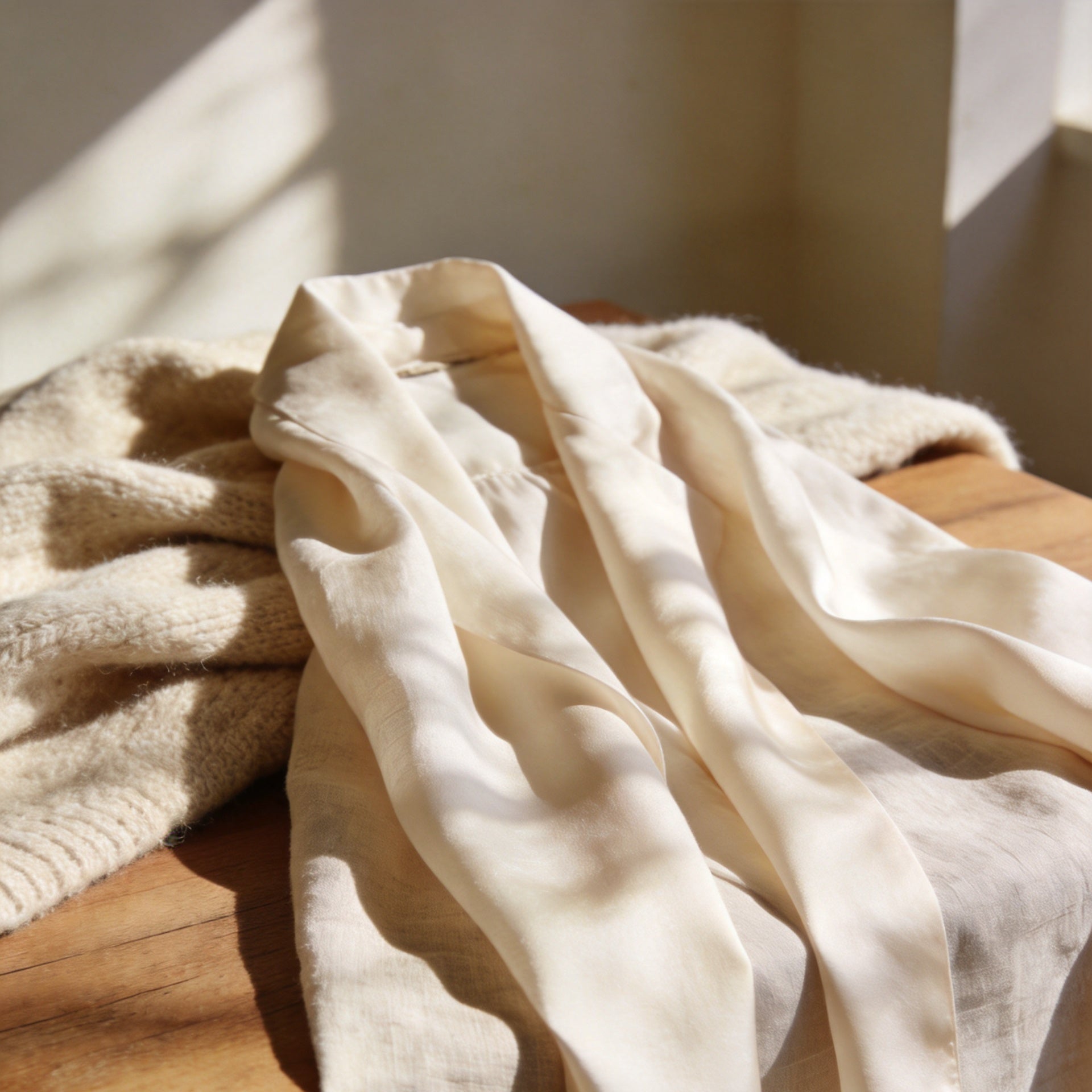
The connection between clothing and nervous system state is not abstract. There is measurable physiology behind it.
Pressure and proprioception. Your skin is your largest sensory organ, and clothing is the most constant source of tactile input you experience throughout the day. When a waistband exerts uneven pressure on your abdomen, it activates mechanoreceptors in the skin: the same receptors that signal touch, pressure, and vibration. Your brain registers this as information to process. Under normal conditions, this signal is filtered out as background noise. Under stress, when the sympathetic nervous system is active and sensory gating becomes less selective, that same pressure signal reaches conscious awareness. The result: you feel the waistband, and you can't stop feeling it.
Temperature regulation. Anxiety and stress frequently cause temperature dysregulation — feeling hot when others are comfortable, or cold when the room is warm. Synthetic fabric blends like nylon-spandex can contribute to overheating when they trap heat and moisture against the skin, but the issue is less about fiber content than about construction. A knit with an open structure or moisture-wicking finish behaves differently from a tight weft. The warning sign is when a garment feels "clammy" or causes you to sweat more than you would otherwise. That's measurable sensory load.
Texture and attention capture. The brain has a limited capacity for attention. Every sensory signal — a tag at the neck, a seam under the arm, a fabric that feels "grippy" rather than smooth — competes for that capacity. In 2012, researchers Adam and Galinsky published foundational research on enclothed cognition, demonstrating that what you wear affects cognitive processing. The study focused on symbolic effects (wearing a lab coat improved attention on a task), but the same principle applies in reverse: clothes that demand physical attention reduce the cognitive resources available for everything else.
The practical implication is straightforward: fabric choices are not just about comfort. They are inputs to your nervous system, and they affect how much mental energy you have for the rest of your day. On days when sensory sensitivity peaks, this effect is magnified. Sensory-friendly clothing for women has the full breakdown of the physiological mechanisms at play.
What to Look For: Five Principles of Nervous System-Friendly Clothing
1. Minimal Sensory Intrusion at Touch Points
The areas where clothing makes the most sustained contact — waist, neck, underarms, inner thighs — are where nervous system-friendly design matters most. Look for: - Soft, wide waistbands that distribute pressure rather than concentrating it - Tagless construction or tear-away tags at the neck - Flat seams or covered seams at friction points - Fabrics that feel smooth against skin rather than textured or "grippy"
A ribbed tank top in a neutral shade achieves most of these criteria in a single piece: soft ribbed fabric, no aggressive seams, and a cut that covers without binding.
2. Consistent Pressure, Not Variable Pressure
The nervous system prefers predictable, even pressure over variable pressure that changes with movement. This is why: - Wide waistbands (2-3 inches) that stay in place outperform narrow elastic bands that roll or dig - High-rise fits that distribute pressure across the torso are generally easier for the nervous system than low-rise fits that concentrate pressure at a single point - Stretch fabric that moves with you (four-way stretch) produces less variable pressure than woven fabric that resists movement
3. Low Thermal Load
Fabric breathability is rarely about "natural fibers are better." It's about how the fabric handles the heat your body produces: - Fabrics in the 180–240 GSM range balance coverage with breathability for most indoor temperatures - Matte-finish knits tend to feel cooler than shiny or coated fabrics because they reflect rather than trap heat - Layering flexibility matters more than a single fabric's breathability — the ability to remove a layer is more valuable than finding one fabric that works in every condition
4. Predictable Sensation
New clothes are inherently unpredictable to the nervous system. Until you've worn a piece through a full day — sat in it, moved in it, experienced how it feels at different temperatures — you don't know how it registers. This is why: - Familiar pieces outperform new ones on regulated days and difficult days alike - Buying multiples of a known style (same cut, same fabric) is a legitimate strategy, not repetitive - A "uniform" approach — wearing the same comfortable pieces on rotation — reduces the cognitive load of evaluating new sensory input
5. Nothing That Needs Adjustment
If a garment requires you to pull it up, adjust a strap, reposition a waistband, or smooth a wrinkle throughout the day, it is producing attention demand. The threshold for nervous system-friendly clothing is: does this piece still feel comfortable when I'm not thinking about it?
Outfit Formulas for Different Nervous System States
For a Regulated Day (Low Sensory Sensitivity)
On days when your nervous system is calm, you have more room to wear pieces with slightly more texture, structure, or visual interest. This is the day for jeans that fit well, a layered outfit, or a new piece you're trying. - A wide-leg lounge pants set in a warm neutral gives you the structure of a matched outfit without the sensory cost of structured fabrics - The key difference from the formulas below: on a regulated day, you can wear something that requires slightly more attention, because your nervous system has attention to spare
For an Activated Day (Moderate Sensory Sensitivity)
When you're stressed, anxious, or running on less sleep than usual, reduce the sensory profile of your outfit. This is the day for: - A familiar matching set — one decision, consistent fabric, no mixing - Wide-leg bottoms that don't constrict at the waist - A soft top with no scratching at the neck - The matching lounge set does exactly this: wide-leg pants with a soft waistband, a relaxed top, no decisions required
If you want specific outfit combinations for this state, outfits that make you feel calm has them.
For an Overstimulated Day (High Sensory Sensitivity)
On days when everything feels like too much — sounds are louder, light feels brighter, and fabric texture is suddenly unbearable — the outfit is critical. The rules are absolute: - Nothing at the neck: scoop neck or wide crew, no tags, no collar, no zippers at the throat - Nothing at the waist: wide, soft waistband or no waistband (a soft dress or loose top) - Nothing that requires decisions: this is the day for a pre-selected "overstimulated outfit" — a known, tested combination you've worn before and know feels okay - Fabric must be smooth and soft — no coarse knits, no ribbed textures that your skin might reject today
How clothes affect mood digs into the broader psychological mechanism: why texture matters more on some days than others, and how to plan around it.
Clothing is one sensory channel. Scent is another, and it takes a shorter route: the olfactory bulb feeds into the limbic system directly, without the thalamic relay that sight and sound pass through. On a day when everything already feels like too much, a warm, low-key scent in the room gives your senses one steady thing to land on instead of one more thing to decide about.
FAQ
What is nervous system dressing?
Nervous system dressing means choosing clothes based on how they feel to your body rather than how they look. It prioritizes sensory comfort — smooth fabrics, non-restrictive fits, minimal seams and tags — as a way of reducing the cognitive and physiological load that clothing can produce. It's not a medical approach or a fashion trend; it's a practical framework for understanding that fabric and fit produce real sensory input that your nervous system processes continuously.
Can clothes really affect your nervous system?
Yes, in a measurable way. Clothing produces constant sensory input through skin contact, pressure, and temperature effects. When your nervous system is already activated, the gating mechanism that normally filters out "background" sensory signals becomes less effective. This means a tag you usually don't notice becomes noticeable, a waistband that was fine becomes irritating, and fabric texture that was neutral becomes distracting. Clothing doesn't cause anxiety or regulate it — but it can reduce one source of sensory load on a day when your system is already working hard.
What fabrics are best for a calm nervous system?
There's no universally "best" fabric because sensory response is individual. That said, the general principles are: matte rather than shiny surfaces, soft rather than rough textures, and consistent rather than variable fabric weight. Brushed cotton, smooth nylon-spandex knits, fine-knit modal, and soft rayon blends all appear frequently in sensory-friendly discussions. What matters more than fiber content is the fabric's hand feel against your skin — which is why wearing something before buying (or testing a small swatch) is more useful than reading a fiber label.
Is this the same as sensory-friendly clothing?
Nervous system dressing is a broader and less clinical framing than sensory-friendly clothing. Sensory-friendly clothing is typically positioned as a response to specific sensory processing conditions — autism, ADHD, sensory processing disorder. Nervous system dressing applies the same principles to anyone who has ever felt annoyed by a tag or irritated by a waistband on a stressful day. The practical overlap is large, but the framing is different: nervous system dressing is about everyday body awareness, not about accommodating a diagnosis.
How do I start building a nervous system-friendly wardrobe?
Start with one outfit. A set of pieces that you know feel comfortable on any day — including hard days. Test each piece across a full day: does it still feel okay after four hours? After eight? Do you ever think about adjusting it? If you don't notice it, it's a keeper. The work-from-home outfit guide shows you how to build a rotation around pieces that pass this test.
Does nervous system dressing mean I can only wear shapeless clothes?
No. The goal is not to eliminate sensory input — it's to choose input that doesn't demand attention. A well-fitted piece with intentional structure (like a mid-weight wide-leg pant or a ribbed tank with a defined cut) produces less sensory disruption than an ill-fitting piece with the same silhouette, because the fit itself reduces the need for adjustment. Structure and comfort are not opposites. The relevant question is not whether a piece has shape, but whether its shape requires management throughout the day.
Your nervous system doesn't stop processing sensory input when you're not wearing clothes. The same principles — choosing inputs that feel regulating rather than demanding — apply to your environment. Scent, in particular, has a direct pathway to the brain's emotion and memory centers: it bypasses the thalamus and connects straight to the amygdala and hippocampus. A carefully chosen scent can influence your nervous system state faster than almost any other sensory input. That's why extending the nervous system framework from what you wear to what fills your space is a natural next step.
The fabric choices in this guide come down to a few specific properties: texture, weight, and construction. If you want to go deeper on the material science — how nylon, cotton, modal, and bamboo actually compare — the fabric guide breaks it down with measurements you can use. And dressing for your nervous system applies today's principles specifically to anxious days.
The specifics of texture and GSM matter a lot in practice. Fabrics that calm your nervous system takes a close look at smooth vs. grippy surfaces, weight ranges, seams, and waistbands — the details that make or break how a piece feels.
When sensory sensitivity is at its peak, you need a go-to formula. What to wear on a high-sensory day lays out five rules and a complete outfit that works.
Building a rotation of tested pieces makes this whole approach easier. The case for having a uniform explains why a pre-tested rotation reduces decision fatigue and gives your nervous system one less thing to process.
Color palette plays a role, too. Some colors and fabric surfaces feel regulating, others add sensory load. Soft colors, quiet textures covers the research and the wardrobe strategy.
And if you're curious about the physiology behind all of this — cortisol, thermal regulation, evening recovery — how loungewear affects your stress levels has the science.
If you want to go deeper on the receptor-level biology — specifically why certain fabric textures produce calming signals while others demand attention — the skin science behind calming loungewear covers the mechanoreceptor and CT afferent mechanisms in full.
Hormonal shifts — particularly during perimenopause and menopause — raise your baseline sensory sensitivity and can make nervous system regulation feel like a moving target. If that's part of your picture, using scent as a grounding ritual during menopause looks at how a simple fragrance practice can act as a reliable anchor when your nervous system needs it most.