7 Outfits That Make You Feel Calm (And Why They Work)
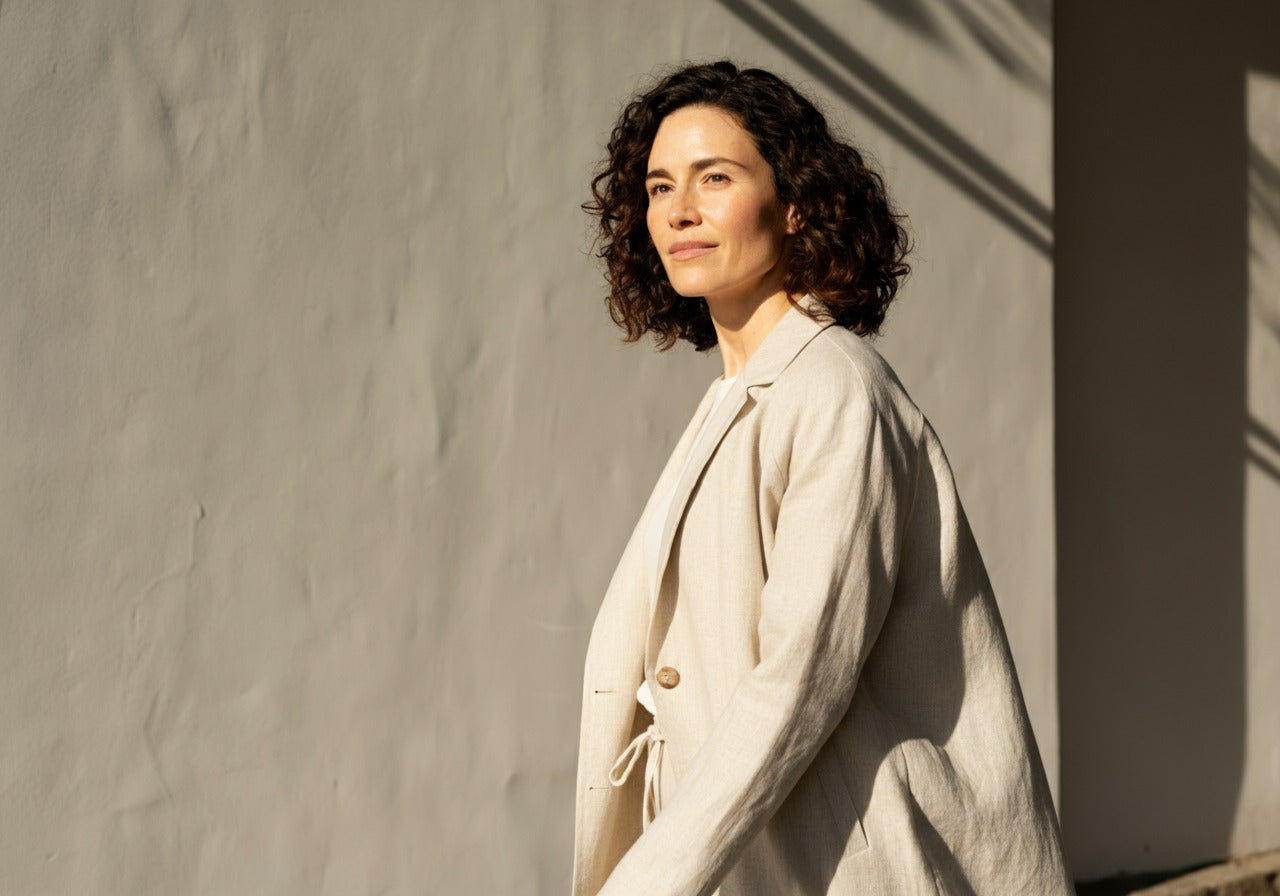
The outfits most likely to make you feel calm share three consistent traits: soft, non-constricting fabrics that don't require adjustment throughout the day; muted, low-contrast colour palettes that ask little of the eye; and simple silhouettes that move with the body rather than against it. Research on enclothed cognition and colour psychology both point to the same conclusion: what we wear has a measurable, if modest, effect on how we feel. The seven outfits below are built around that evidence, not around trend cycles. Each one comes with a reason, not just a description.
Why some outfits feel calmer than others
Clothing affects mood through at least two distinct channels. The first is sensory: fabrics that are scratchy, tight, or thermally uncomfortable create low-grade physical irritation that accumulates across the day. The second is psychological: colour, fit, and visual complexity all influence the nervous system's baseline arousal level. High-contrast outfits, bold patterns, and stiff structured pieces tend to increase alertness — useful before a meeting, counterproductive when you're trying to settle.
Soft, muted clothing in fluid fabrics works in the opposite direction. Warm neutral tones and earth tones have been shown to lower the psychological stress response compared to high-saturation colours. Loose-fitting garments reduce proprioceptive tension — the body's sense of pressure against the skin — which has a direct calming effect on the nervous system. This is why so many people instinctively reach for soft, familiar pieces when anxious or overwhelmed: it's a physiological response, not arbitrary comfort-seeking.
For the full research framework behind this, dressing for how you want to feel covers the enclothed cognition science and the three-register comfort system in depth.
7 outfits that make you feel calm
1. The all-sage monochrome
What it looks like: Sage green ribbed top + matching or tonal wide-leg pants, soft slip-on shoes in cream or natural.
Why it works: Earthy green tones sit in the mid-range of the visible spectrum, requiring less cognitive processing than warm reds or electric blues. Studies on colour and physiological response consistently find that green-adjacent tones are associated with reduced cortisol levels — likely tied to evolutionary associations with safe, natural environments. Wearing one colour head to toe removes the visual decision-making from the outfit entirely. The look is simply complete.
The key: keep the shade muted. Dusty sage, not chartreuse. The calming effect comes from low saturation, not the green itself.
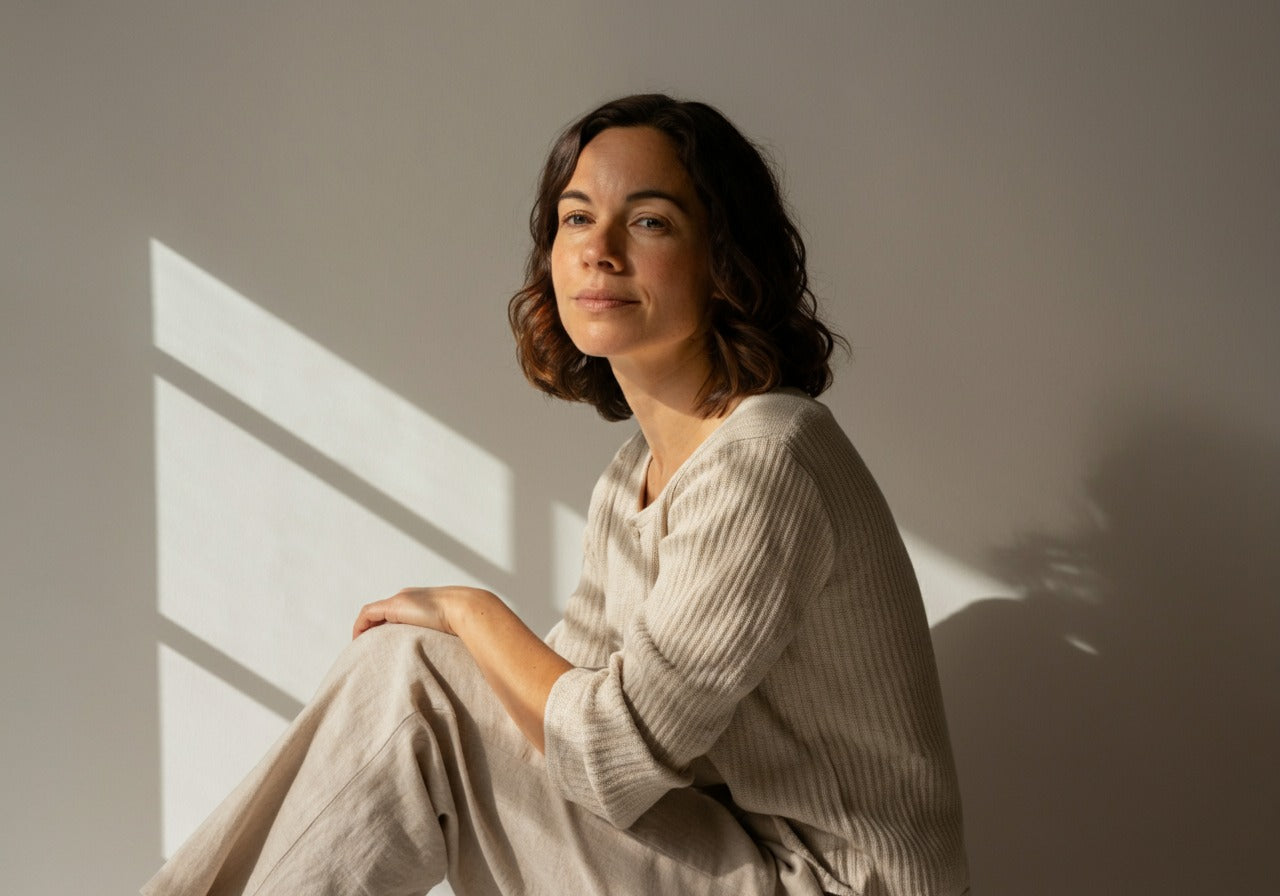
2. Cream ribbed top + wide-leg soft pants
What it looks like: A fitted ribbed long-sleeve or tank in warm cream, paired with wide-leg pants in a similar warm neutral — cream, sand, warm grey. Slip-on mules or bare feet.
Why it works: This is a near-monochrome outfit with almost no visual contrast. Low-contrast dressing is neurologically quieter — the brain processes fewer competing signals. Cream and warm neutrals also read as "soft" before any tactile information reaches you, so the calming cue starts visually.
A ribbed tank in a warm neutral shade does most of the work in this outfit. The ribbed texture adds visual interest without adding contrast, which keeps it feeling quiet rather than flat.
3. The soft matching set
What it looks like: A matching two-piece in the same fabric and colour — a ribbed set, a knit set, or a lounge set. Colour: dusty blush, warm oatmeal, soft stone.
Why it works: Matching sets remove the one decision that most derails a getting-dressed routine — what goes with what. When the top and bottom are designed together, the outfit is finished the moment you've put it on. That single-decision quality is itself calming, particularly on days when decision fatigue is already present.
The ribbed 2-piece set with crop top and flared pants works for this specifically because the flared silhouette allows complete freedom of movement — no fabric pulling, no adjusting — while the ribbed texture reads as intentional rather than purely casual.
4. The warm layer system
What it looks like: A light base layer (tank or long-sleeve) in warm stone or oatmeal, a loose zip-up in the same tonal family, relaxed pants in a matching neutral. All in the same colour temperature — all warm, no mixed undertones.
Why it works: Temperature regulation is one of the most direct links between clothing and the nervous system. Being slightly too warm or too cool both increase physiological stress. Layering in matching tones gives temperature control without breaking the visual quiet of the outfit. The zip-up becomes an adjustable comfort tool — on when you need that contained feeling, off when you don't.
A cropped zip jacket in a warm neutral layered over a ribbed tank covers both functions: something to hold onto and something to remove without disrupting the overall look.
5. Dusty blue + natural white
What it looks like: A soft dusty blue top (long-sleeve, relaxed fit) with natural white or cream wide-leg pants.
Why it works: Blue is the colour most consistently associated with calm across cross-cultural colour psychology research. Dusty, desaturated blues specifically — not bright cobalt — appear to lower heart rate and induce a sense of mental ease in controlled studies. Natural white and cream read as clean rather than clinical, and warm undertones prevent the outfit from feeling stark. The contrast between dusty blue and cream is soft enough to be restful rather than activating.
6. Oversized long-sleeve + high-waist leggings
What it looks like: An oversized, slightly boxy long-sleeve top in a muted tone — dusty lavender, warm grey, faded sage — with high-waist leggings in a complementary neutral. Top falls mid-thigh or lower.
Why it works: This is the "cocooning" outfit. The long, loose top creates a sense of envelopment without bulk, and the high-waist leggings provide gentle compression around the core that many people find grounding. Light, consistent pressure on the torso activates the parasympathetic nervous system — the same mechanism behind weighted blankets.
Pairing with high-waist leggings in a soft neutral keeps the silhouette clean underneath the oversized top without adding visual bulk. The effect is pulled-together even though the effort required is minimal.
7. Soft knit top + flared pants
What it looks like: A relaxed, medium-weight knit top in warm oatmeal or cream, with wide-leg or slightly flared pants in the same tonal family. Slip-on shoes or bare feet.
Why it works: Flared and wide-leg silhouettes allow unrestricted movement, which has a direct effect on muscle tension. Tight-fitting clothes that restrict movement — even subtly — keep the body in a slightly contracted state throughout the day. Garments that move freely do the opposite. Medium-weight knit adds tactile warmth without the bulk or itchiness of heavier knits. Look for knit with some drape rather than structured knits that hold their shape.
Frequently asked questions
Do colours actually affect how calm you feel?
There is consistent evidence that colour influences mood and physiological state, though effects are modest and vary by individual. Muted, low-saturation tones in the green, blue, and warm neutral range are most reliably associated with reduced arousal and lower stress response. The most important variable is probably not the specific colour but the saturation level: quiet tones are quieter, regardless of their hue.
Do I need to buy new clothes to build a calm wardrobe?
No. Look through what you already own for pieces that meet two criteria: a soft, non-constricting fabric and a muted or neutral colour. Most people already have several qualifying pieces — they just haven't been organised with this intention. Identify the two or three pieces you consistently reach for when you want to feel settled, and make sure they're clean and accessible.
Is there a specific fabric that's most calming?
Modal and bamboo viscose are most frequently described as the most comfortable against bare skin — both are notably smooth, breathe well, and don't pill quickly. Cotton-jersey is a close second and more widely available. For people with sensory sensitivities, seamless construction in any of these fabrics removes the friction point of seams and waistband tags.
Can I wear calming outfits to work?
Yes, with some adjustments. The principles — muted tones, non-restrictive fit, soft fabrics — are compatible with professional contexts when applied to appropriate garments. A wide-leg trouser in warm stone, a relaxed modal blouse, and a soft knit jacket can all read as polished while meeting the criteria for a calm outfit. The main adjustment is silhouette: structured calm reads more professional than extremely relaxed fits.
How is this different from just wearing comfortable clothes?
Comfort is necessary but not sufficient. Many comfortable clothes — bright athletic wear, heavily logoed sweatshirts, performance fabrics designed for stimulation — don't meet the criteria for calm dressing even if they're physically comfortable. Calm dressing specifically targets low visual complexity, muted colour palette, and non-restrictive fit in combination, rather than optimising for any single factor.
On the harder days when even constructing an outfit feels like too much, what to wear when you're feeling down takes this down to the simplest level: a three-tier system based on actual energy, not aspiration. And for the broader context of why clothing connects to how you feel at all, dressing for how you want to feel covers the research and the full framework.
The calm outfits above aren't a style exercise — they're small, repeatable tools for shifting how your day actually feels. If that way of thinking about your wardrobe clicks, dressing for how you want to feel is where to go next. It covers the full framework — the three-register comfort system, how to audit your closet by emotional state rather than by category, and how to build a wardrobe that supports the version of yourself you actually want to be, not the one you think you should be.
Getting dressed is the morning-shaped version of this. The evening has its own version, and it's usually shorter — one small thing you do at the same point every night so the day has a clear edge to it. Striking a match and lighting one candle is about as low-effort as a calming ritual gets, and it asks nothing at all of your wardrobe.
For the framework behind this — why some fabrics feel regulating and others feel draining, across different nervous system states — the nervous system dressing guide covers the principles and the outfit formulas.
When the specific challenge is a high-sensory day — where everything feels like too much — what to wear on a high-sensory day covers the five dressing rules and the outfit formula designed for this exact state.
For the cognitive science behind why having a pre-selected rotation of comfortable outfits reduces decision fatigue — and how to build one without feeling repetitive — the case for having a uniform covers the research and the practical steps.
For how color palette and fabric texture affect the "calm" effect — which colors and surfaces feel regulating to the nervous system and why — soft colors, quiet textures covers the research and the practical wardrobe strategy.