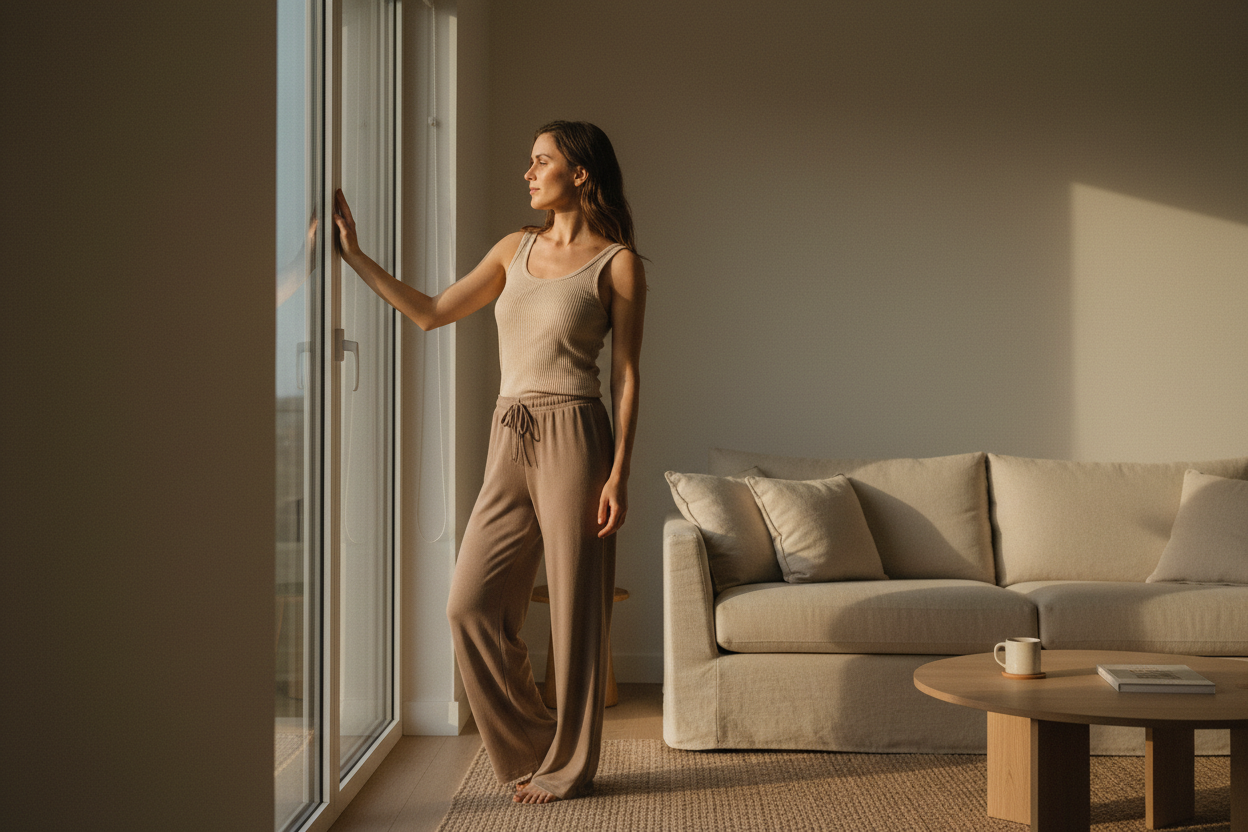
How Loungewear Affects Your Stress Levels: It's Not Just Comfort
You know the specific feeling of coming home after a long day and changing into your softest clothes. The moment the stiff office pants come off and the wide-leg pants go on, something shifts. The shoulders drop. The breath deepens. The day recedes a few degrees. It's such a familiar ritual that it's easy to dismiss as just "getting comfortable." But there is measurable physiology behind it. Changing into specific types of clothing affects your stress response — and not all "comfortable" clothes produce the same effect.
Here's what's actually going on. And why some of those "comfortable" clothes you already own might not be helping as much as you think.
If you want the full picture of how clothing interacts with your nervous system across different states, start with the nervous system dressing guide.
The Physiology of "Coming Home and Changing"

The feeling of relief when you change out of constrictive clothing is not psychological. It's a measurable reduction in sensory input to your nervous system.
Throughout the day, clothing produces continuous pressure and tactile signals. Jeans with button waistbands, shirts with collars, bras with underwires, trousers you have to adjust every time you sit — structured clothing like this produces higher and more variable sensory input than soft, unstructured pieces. These signals are processed by the somatosensory cortex alongside all other tactile input. They are not "ignored" just because you're used to them. Your nervous system is processing them continuously.
When you change into soft loungewear, you reduce the volume and variability of this sensory input. A wide-leg pants set with a soft waistband produces lower and more consistent pressure signals than structured pants with a button closure. A ribbed tank with no collar and no tags produces less sensory input at the neck than a collared shirt. The total sensory reduction across all garments can be significant enough to lower physiological arousal markers like heart rate and skin conductance.
Here's the thing: the relief you feel when changing is not about letting your body "rest." It's about stopping a source of sustained sensory input your nervous system has been processing all day, whether you noticed it or not.
The fabric itself matters a lot here. Not all soft clothes are equal, and fabrics that calm your nervous system gets into the material specifics.
Clothing and Cortisol
Cortisol — the primary stress hormone — follows a natural daily rhythm: highest shortly after waking, declining through the day, and lowest during sleep. This rhythm is sensitive to environmental stressors, including sustained physical discomfort.
While the direct relationship between clothing and cortisol levels is under-studied (most cortisol research focuses on psychological stress, not physical comfort), the indirect evidence is consistent:
Sustained physical discomfort increases cortisol. Studies on workplace ergonomics and sleep quality show that physical discomfort — including pressure, temperature dysregulation, and constriction — correlates with elevated cortisol levels. Clothing that produces any of these effects may contribute to a flatter cortisol decline through the afternoon and evening.
The act of changing clothes can be a behavioral stress boundary. Changing out of "work clothes" and into "home clothes" functions as a contextual signal to your nervous system that the work day is over. This behavioral transition may have its own stress-reducing effect, separate from the physical comfort change. Researchers call it "context-dependent learning": your nervous system learns that soft clothing is associated with rest, and the clothing itself becomes a cue for the relaxation response.
Temperature regulation and cortisol. Thermal discomfort — feeling too hot or too cold — activates the same hypothalamic-pituitary-adrenal (HPA) axis as psychological stress. Loungewear that supports thermal neutrality (not too warm, not too cool) may help maintain a more regulated cortisol rhythm. Mid-weight fabrics in the 180–250 GSM range, like those used in high-waist stretch leggings, support thermal neutrality across most indoor environments.
Why Some "Comfortable" Clothes Don't Reduce Stress
Not all loungewear has the same effect on your nervous system. The difference comes down to three factors:
1. Fabric That Still Needs Management
Some loungewear is soft but requires ongoing adjustment. A waistband that rolls. A top that rides up. A strap that slips off your shoulder. Any garment that requires adjustment during wear is still producing variable sensory input. The pressure on your nervous system hasn't stopped; it's just changed form. The definition of stress-reducing loungewear is: you put it on, and you don't think about it again until you take it off.
2. Fabric That Overheats
Ultra-plush, heavyweight fabrics (fleece, thick sherpa, heavy sweatshirt knits) feel comfortable in the moment of putting them on, but they can cause overheating within 15-20 minutes of wear in a heated indoor environment. Overheating activates the thermoregulatory stress response — your body has to work to cool itself. The initial comfort is replaced by a low-level heat stress that you may not consciously notice but that your nervous system is processing.
3. Fabric With Variable Sensory Feel
Some loungewear is made from fabrics with uneven texture. Maybe from the knit structure — loose knits, bouclé. Or from fabric that shifts against itself, like slippery satin-weave knits. These produce variable sensory input as the fabric moves against your skin throughout the day. The variability itself is the issue: the nervous system has to process each shift as a new signal.
What Stress-Reducing Loungewear Actually Looks Like
Based on the physiology, here are the specific criteria for loungewear that supports your nervous system rather than adding to its load:
| Criterion | Why It Matters | What to Look For |
|---|---|---|
| No adjustment required | Eliminates variable sensory input throughout the day | Wide, flat waistbands; stretch fabric with good recovery; consistent fit |
| Thermal neutral | Prevents heat or cold stress response | Mid-weight fabrics (180–250 GSM); breathable knit structure |
| Consistent texture | Reduces micro-sensory events per hour | Smooth, even surface; matte finish; no variable stretch areas |
| Low visual processing | Reduces total sensory load across channels | Solid or low-contrast colors; matte surface; no busy patterns |
| "Already known" feel | Eliminates sensory uncertainty — the fabric's feel is predictable | Same pieces in rotation; no new sensory evaluation needed |
A matching set in a neutral solid meets all five criteria: familiar, consistent texture, thermal neutral weight, no adjustment, low visual processing. It's the piece you reach for when you want your nervous system to have less to process.
The Evening Wind-Down Connection
One of the most practical applications of stress-reducing loungewear is the evening transition. Your cortisol should be declining in the evening to prepare for sleep. Changing into specific "evening loungewear" — different from what you wore during the day — can support this decline by creating a strong contextual signal.
The combination of: - Switching to soft, familiar fabric at a consistent time - Choosing colors that read as calm (warm neutrals, muted tones) - Removing any remaining structured garments from the day
...creates a multi-sensory signal to your nervous system: the active part of the day is over. This is more effective than just "trying to relax" while still wearing the same clothes you wore through a stressful afternoon.
Adding a calming scent to your evening environment reinforces this transition signal through a different sensory pathway — the olfactory system connects directly to the amygdala and hippocampus, bypassing the thalamus. A consistent evening ritual that pairs familiar clothing with a familiar scent anchors the transition to rest more effectively than either channel alone.
There's more to the evening transition than just clothing. The evening wind-down routine covers the full framework, including outfit choices that support winding down.
FAQ
Does changing into comfortable clothes actually lower cortisol?
There isn't a study that directly measures cortisol before and after changing into loungewear. But the indirect evidence lines up pretty clearly. Sustained physical discomfort, including from clothing, correlates with elevated cortisol markers. Reducing sensory input during rest periods fits what we know about stress physiology. The most reasonable read: changing into comfortable, non-restrictive clothing likely supports normal cortisol decline in the evening. It's one factor among many — sleep, nutrition, psychological stress, exercise — but it's one you can act on in about thirty seconds.
Can loungewear cause stress instead of relieving it?
Yes, if the loungewear itself requires management. A piece that's soft but needs constant adjustment, or fabric that overheats after 20 minutes, is adding physiological load rather than reducing it. The "it's comfortable when I first put it on" test is not sufficient. The real test is: does it still feel comfortable at the end of a full evening of wear?
Is there a difference between loungewear for stress reduction vs. loungewear for comfort?
Yes. Comfort is subjective and can come from familiar sensations that aren't necessarily low-load. A favorite heavy fleece. A textured sweatshirt. Stress-reducing loungewear is specifically optimized for low sensory load: low tactile variability, thermal neutrality, no adjustment requirement. Some comfortable pieces meet these criteria; some don't. The distinction is useful when you're choosing loungewear for a specific purpose — relaxation vs. general comfort.
Should I wear different loungewear for work vs. rest, even at home?
Many people find it useful to have separate categories: "active loungewear" for WFH or daytime wear (pieces that are comfortable but presentable on camera) and "rest loungewear" for evening (softer, looser pieces optimized for relaxation). The separation creates a contextual boundary that helps your nervous system shift between modes. The intentional loungewear guide covers how to build both categories from a single coordinated palette.
How quickly does changing clothes affect stress levels?
The sensory reduction is immediate. Within minutes of changing into low-load clothing, your nervous system registers the drop in tactile input. The behavioral shift — changing signals "the work day is over" — kicks in as soon as you finish changing. The deeper effects, including anything happening with cortisol, build over the next hour or so. That's why the "change when you get home" habit works so reliably. It costs nothing and you feel it right away.
The right fabric changes how your nervous system experiences an entire evening. If you want to understand which materials genuinely help versus which just feel soft in the moment, fabrics that calm your nervous system walks through the specifics. And if you're curious about dressing for different nervous system states — regulated, activated, overstimulated — the nervous system dressing guide is where to start.