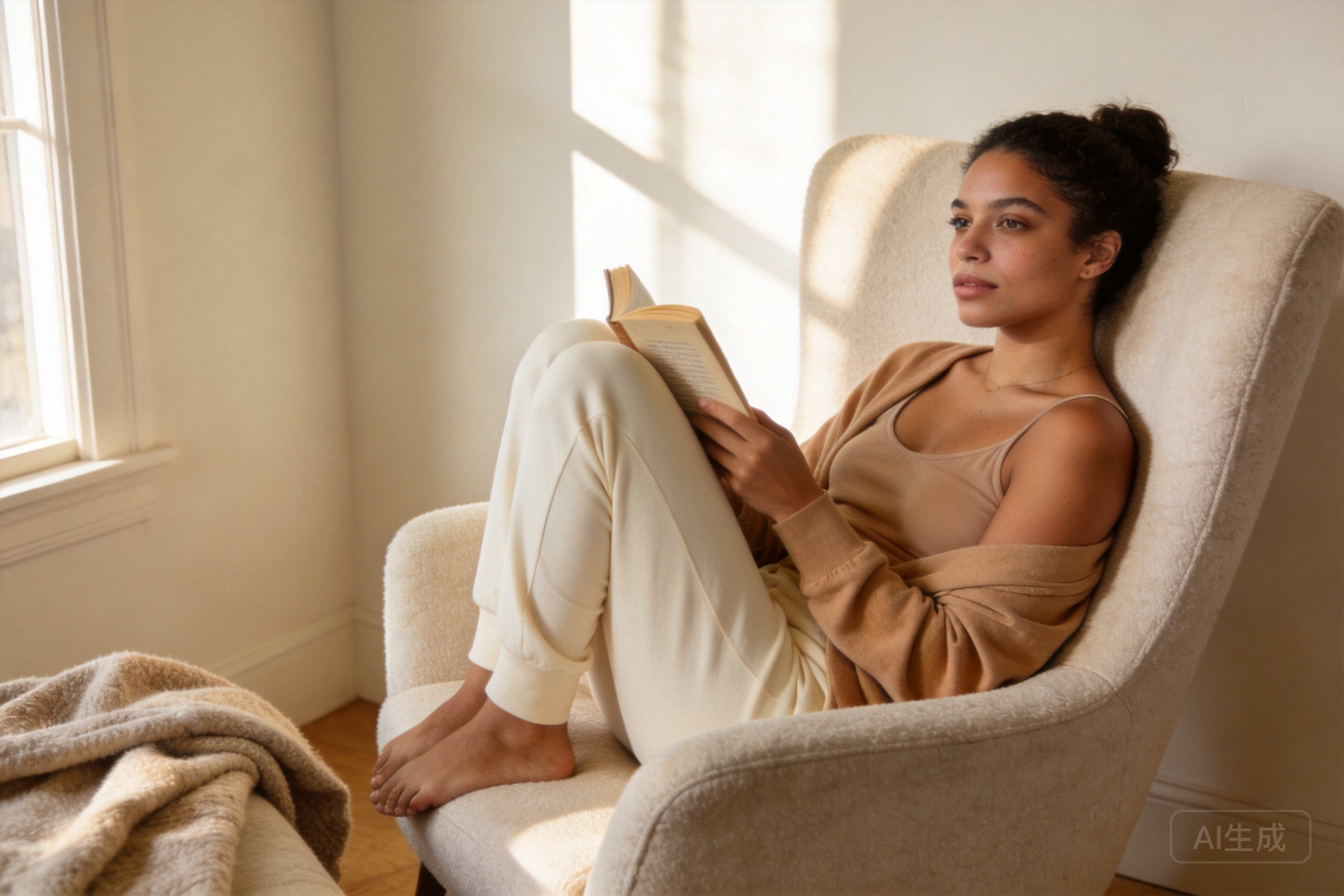
Soft Colors, Quiet Textures: Dressing for a Calm Nervous System
You walk into a room painted bright white with fluorescent lighting, and something in your chest tightens. Later, you sit in a cafe with warm wood tones and soft lamps, and your shoulders drop. This is not imagination. Color and visual texture are processed by the same sensory system that handles touch, sound, and temperature — and they produce measurable physiological responses.
The same principle applies to what you wear. Soft, muted colors and quiet, consistent textures ask less from your visual and tactile systems than bright, high-contrast colors or busy, variable surfaces. Dressing for a calm nervous system means paying attention to both: the colors you see when you look down at your own clothes, and the textures your skin registers all day long.
What follows is a practical guide to color and texture as sensory inputs: which palettes feel regulating, which fabric surfaces keep things quiet, and how to build a wardrobe that does both at once.
How Visual Input Affects Your Nervous System
Visual information is processed through the same reticular activating system that regulates arousal and attention. Bright, high-contrast, or saturated colors produce a measurable increase in physiological arousal. Heart rate, skin conductance, and cortisol levels all respond to color exposure.
This doesn't mean you should never wear bright colors. It means color is not neutral. On a day when your system is already processing high load, wearing a color that demands more visual work (a saturated red, a high-contrast pattern, a bold print) adds to that load — the same way a scratchy fabric adds tactile load.
The colors most associated with lower physiological arousal in the research are muted versions of warm neutrals (taupe, oatmeal, warm gray, dusty rose) and cool neutrals (soft slate, heather gray, muted navy). These colors require less visual processing because they fall into what neuroscientists call the "low spatial frequency" range. They produce even, consistent input to the visual cortex rather than sharp edges, high contrast, or high saturation.
The Color Palette for a Calm Nervous System

Warm Neutrals
Warm neutrals (taupe, oatmeal, warm beige, cream, dusty rose, soft terracotta) are the most consistently reported calming color family across both research and real-world experience. They create a visual environment that feels warm and contained, without demanding attention.
A wardrobe built around warm neutrals has a second practical benefit: every piece coordinates with every other piece. A ribbed tank top in a warm neutral comes in eight colors, most of which stay in the warm neutral family. It pairs with any bottom in the same palette without a second thought.
Cool Neutrals
Cool neutrals (heather gray, soft slate, muted navy, charcoal, off-white) are equally low-arousal but feel different. They tend toward "structured" and "clean" rather than warm, which some people find more regulating for focused work.
What to Avoid on High-Sensory Days
-
High-saturation colors: Electric blue, fire-engine red, neon pink. These produce high visual arousal regardless of context.
-
High-contrast patterns: Bold stripes, checkerboard, polka dots with strong contrast. The visual system processes each edge and contrast boundary, adding to total sensory load.
-
Busy prints: Large floral patterns, abstract prints, animal prints with multiple colors. They require sustained visual processing throughout the day because you see them every time you look down.
These colors and patterns aren't bad. They just cost more sensory processing energy. On a regulated day, that's fine. On a high-sensory day, it's probably not what you need. Our high-sensory day dressing guide walks through this in practical terms.
Texture: The Visual and Tactile Overlap
Texture hits you at two sensory levels at once. Tactile texture is how the fabric feels against your skin. Visual texture is how it looks to your eyes. Both affect your nervous system, often without you noticing.
Quiet Textures
Quiet textures are consistent, even, and matte. They produce low tactile input (smooth against skin) and low visual input (they absorb light rather than reflecting or scattering it). Examples: - Fine-gauge ribbed knits (small, even ribs that read as a solid surface from a distance) - Brushed cotton or peached nylon-spandex (matte finish, soft hand feel) - Flat knit jersey in a solid color (no texture variation)
Loud Textures
Loud textures are variable, uneven, or shiny. They produce more tactile input (variable friction against skin) and more visual input (variation catches the eye). Examples: - Bouclé or nubby weaves (uneven surface, visual and tactile variation) - Shiny satin or wet-look finishes (high visual contrast, slippery tactile feel) - Large ribs or cable knits (deep texture that creates visual shadows) - Sequins, beading, or embellished surfaces (multiple small sensory events)
Where Matte Finishes Help
Matte fabric finishes deserve special mention because they address both visual and tactile channels simultaneously. A matte fabric: - Visually: absorbs light, creating a soft, even appearance that doesn't catch attention - Tactilely: tends to have a smoother surface that produces less friction against skin
The difference between a matte ribbed knit and a shiny jersey in the same silhouette can be the difference between a piece that feels regulating and one that feels demanding, even though the cut and fit are identical.
How to Build a Quiet Palette Wardrobe
Start with One Neutral Family
Choose warm or cool neutrals as your base. Build your core pieces (bottoms, basic tops, matching sets) in this palette. Three bottoms and four tops in the same neutral family give you twelve combinations, none of which needs to be a "statement."
A matching lounge set in a neutral is an easy place to start. You get a complete outfit plus two separates that coordinate with everything else in your base palette.
Add One Muted Accent
Once your base is established, add one muted accent. Dusty sage, soft mauve, muted mustard. Something with visual interest for regulated days, but without the sensory load of a saturated color. The accent should be muted enough to sit alongside your base neutrals without creating contrast.
Reserve Bold Colors for Regulated Days
Bold colors and prints are not off-limits. They just have a context: regulated days when your nervous system has capacity for more visual input. Having a few bolder pieces for those days gives you variety when you want it, without making every morning a choice between visual stimulation and comfort.
FAQ
Can wearing black be calming for the nervous system?
It depends on the person. Some people find black visually calming because it creates a contained, low-variation visual field. Others find black heavy or draining, whether from cultural associations (formality, seriousness) or because it absorbs heat. If black feels neutral to you, it works. If it feels heavy, try a warm charcoal or soft slate instead.
Do I need to avoid all patterns?
No. Patterns with low contrast and consistent rhythm (fine stripes in similar tones, small-scale geometrics in muted colors, tonal textures that read as solid from a distance) produce lower visual demand than high-contrast or busy patterns. The question isn't "pattern or no pattern." It's "how much visual processing does this pattern ask for?"
Why do some people feel calmer in bright colors?
Sensory preference varies. For some people, bright colors lift their mood in a way they experience as calming. The arousal itself feels positive and regulating. That's valid. The research on color and arousal describes population averages, not rules. If bright colors feel regulating to you, wear them. The point is to know what your nervous system prefers and choose accordingly.
Is visual texture as important as tactile texture?
For overall sensory load, the two are additive. A piece with quiet visual texture (solid color, matte finish) and loud tactile texture (scratchy fabric, uneven weave) sends mixed signals. A piece that's quiet on both channels (consistent-color matte with a smooth hand feel) produces the lowest total load. If you have to choose, tactile texture matters more for physical comfort. Visual texture matters more for sustained attention through the day.
What about white? Is white calming?
White is neutral in color, but its brightness can create contrast against darker surroundings that some people find activating. Off-white, cream, warm ivory, and heathered white give the calming effect most people associate with white clothing, without the brightness contrast. The fabric guide explains how different fabric weights and finishes interact with light colors.
For more on how specific fabric textures interact with your nervous system (which ones feel regulating, which ones add sensory load), read fabrics that calm your nervous system. And the nervous system dressing guide ties everything together: color, texture, and nervous system state across regulated, activated, and overstimulated days.