
Why Some Fabrics Feel Calming — The Skin Science Behind It
You change into a soft set after work and something shifts. Not dramatically. Just — the day loosens its grip a little. Your shoulders settle. That's not imagined. Your skin is in direct conversation with your nervous system, and the fabric you just put on changed what it had to say.
Certain fabrics calm your nervous system because of how your skin's mechanoreceptors — specialized nerve endings distributed across your entire body — process touch signals. Smooth, even-pressure fabrics produce steady, filterable sensory input. Fabrics that are rough, clingy, or variable keep feeding your brain new data, which costs attention. The science is specific, and once you understand it, choosing loungewear that genuinely helps you decompress feels less like a preference and more like a physiological decision.
This is different from asking whether fabric "feels nice." It's asking what your nervous system is actually doing with the input.
How Your Skin Reads Fabric (The Receptor Map)
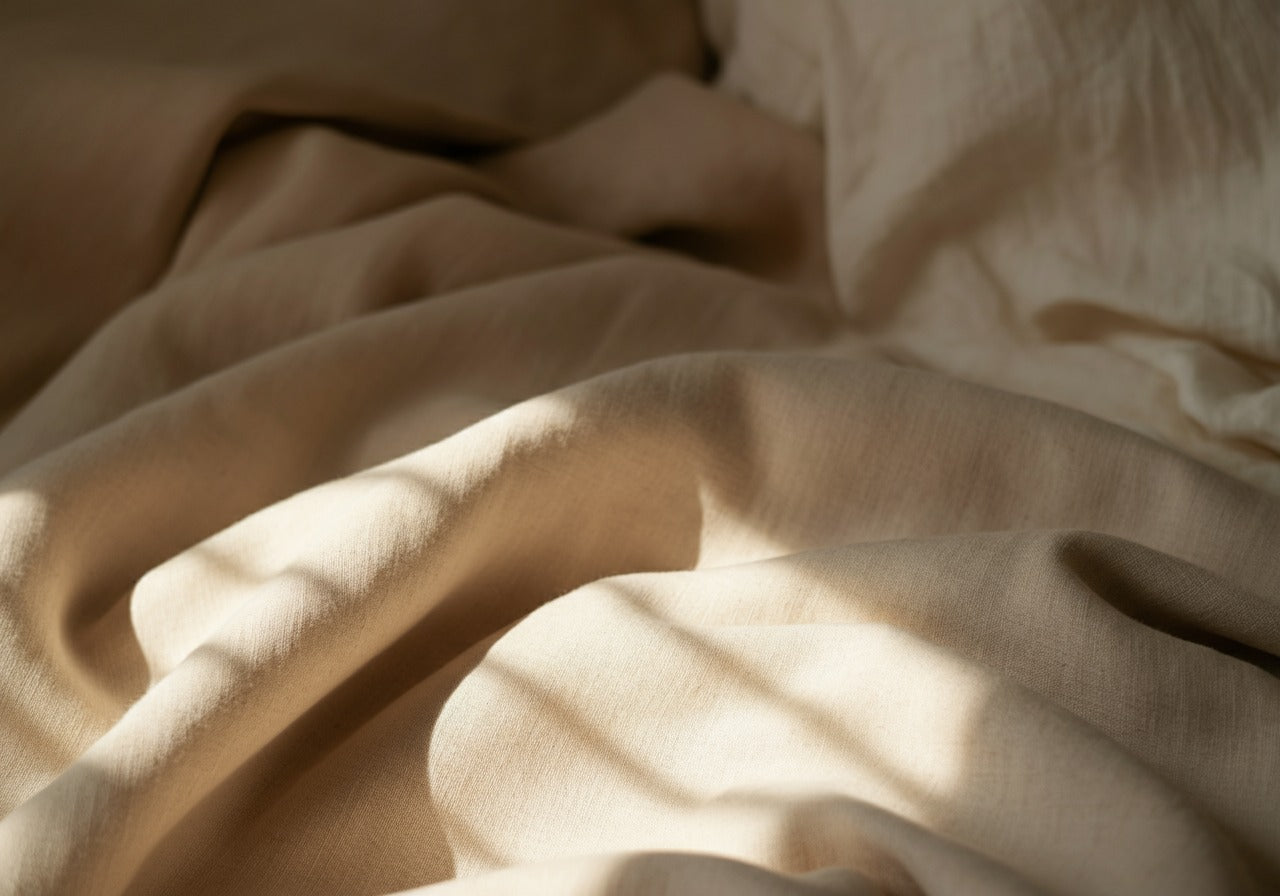
Your skin contains four main types of mechanoreceptors that respond to touch. Each one does a different job, and each responds differently to fabric texture.
Meissner's corpuscles are packed densely in your fingertips and the inner surfaces of your arms. They respond to light touch and fine texture variation. When you run your hand across a fabric and feel the grain of it — the ribbing, the pilling, the weave — that's Meissner's corpuscles firing. Smooth fabrics produce fewer, less frequent signals here. Textured or uneven fabrics keep them active.
Merkel's discs respond to sustained pressure and shape. They're what tells you there's a waistband present even when you stop thinking about it. A wide, flat waistband activates Merkel's discs evenly across a broad area. A narrow elastic pressing into a single line? That's a concentrated, sustained signal your brain keeps processing.
Ruffini endings detect stretch and skin displacement. They register when fabric pulls or tightens as you move. Fabric with good four-way stretch adapts with your body; fabric that resists creates repeated small tugs that Ruffini endings register as ongoing input.
C-tactile afferents (CT afferents) are the most relevant for the calming effect. These slow-conducting nerve fibers respond specifically to gentle, stroking touch — the kind that comes from fabric gliding lightly across skin. Activating CT afferents triggers the release of oxytocin and signals the parasympathetic nervous system to quiet down. Crucially, CT afferents respond best to a specific pressure range: gentle, consistent contact. Too rough, too sticky, or too variable, and the signal changes.
The practical translation: fabric that feels genuinely calming is fabric that activates CT afferents while keeping the other receptor types quiet. That means smooth, consistent, gently weighted — the kind of surface that touches without demanding anything back.
Why Modal Feels So Soft: The Fiber Structure Explanation
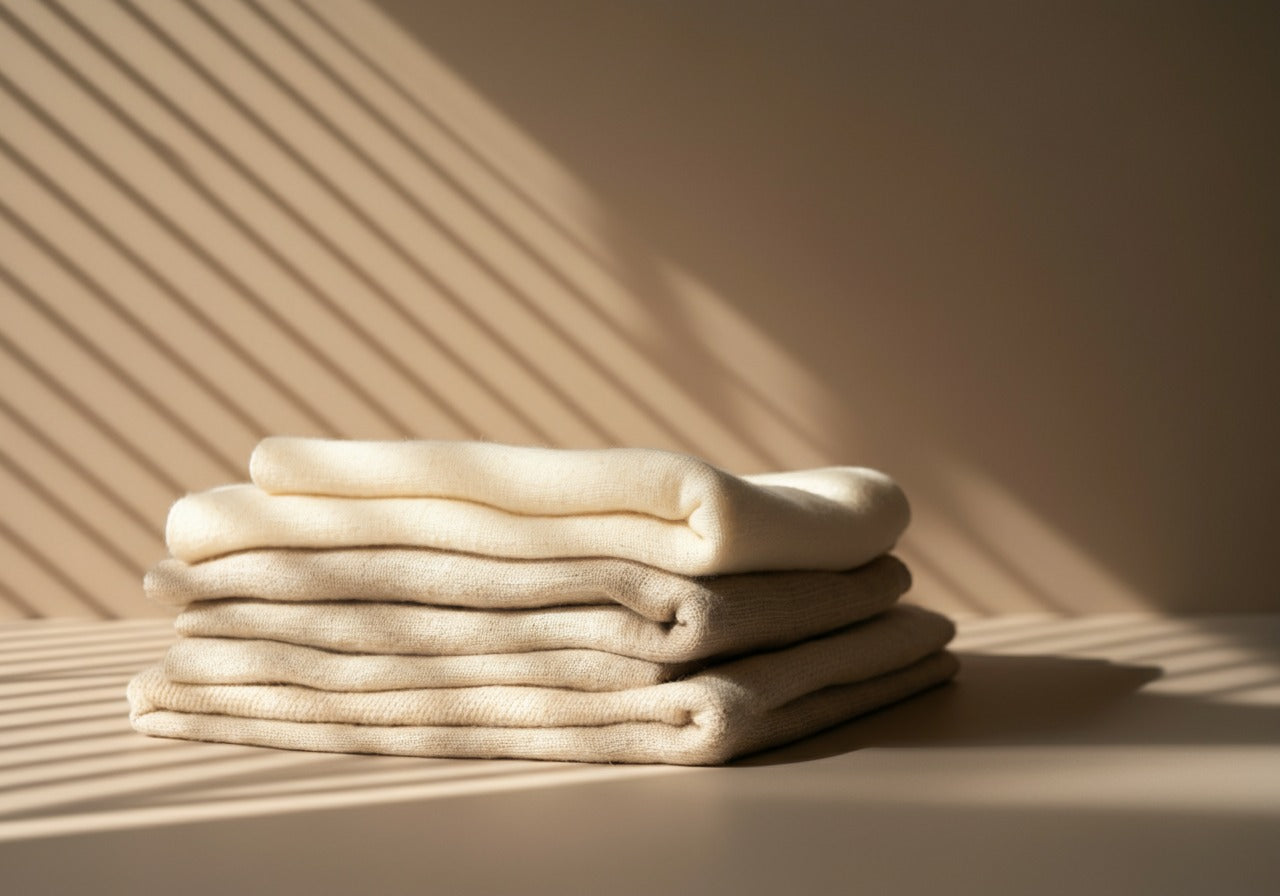
Modal is made from beech tree pulp, processed to produce fibers that are exceptionally round and uniform in cross-section. Under a microscope, modal fibers look almost circular, with a smooth surface. Cotton fibers, by contrast, are kidney-bean shaped and slightly irregular. Polyester fibers are typically triangular or multi-lobed, depending on how they're extruded.
That shape difference has a direct sensory consequence.
When a fiber with a smooth, round cross-section lies against your skin, it contacts evenly across the surface. The pressure it produces is distributed, consistent, and easy for your brain to filter as background. When an irregular or triangular fiber contacts skin, the contact points are variable — more pressure at the peaks of the cross-section, less at the valleys. More variation in contact means more variation in mechanoreceptor input.
This is why modal fabric reliably registers as softer even at the same GSM (grams per square meter) as comparable cotton or synthetic knits. It's not just about marketing. The geometry of the fiber changes the quality of the sensory signal your skin sends.
Bamboo viscose and lyocell (Tencel) work similarly — both involve cellulosic fibers processed for smooth, round cross-sections. The softness is structural, not a coating.
That said: a well-finished synthetic can rival modal in hand feel. A nylon-spandex blend processed with a fine gauge and smooth surface finish will feel different from a rough-knit nylon. Fiber content is one variable. Construction and finishing are others.
Texture, Ribbing, and the Sensory Cost of "Interesting" Fabric
Ribbed fabric is one of the most common textures in loungewear — and it's worth being honest about what it does sensorially.
The raised columns of a ribbed knit create alternating zones of higher and lower pressure against skin. For most people, this is subtle and registers as pleasant texture. But for skin that's already in a heightened state — end-of-day fatigue, elevated cortisol, hormonal fluctuation — that same texture produces more active input than a smooth knit would.
This doesn't mean ribbed fabric is bad for nervous system regulation. It means it's a variable. Fine-gauge ribbing (tight, small-ridged) produces less variation in contact than chunky ribbing. Ribbing on a tank top, where the torso is relatively still, registers less than ribbing on leggings, where movement constantly shifts the pressure pattern.
| Fabric type | Receptor activity | Best for |
|---|---|---|
| Fine-gauge ribbed knit | Low–moderate (consistent texture, predictable pattern) | Tops, tanks, upper body where movement is limited |
| Smooth jersey / brushed cotton | Low (even surface, minimal variation) | Days when sensory sensitivity is higher |
| Chunky or boucle texture | Moderate–high (variable contact, more active input) | Lower-sensitivity days, outerwear |
| Nylon-spandex smooth knit | Low (when well-finished; smooth surface, even stretch) | Bottoms, high-movement areas |
| Modal or bamboo knit | Low (smooth fiber cross-section, gentle drape) | Close contact, full-body |
The category of fabric marketed as "sensory loungewear" often lands in the fine-gauge ribbed or smooth jersey range — not because those textures are universally perfect, but because they balance texture interest with sensory manageability. A ribbed tank in a neutral shade sits in that range: enough surface texture to feel substantial, not so much that it produces active input when you're trying to rest.
Weight, Temperature, and the Autonomic Nervous System
Fabric weight affects your nervous system through two mechanisms that work together: proprioceptive input and thermal regulation.
Proprioceptive input is the sense of where your body is in space. Heavier fabrics produce more sustained pressure on the skin, which activates Merkel's discs and provides continuous positional information. This is the same principle behind weighted blankets — deep, sustained pressure input can signal the parasympathetic nervous system to shift toward rest. Fabrics in the 200–260 GSM range hit a middle ground where the weight registers as "present" without feeling heavy.
Thermal regulation connects to nervous system state more directly than most people expect. Your autonomic nervous system — the same system managing your stress response — is also managing your core temperature. When fabric traps heat and raises the microclimate between fabric and skin, your body responds: heart rate increases slightly, sweat glands activate, and the regulatory effort itself consumes physiological resources. You feel it as a vague discomfort or restlessness that's hard to attribute to anything specific.
Fabrics that regulate thermal load well have two characteristics: 1. An open knit structure that allows air exchange (not necessarily natural fiber — a knit nylon-spandex in a mid-gauge can manage heat exchange well) 2. A surface that feels temperature-neutral on first contact — not noticeably cool, not noticeably warm
When fabric hits both, your body doesn't have to compensate. The nervous system can stay in the background, which is exactly where it should be when you're trying to unwind.
A ribbed two-piece set in a smooth mid-weight knit manages this balance reasonably well — the knit structure allows movement without trapping heat, and the weight sits in that middle range where the body recognizes it as "covered" without working to regulate temperature.
The Honest Part: Natural vs. Synthetic, and What Actually Matters
The loungewear market is full of "modal," "bamboo," and "organic cotton" labeling, and it's worth being clear about what those claims do and don't mean for nervous system comfort.
What fiber content actually predicts: - Fiber cross-section shape (affects surface smoothness) - Initial temperature feel (natural cellulosic fibers tend to feel slightly cooler on contact due to higher thermal conductivity) - Moisture absorption (natural fibers absorb; synthetics wick or repel — different performance depending on context)
What fiber content doesn't predict: - How the garment actually feels on your skin. A poorly constructed cotton jersey can feel rougher and more demanding than a well-finished nylon-spandex blend. GSM, knit gauge, surface finish, and seam construction all matter as much as or more than fiber origin.
Gloravi's pieces use nylon/polyester/spandex blends. That's not a compromise — it's an engineering choice that allows for consistent stretch recovery, shape retention, and a smooth surface finish that performs well across the sensory criteria described here. The honest question isn't "is this modal?" It's "does this surface feel consistent and even against skin, does it stay put when I move, and does it manage temperature without trapping heat?" Those are the variables your nervous system actually responds to.
For a deeper comparison of specific fibers — modal vs. cotton vs. bamboo vs. Tencel — with measurements and performance context, the fabric guide has the full breakdown.
What Soft Glow Living Has to Do With Any of This
Soft Glow Living — Gloravi's underlying philosophy — isn't about wearing nicer things. It's about treating daily choices as having physiological weight. What you put on your body in the morning shapes what your body spends the next twelve hours processing. What you change into after work either adds a layer of sensory noise or removes one.
That's a small thing. But small physiological inputs, repeated daily, accumulate. You're not transforming your nervous system by changing into soft loungewear. You're just choosing not to add unnecessary load to a system that's already working hard. That's the whole idea.
Skin is one way in. Smell is another, and it runs on the same modest logic — not transformation, just fewer things asking something of you. A clean, uncluttered scent on the desk does for a room roughly what a soft sleeve does for a forearm: after a minute you stop noticing it, which is the point.
The nervous system dressing guide applies this framework across different sensory states and outfit scenarios if you want the broader context.
FAQ
Why does fabric feel different on some days than others?
Your skin's sensory threshold changes based on your nervous system state. When cortisol is elevated — from stress, poor sleep, hormonal fluctuations, or overstimulation — your brain's sensory gating becomes less selective. Signals that normally stay below awareness reach conscious attention. A fabric that felt fine yesterday can feel actively distracting today because your interoceptive sensitivity is higher, not because the fabric changed. This is why what you wear on high-sensory days matters more than what you wear on regulated ones.
Does fabric weight actually help with anxiety?
It can. The mechanism is similar to weighted blankets: sustained, even pressure input activates the parasympathetic nervous system through proprioceptive feedback. Fabrics in the 200–260 GSM range provide enough pressure to register as "grounding" without the restrictive feeling of heavy fabric. The effect is subtle and individual — some people find it calming, others find heavier fabric more constricting. The key word is "even" pressure: a wide waistband that distributes weight uniformly affects the nervous system differently than a narrow elastic that concentrates pressure on a single line.
Is natural fabric always better for sensitive skin?
No. Fiber origin (natural vs. synthetic) is one variable among several. A rough or loosely knit natural fiber can produce more sensory noise than a well-finished synthetic knit. The more relevant factors are surface smoothness, knit gauge, construction quality, and seam placement. Linen, for example, is natural but creates significant sensory load due to its texture. Well-finished nylon-spandex is synthetic but often smoother against skin than cotton jersey.
What makes ribbed fabric feel comfortable versus uncomfortable?
Gauge and context. Fine-gauge ribbing (tightly knit, small ridges) produces more even pressure than chunky ribbing, which creates noticeable ridges against skin. Ribbing also registers differently depending on body movement: on a top where the torso is relatively still, fine ribbing is barely noticeable. On leggings, where the fabric shifts with every step, the same texture produces more active input. If ribbed fabric bothers you, try fine-gauge ribbing in areas with less movement before switching to smooth altogether.
How do CT afferents relate to the calming effect of soft fabric?
C-tactile (CT) afferents are unmyelinated nerve fibers in the skin that respond specifically to gentle, stroking touch — skin being lightly moved across rather than held still. They connect directly to the insular cortex, which processes interoceptive signals and social-emotional information, and their activation is associated with oxytocin release. Soft fabric that moves gently across skin activates CT afferents in a way that rougher, stickier, or more textured fabric doesn't. This is part of why soft, flowing fabric registers as calming on a level that has nothing to do with preference — it's triggering a specific peripheral nerve pathway that feeds into parasympathetic regulation.
Does color or pattern affect how fabric feels sensorially?
Color and pattern don't affect tactile sensation directly, but they affect visual sensory load, which is processed by the same finite attention resources as tactile input. High-contrast patterns or very saturated colors require more visual processing than quiet, muted tones. For some people, wearing visually "loud" clothing adds to overall sensory load even when the fabric itself is soft. This is why sensory-friendly loungewear tends to skew toward neutrals and soft tones — not purely aesthetic preference. If you want more on this, fabrics and nervous system regulation covers the visual and tactile side together.
And if you're shopping for one specific piece rather than the science, our guide to the best fabric for lounge dresses takes everything here and turns it into a practical way to choose — by weight, drape, and how a fabric actually settles against the skin over a long, quiet evening.
Glow softly. Live freely.