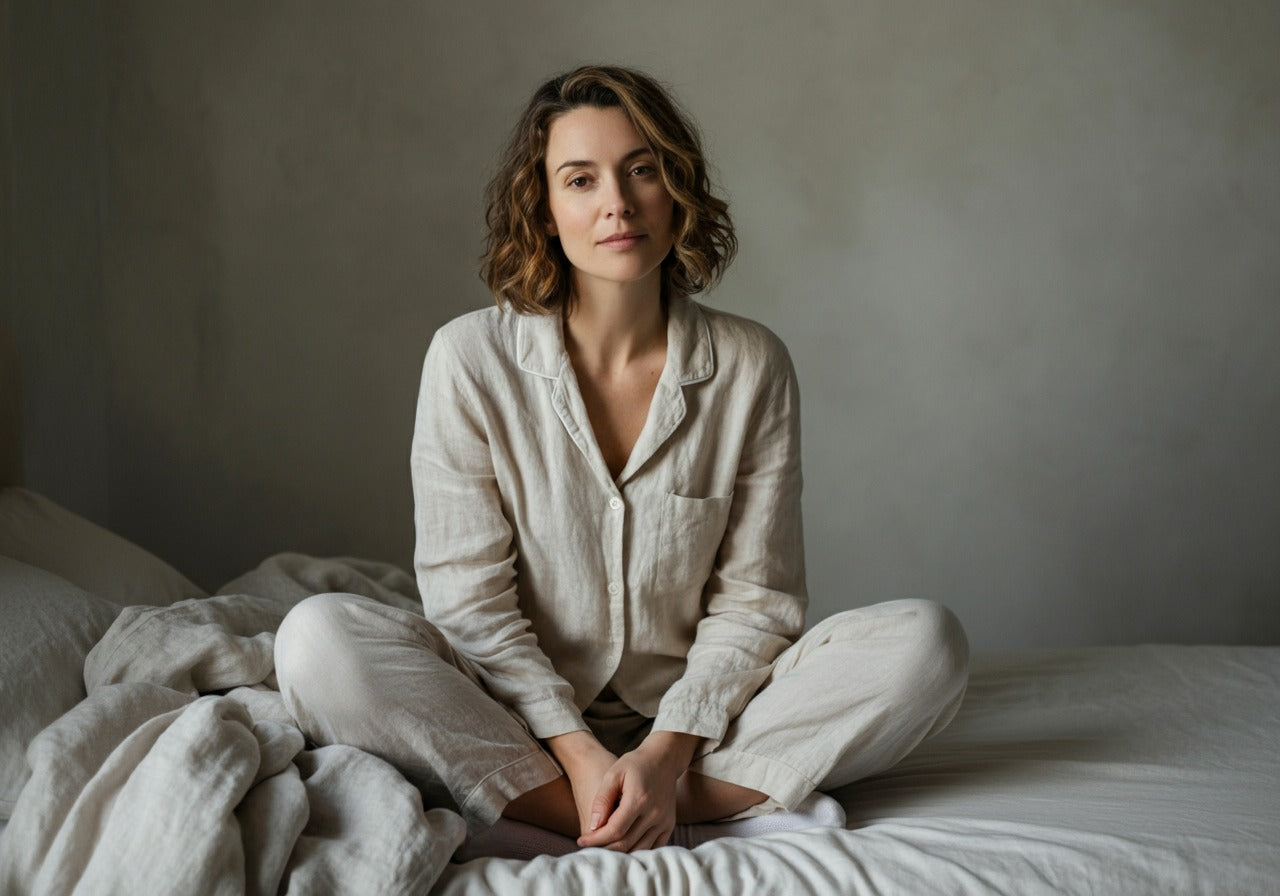
Dressing for Your Nervous System: Anxiety & Clothes
Anxiety has a specific effect on getting dressed. The closet becomes overwhelming. Every option either feels like too much or not enough. The texture of your usual favorite feels wrong. You put something on, take it off, stand there longer than you planned, and somehow feel worse than when you started — because now you're late and you still don't know what to wear.
Dressing for your nervous system means making clothing choices that work with your body's current state rather than against it. On anxious days, that means choosing clothes that minimize sensory irritation, reduce the number of decisions you have to make, and don't demand constant physical awareness throughout the day. The short answer: soft fabrics, non-restrictive waists, nothing at the neck that scratches, and an outfit you don't have to think about. Below is why this works — and exactly what to look for.
Why Anxiety Changes How Clothing Feels
When your nervous system is activated — whether from stress, anxious thoughts, or just a hard morning — your body's interoceptive awareness increases. Interoception is your ability to sense what's happening inside your body: your heartbeat, your breath, the feeling of a waistband pressing against your stomach. Under stress, this system becomes more sensitive.
This is why a tag that never bothered you on a calm Tuesday feels unbearable on a hard Wednesday. The tag didn't change. Your sensory threshold did.
From a physiological standpoint, anxiety activates the sympathetic nervous system — the same system that coordinates your fight-or-flight response. In this state, touch becomes more acute, temperature dysregulation is more common, and the body holds tension in the shoulders, jaw, and abdomen. A tight collar adds to that neck tension. A waistband that digs into your stomach creates a constant low-level signal your nervous system interprets as something to manage.
None of these sensations are dramatic on their own. But they compound. And on a day when your nervous system is already working hard, there's no reason to add to the load. For a deeper look at how sensory sensitivity shapes everyday dressing choices, sensory-friendly clothing for women covers this in detail.
What to Look for in Clothes on Anxious Days

These are the physical properties that make a meaningful difference when your nervous system is running hot:
- No tight waistbands. Elastic that digs sends a constant pressure signal to your abdomen — which is already tense if you're anxious. Look for wide, soft waistbands or high-waist designs that distribute pressure evenly across the midsection without cinching. The women's high-waist leggings are built around this principle — smooth stretch knit, no rolling, no dig-in.
- Soft at the neck. The neck and collarbones are areas where tension accumulates during anxiety. Anything scratchy, tight, or with prominent seams at the neckline compounds that. A scoop neck or wide crew neck with no tags and no internal seams is the baseline.
- Low-friction fabric. Fabric that moves with you all day — smooth against skin rather than grippy or rough — removes a source of ongoing sensory input. This doesn't require specific fiber content; it's about how the fabric feels against skin, not what it's made of.
- No adjustment required. If you have to tug something down, hike something up, or regularly re-settle a waistband throughout the day, that outfit is costing you attention. On anxious days, your attention is already overextended.
- Familiar over new. Anxiety is not the day for a new outfit. Wear something your body already knows. The familiarity itself reduces the mental overhead of the day.
A simple ribbed tank top in a color you already own achieves most of this — soft ribbed fabric, no fuss, nothing to manage.
What to Avoid
Equally useful is knowing what makes things worse:
- Tags and seams at the neck or underarm. These are tolerable under normal sensory conditions. On high-anxiety days, they become focal points your brain can't stop returning to.
- Waistbands with hooks, buttons, or stiff elastic. Anything that creates uneven pressure or requires active management throughout the day.
- Fabrics that trap heat. Temperature dysregulation is a common physical symptom of anxiety — feeling hot, sweating slightly without exertion. Non-breathable fabrics accelerate this.
- Anything that fits differently than you expect. New clothes, recently altered items, anything you're not certain will feel right. Uncertainty compounds anxiety.
- Too many layers. Each layer is another variable. On hard days, simple is more stable.
For reference on how to build an outfit around these principles — and why outfits that feel calm are worth deliberately designing — outfits that make you feel calm covers the structural side.
Reducing Decision Fatigue
There's a reason doctors and executives have talked about wearing the same thing every day: decision fatigue is real, and it starts accumulating from the moment you open your closet. When you're anxious, your prefrontal cortex — the part of your brain that handles decisions and executive function — is already contending with anxious thought loops. Every clothing choice you add to that load is competing for resources your nervous system needs for other things.
The practical solution isn't minimalism for its own sake. It's having a pre-selected "anxious day outfit" — something you've already decided on, that you know feels right, that you can put on without deliberation.
A matching set does this efficiently. There's no pairing required. No wondering if the top and bottom go together. No second-guessing. The yoga set is a good example of this: a complete outfit in one decision. Long-sleeve crop top and wide-leg pants, both from the same family of fabric and fit. Put it on and the getting-dressed part of the day is done.
This connects to research on enclothed cognition (Adam and Galinsky, 2012), which found that what we wear affects not just how others perceive us but how we process the world cognitively and emotionally. Interestingly, on difficult days, getting dressed in actual clothes — rather than staying in pajamas — can support mood regulation, but only when the clothes are the right kind: comfortable, non-restrictive, familiar. The act of dressing signals to your nervous system that the day is beginning, without the cost of clothes that create additional sensory load.
Clothes aren't the only thing you can decide once and stop deciding. A fixed scent works the same way and asks even less of you: light the same clean scent every morning before anything else starts, and after a couple of weeks the smell carries part of that beginning-of-day signal on its own.
For more on the relationship between what you wear and how you feel emotionally, how clothes affect mood goes deeper on the research. And dressing for how you want to feel — the B cluster pillar — covers the intentional use of clothing as an everyday emotional tool.
FAQ
What should I wear when I'm having an anxiety attack?
Reach for whatever is closest, softest, and most familiar. This is not the moment to think about what looks good. A soft hoodie, wide-leg pants, or a loose matching set — something with no tight waistband, no scratchy fabric, nothing at the neck. The goal is to remove sensory demands, not introduce new ones.
Can clothing actually help with anxiety?
Clothing doesn't treat anxiety, and this isn't medical advice. What it can do is reduce one source of sensory load on a day when your system is already working hard. Removing physical friction — a tag, a tight waistband, a scratchy seam — means one fewer thing your nervous system is managing. On days when everything feels like too much, reducing the number of things that demand attention has a real, if modest, effect.
Why does fabric feel different when I'm anxious?
Because your interoceptive sensitivity increases when your nervous system is activated. You're more aware of physical sensations — including the feeling of fabric against your skin. A texture that reads as neutral on a calm day can read as irritating on an anxious one. This is physiological, not imaginary.
Is it better to stay in pajamas or get dressed on a hard day?
Getting dressed — even in very comfortable clothes — tends to be more supportive than staying in pajamas, with one condition: the clothes you change into have to actually feel good. If "getting dressed" means putting on something that pulls or scratches or requires adjustment, it negates the benefit. The point is to signal to yourself that the day is happening, using clothes that don't add to the load.
What to wear when anxious at work?
Look for the most comfortable version of whatever your workplace context requires. A soft, non-clingy fabric. Nothing tight at the neck or waist. A familiar outfit you've worn and liked before. If you have flexibility, a matching set in a neutral reads as put-together without introducing any sensory complexity. The goal is to look fine and feel nothing — meaning the clothes don't register as a problem throughout the day.
How does dressing connect to morning anxiety specifically?
Morning is when anxiety often peaks — cortisol levels are naturally higher in the first hours after waking, and the transition from sleep to the day's demands happens quickly. The closet decision adds cognitive load at the worst possible moment. Pre-selecting an anxious-day outfit — ideally the night before — removes that decision from a moment when your nervous system has the least capacity for it. Mindful morning routine covers the broader morning framework if that context is useful.
One more note: if anxiety tends to build rather than ease through the day, evenings are often where it peaks. The evening wind-down routine covers the wind-down side — including what to change into at the end of the day. The idea that what you wear at 8pm matters as much as what you wear at 8am isn't intuitive, but it's consistent with what we know about how the nervous system uses physical cues to shift states.
And on the days when getting dressed isn't about anxiety specifically — when it's more general heaviness or low energy — what to wear when feeling down takes a different angle on the same territory.
The broader framework this fits into — what nervous system dressing is, how fabrics affect sensory load, and outfit formulas for different states — is covered in the nervous system dressing guide.
For a focused look at the fabric properties themselves — GSM ranges, surface texture, breathability, and construction details — fabrics that calm your nervous system explains why specific fabrics feel regulating or draining.
When anxiety is the cause of the high-sensory day, the specific clothing principles are the same. For a day-by-day approach to dressing on hard days — what to reach for, what to avoid — what to wear on a high-sensory day covers the five rules and a complete outfit formula.
The "known outfit" approach is central to dressing for a sensitive nervous system — the case for having a uniform explains the decision fatigue research and how to build a pre-tested rotation that works across all your contexts.
The stress-reducing potential of clothing is not limited to anxious days — the same fabric and fit principles apply to daily stress recovery. How loungewear affects your stress levels covers the overall physiology of clothing and the stress response.