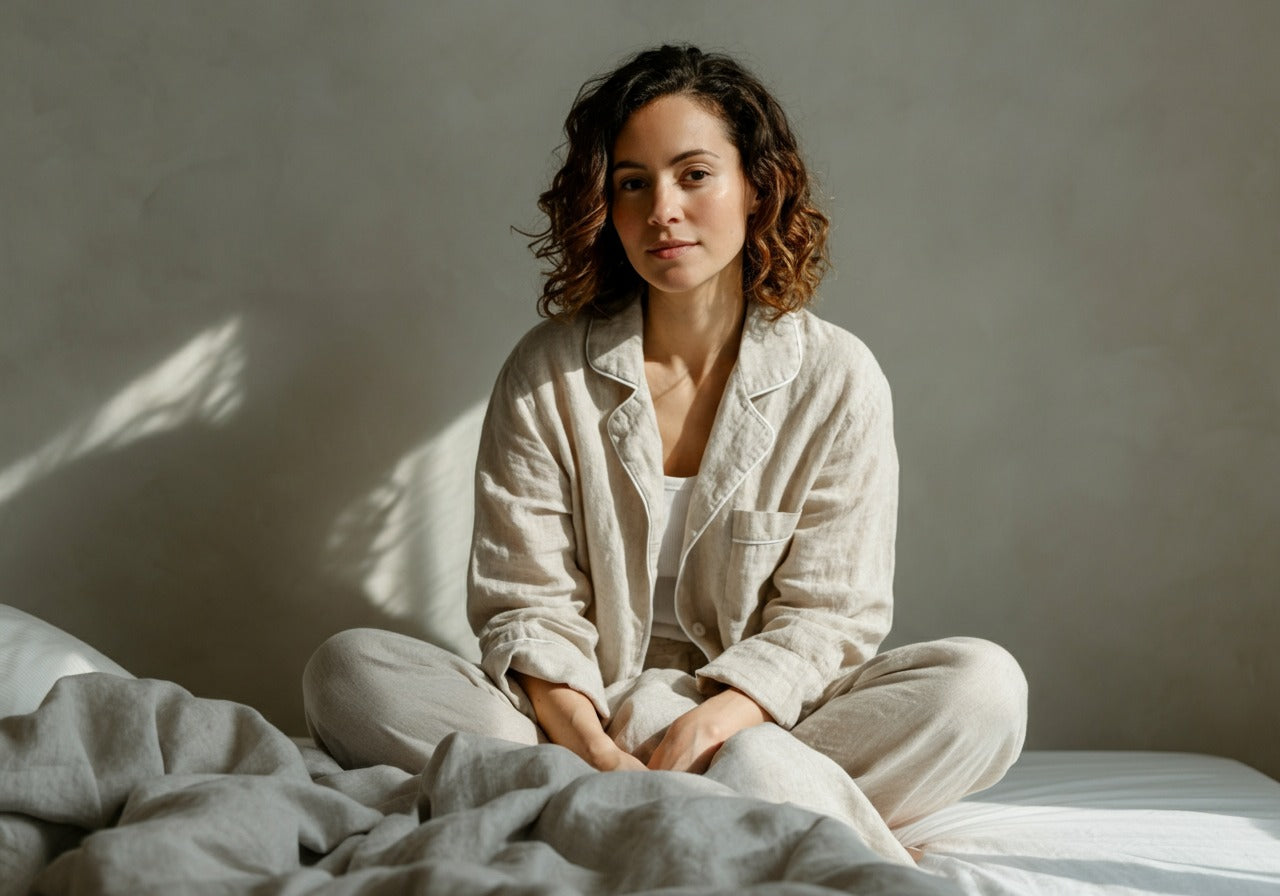
What to Wear When You're Feeling Down: A Gentle Dressing Guide
On hard days, the goal isn't to look good. It's to feel a little less bad. Getting dressed when you're struggling emotionally doesn't have to involve effort or intention — it just has to happen. The most useful framework for dressing on difficult days is a three-level system based on your actual energy that morning: Level 1 for days when getting out of bed is the win, Level 2 for days when you can manage one small decision, and Level 3 for days when you want to feel like yourself again without working too hard. Soft fabrics, loose fits, and pieces that don't require thinking make all three levels easier.
Why getting dressed feels so hard on low days
Depression and low mood affect decision-making before almost anything else. The mental bandwidth required to choose an outfit — colours, proportions, what goes with what — is the same bandwidth that feels entirely unavailable when you're not doing well. This isn't laziness. Research on cognitive load suggests that depleted mental resources make even minor choices feel disproportionately difficult, which is why a wardrobe full of clothes can feel like it has nothing in it on the days you most need something to wear.
There's also a physical layer. Clothing that rubs, constricts, or requires adjusting throughout the day adds sensory friction to an already difficult experience. Tight waistbands, scratchy fabrics, and anything that needs to be "managed" are exhausting in a way that's hard to explain until you've lived it.
The solution isn't trying harder. It's building a small, pre-decided set of options so that getting dressed takes a decision off your plate entirely.
The 3-level formula for dressing on difficult days

The three levels below aren't about aspiration — they're about meeting yourself where you are. Start at whichever level matches your energy, not the one you think you should be at.
Level 1: Zero-effort comfort (the bare minimum, done)
This is for the days when getting dressed at all is an achievement. The goal is clean, soft, and covers you — nothing else.
- A single soft fabric on top and bottom that you don't have to think about matching. Modal, bamboo, or cotton-jersey pieces in neutral tones work because they look considered without any effort.
- No buttons, no zips, no waistbands with hardware. Pull-on everything.
- One colour family, or pieces so neutral they can't clash. Cream, dusty grey, soft olive.
- Shoes that slip on. No lacing, no buckles.
One outfit. Not five options. One.
Level 2: One step up (still effortless, slightly more dressed)
This is for days when you want to feel a bit more like a person but can't manage actual effort.
- A soft ribbed top in a colour you like — ribbed fabric reads as "dressed" even when it feels like not trying. Pairing it with high-waist leggings in a warm neutral creates a complete look without any decision-making involved.
- A loose layer on top — a zip-up or drape cardigan — gives you something to hold onto throughout the day and adds warmth without adding weight.
- Same slip-on shoes. This is not the day to revisit footwear.
Level 3: Feeling like yourself (soft, but present)
This is for when the worst has lifted slightly and you'd like your outside to match the effort you're putting in.
- A monochrome soft set: one shade, top to bottom. Visual cohesion makes it look intentional with zero coordination required.
- One piece that you know makes you feel good — not "good" in a performance sense, but good in a "I feel comfortable being seen in this" sense. A fabric you love, or a silhouette that doesn't require managing.
- Optional: one small thing that feels like you — a ring, a hair clip, something that says I showed up today.
The fabrics that actually help
Sensory comfort matters more on low days. Fabrics that are scratchy, stiff, or require frequent readjustment add up over the course of a day in ways that are easy to underestimate.
Modal: Derived from beech wood pulp, modal has a smooth, almost silky hand feel without the slipperiness of actual silk. It doesn't irritate, it breathes, and it holds its shape through a full day. It's the fabric most often described as "feels like a second skin" for a reason.
Bamboo viscose: Similar softness to modal, with slightly more drape and a cooling effect against the skin — grounding when emotions feel heightened.
Cotton-jersey: More textured than modal but still gentle. A good cotton-jersey piece feels comforting rather than constricting. Look for at least 95% cotton rather than blends with high synthetic content.
What to avoid on hard days: Anything with a defined waistband that sits against your skin, coarse denim, synthetic performance fabrics designed to compress, or embellishments at the neckline that sit against your throat. None of these are inherently bad fabrics — they're just not what your nervous system needs right now.
The one-decision outfit: pre-building your hard-day uniform
The single most useful thing you can do on a good day is create your hard-day uniform in advance. This means choosing two or three complete outfits that require zero decisions in the moment — everything folded together or on the same hanger, so that on a difficult morning, getting dressed is a single action.
A practical starting point: a ribbed tank in a soft neutral paired with high-waist leggings in the same tone constitutes a complete, wearable outfit that can carry you through most of a day. Pre-pair them, put them in a specific drawer, and don't use them for anything else.
Having multiples of the pieces you rely on most is also worth considering. If laundry feels unmanageable during difficult periods, having two of your go-to basics means you're never without what helps.
On the days when staying at home is the right call, cozy outfits at home takes the same low-effort logic and adds the research on why having specific home clothes — rather than just wearing whatever's closest — makes a genuine difference to how those days feel.
Frequently asked questions
Does what I wear actually affect how I feel when I'm depressed?
Research on enclothed cognition — the study of how clothing affects the wearer's psychological state — suggests that what we wear can influence mood and self-perception, even when we don't consciously register it. A 2012 study by Adam and Galinsky found that wearing clothing associated with a particular role or identity affected performance and focus. For low-mood dressing specifically, the mechanism is probably simpler: clothes that feel good against your skin remove one ongoing source of low-grade irritation from an already difficult day. That's not a cure — but it's a real and small improvement.
Is it okay to wear the same outfit multiple days in a row when I'm depressed?
Yes. Wearing the same clean, comfortable outfit repeatedly is a reasonable coping strategy when decision-making is difficult. If having one reliable outfit reduces the decisions you need to make in the morning, that's a practical adaptation, not a failure.
Should I try to "dress up" to boost my mood?
Only if the idea of it feels accessible, not obligatory. Dressing up can work as a mood-shift strategy when you have some energy to spend — but on the lowest days, the effort required can deplete the small reserves you have. The goal on hard days is to get dressed, not to get dressed well. Level 1 is a full success.
What colours are most helpful when feeling down?
Softer, muted tones tend to feel less demanding than bold or high-contrast combinations. Cream, dusty sage, pale blush, warm stone — colours that don't require the eye or brain to do much work. If you have a colour you personally associate with feeling safe or comfortable, that colour is the right choice regardless of what any guide says.
How do I build a hard-day wardrobe without buying a lot of new things?
Go through what you already own and find two or three pieces that pass this test: would I reach for this on the worst morning I've had recently? Those are your hard-day basics. Fold them together in a dedicated spot. If you find gaps — usually in the "soft but slightly dressed" middle ground of Level 2 — one or two pieces in a fabric you love are enough to fill them.
On the hard days, getting dressed is enough. On the slightly easier days, having a system makes it one less thing to navigate. The clothes themselves matter less than the fact of putting them on — but having soft, pre-decided options makes that easier to do.
For the lighter days — when the question shifts from "how do I get through this" to "how do I want to feel today" — 7 outfits that make you feel calm gives specific combinations with the colour and fabric reasoning behind each one. And for the broader framework connecting clothing, mood, and day-to-day emotional regulation, dressing for how you want to feel covers the research and the system in full.
For days when anxiety specifically is the challenge, dressing for your nervous system covers the sensory and decision-reduction angle in more detail.