How to Do a Sound Bath at Home: Setup, Steps, and Timing
You searched for a sound bath near you and got three results. One is a forty-minute drive. One meets Tuesdays at 6, which is exactly when you're still answering email. The third has a waitlist and a drop-in price that makes it a once-a-month thing at best.
So here's how to do a sound bath at home instead, with nobody standing over you holding a gong. You need four things: a floor you can lie on for forty minutes, something over your eyes, a sound source you are not operating, and an ending that arrives on its own. Everything after that is refinement.
One note before the setup. Everything below is about running a session yourself. If you've never been to one and want to know what the hour actually feels like and what happens in the room, what a sound bath is and what to expect covers that ground. Come back when you want to build your own.
Start With the Sound Source
Every other choice here is flexible. This one decides whether the session does anything.
In a studio, a large part of what you're responding to isn't melody. It's pressure. A gong or a big bowl moves enough air that you feel it in your sternum and along your back, and that physical sensation is most of what people remember afterward. The sound arrives through your ribs as much as through your ears.
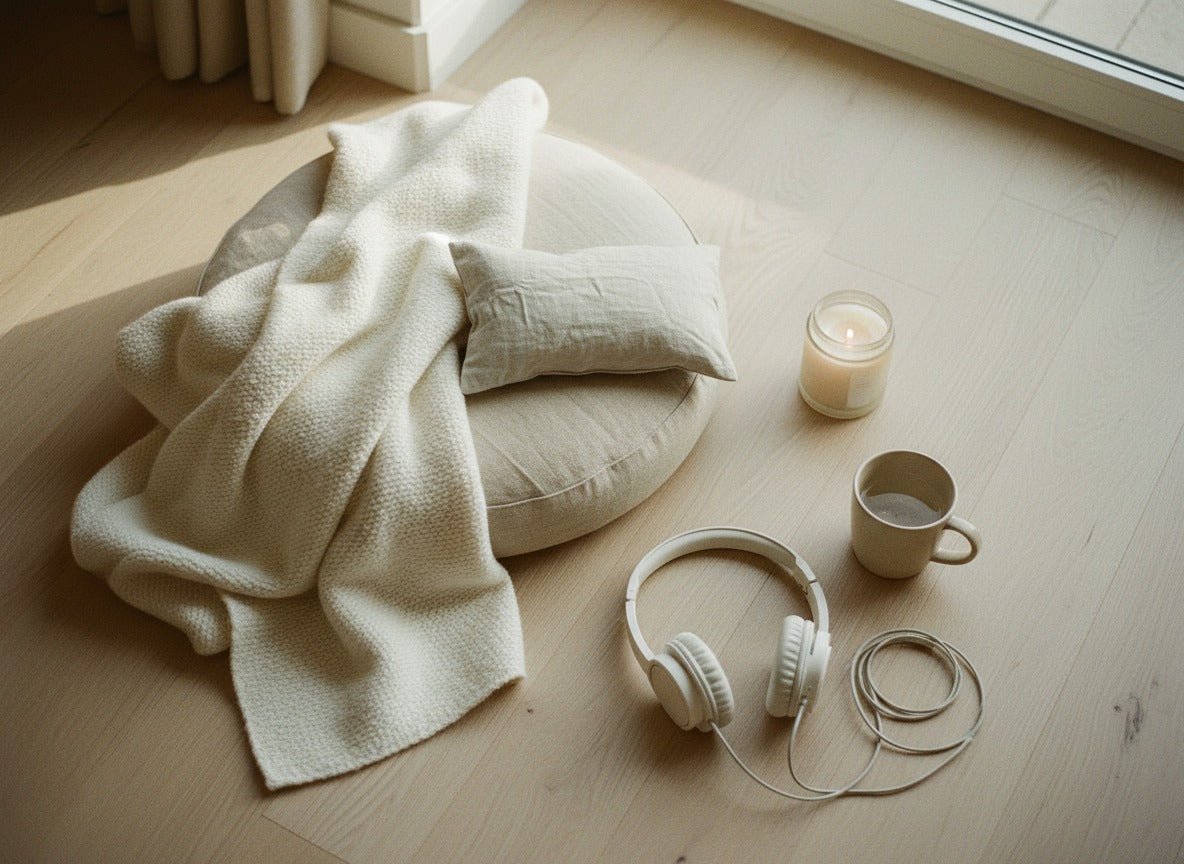
Small speakers can't do that. A phone speaker reproduces almost nothing in the low range where the chest-felt part lives, so it hands you a thin, pretty version of the same recording. Over-ear headphones give the frequencies back but not the air movement. You get the sound without the weight of it.
Pick with the tradeoff in front of you.
| Sound source | What you get | What you give up | Best for |
|---|---|---|---|
| Phone or laptop speaker | Convenience | The low end, which is the point | Not worth doing |
| Over-ear headphones | Full frequency range, close detail, household noise sealed out | Air movement, so nothing lands in your body | Apartments, thin walls, someone asleep down the hall |
| A speaker that moves air (bookshelf size or larger) | Some of the chest-felt quality, sound that fills the room | Detail at low volume, and the neighbors hear it | Houses, daytime, a room with a door |
| Your own singing bowl | Real acoustic sound, real vibration | Your hands and your attention | Opening and closing only |
That last row is the one people get wrong. The usual advice is that if you own a bowl, you should play it for yourself. Playing costs you something, though. Striking and circling a rim keeps your hands busy and your attention pointed outward at technique, which is the opposite of what the practice is asking for. Use the bowl as a bracket. Three or four minutes at the start to mark the beginning, then lie down and let a recording carry the middle, then one strike at the end to close it. You get the acoustic quality where it counts and the release where you need it.
For recordings, length matters more than the source. Look for one continuous track of 30 to 45 minutes rather than a playlist. Playlists bring gaps, volume jumps between tracks, and sometimes an ad, and each of those pulls you back to the surface.
Set the volume before you lie down, and set it lower than feels impressive. Resonance that's a little too loud turns uncomfortable in the ears around minute fifteen, and by then you won't want to get up and fix it.
Setting Up the Room: The Fifteen Minutes Before
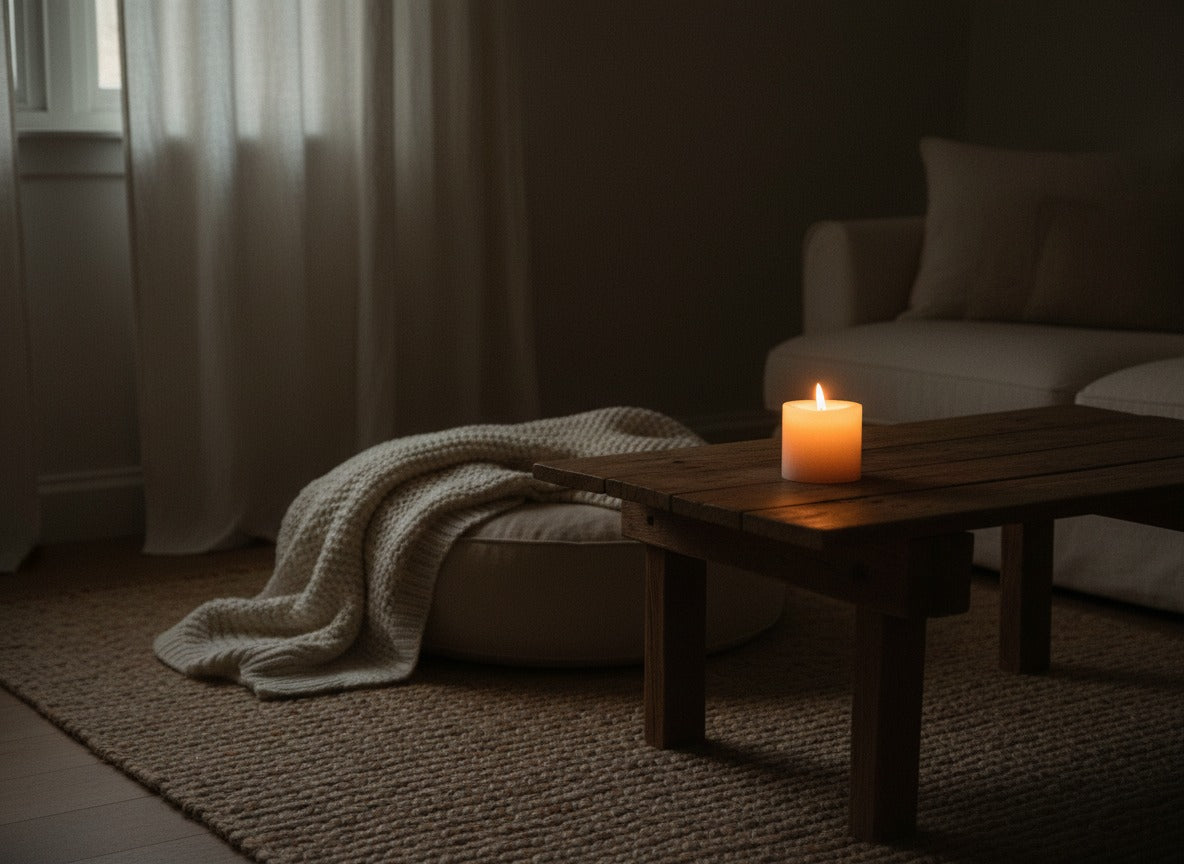
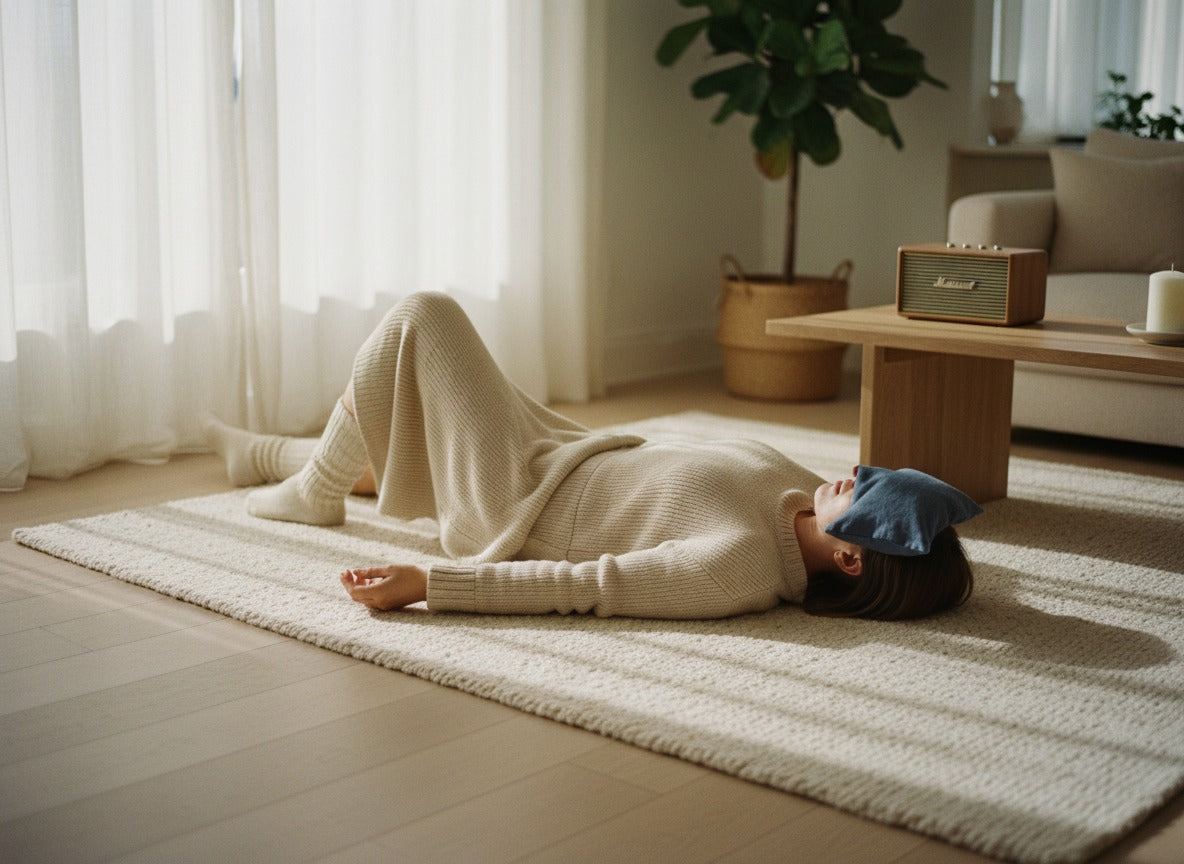
- Set up on the floor rather than the bed. A mattress is a sleep cue your body already knows, and the soft surface lets your lower back sag until it aches. A rug with a folded blanket works. So does a zabuton-style floor cushion under your hips and shoulders, with something thin under your head.
- Get warmer than you think you need. Body temperature drops once you stop moving, and getting cold at minute twenty-five is a common way a home session ends early. Socks, and a blanket over you even in summer.
- Cover your eyes with an eye pillow, a folded scarf, or a sleep mask. Light coming through your eyelids keeps a low-level visual load running the whole time, and you don't notice it until it's gone.
- Download the track before you start. Airplane mode plus Do Not Disturb, phone face down or in another room. If the audio is playing from that same phone, streaming and airplane mode won't cooperate, so save the file first.
- Light the candle twenty to thirty minutes ahead, then blow it out. A freshly lit candle gives you the sharp combustion note of the first few minutes rather than the rounded scent the wax delivers once the surface has melted evenly. Light it while you're setting up and extinguish it before you lie down. The scent stays in the room for another 30 to 45 minutes after the flame is out, so you get the whole session with the smell and none of the open flame. Sound bath and scent goes into why the timing works this way.
- Decide how the session ends before it starts. More on that below, because it's the piece home practice usually skips.
Clothing is the one setup detail that’s easy to skip at home, since you’re already in whatever you had on. Half an hour on the floor changes what feels comfortable, though — waistbands, seams, and anything with a wire sit differently once you’re horizontal. The fabric and fit side of what to wear to a sound bath holds up at home too, minus the part about sharing a room with strangers.
The Session, Roughly by the Minute
Nothing here is a rule. It's what the arc tends to look like when the setup is right.
The first five minutes belong to your body. Something itches, you need to swallow, one shoulder sits higher than the other. Adjust once, then stop adjusting. Every correction after the first is your attention leaving the sound.
Minutes five to fifteen are the negotiation. Your mind produces a grocery list, an email you should have sent, a small social replay from Tuesday. Let the list run, then put your attention back on where the sound is sitting in the room. You'll do this maybe thirty times over the session. That repetition is the practice itself.
Somewhere between minute fifteen and thirty-five, time gets loose. This is the part you came for. It doesn't announce itself, and you usually only notice afterward that a long stretch went missing. Some people fall asleep here. In a studio that's slightly embarrassing. At home it's fine, and it often means you were carrying more fatigue than you'd admitted.
The last five minutes thin out on their own if you chose the track well. Let them.
How to Come Out of It
Nobody is going to bring you back, and this is where home sessions most often lose their value. Sitting straight up and reaching for your phone spends most of what the last forty minutes built.
Stay flat for two full minutes after the sound stops. Silence is part of it, and the contrast is where a lot of the settled feeling actually registers. Then move fingers and toes, roll onto one side, wait a beat, and press up from there. Water helps. Give yourself ten minutes before anything that needs a decision.
Don't end on an alarm. An alarm finishes the session with a startle response, a jolt through the exact system you just spent forty minutes calming, and it undoes the last stretch of the session in about a second. A track that runs out on its own ends things in the same register they started in. That's the whole reason to choose a fixed-length recording over a timer.
If the First One Falls Flat
A few things go wrong predictably.
You spent the whole time listening to yourself trying. Normal for the first two or three sessions, and it fades once the setup stops being novel. If you fell asleep every single time, move the session earlier in the evening or prop your head a little higher. If you were restless and bored, forty minutes may be too long to start with, so try twenty-five and grow into it. And if you kept surfacing to check how much was left, that's the track's fault. A single fixed-length recording removes the question.
If nothing registered physically at all, go back to the table above. Usually it's the speaker.
Sound Bath at Home FAQ
How long should a sound bath at home be?
Thirty to forty-five minutes. Under twenty, you rarely get past the body-settling stage, which means you do the uncomfortable part and skip the part that makes it worth doing. Studio sessions usually run around an hour, and part of that hour is arriving, setting up mats, and settling a room full of strangers. At home you skip all of that, so a shorter block gets you to the same place. If forty-five feels like a stretch to schedule, thirty is a real session and twenty-five is a decent floor. Consistency matters more than length. Two thirty-minute sessions a week does more than one ambitious ninety-minute attempt a month.
Do I need singing bowls to do a sound bath at home?
No. A good recording through decent speakers or over-ear headphones gets you most of the way, and it removes the problem of having to play an instrument while also trying to receive it. Bowls are worth owning if you like the object and the sound of your own room, though they're an expense you can postpone indefinitely without losing the practice. If you do own one, use it to open and close the session rather than to fill the middle. Three or four minutes at the start, one strike at the end, and a recording for everything in between. That combination gives you the acoustic quality without asking your hands to stay busy for forty minutes.
Can I do a sound bath at home in bed?
You can, and it will usually turn into a nap. Your body has years of association between that mattress and going unconscious, so the sound becomes a soundtrack to falling asleep rather than something you stay with. There's also a physical issue: a soft mattress lets your lower back sink, and a sagging spine starts aching around minute twenty. The floor with a folded blanket or a firm cushion keeps you in the alert-but-still state the practice depends on. If you want the sound specifically to help you sleep, that's a different and completely valid use, and bed is the right place for it.
What if I fall asleep during it?
Nothing is lost. Sleeping through a sound bath at home usually means your baseline fatigue is higher than you thought, and the session did its job by giving your nervous system permission to stop. If it happens every time and you'd rather stay present, three adjustments help. Move the session earlier, before the evening drop in alertness. Prop your head and upper back slightly higher instead of lying completely flat. Keep the room a little cooler while staying warm under a blanket. And if you still drift off most times, take the hint and treat it as rest.
What time of day works best?
Late afternoon and early evening tend to work best for most people. There's enough distance from the workday that your mind isn't still finishing tasks, and enough distance from bedtime that you don't just fall asleep. Mid-morning works well on a day off. The one time to avoid is immediately after eating, since digestion makes lying flat uncomfortable and pulls blood away from the settled feeling you're after. If evening is your only window, do it right after you've closed the laptop rather than as the very last thing before bed, and let the wind-down that follows carry the state forward.
How often should I do this at home?
Once or twice a week is a sustainable rhythm, and it's often enough that the setup becomes automatic. It also gets easier as you go. Your body starts recognizing the sequence, so the settling phase shortens: what takes fifteen minutes in your first session might take three or four by the sixth. Daily is fine if you want it, though a practice you have to schedule every single day tends to quietly stop happening within a month. Twice a week at a fixed time, in the same room with the same scent, holds up better over a year.
Before You Lie Down
The candle is the one part of the setup that keeps working after you close your eyes. Sound does the main job of shifting you out of the narrating, planning mode, and scent runs on a separate track into the same emotional and memory system, holding the state open a little longer than it would stay on its own.
That's also why the same scent every time is worth more than the perfect scent once. After a handful of sessions, the smell alone starts triggering part of the shift before the first note plays. A warm, settled scent like the coconut-apricot Warmth candle suits evening sessions where you want to soften. Something cleaner like the Clarity tin fits a morning or midday practice where you're trying to reset rather than dissolve. If you're setting the whole thing up as a repeating evening ritual, the Evening Ritual set covers that arc, and building your soft glow ritual walks through how the pieces stack in order.
Once the sound source and the scent are settled, the room itself is the last variable. How to build a meditation corner covers the floor support, lighting, and the small matter of having one spot in the house that means only this.
Set it up carefully once. The second session takes five minutes to start.