How to Build a Meditation Corner at Home (Step by Step)
There's a corner in most homes that quietly holds things — a chair nobody sits in, a small stretch of wall near a window, a forgotten edge of the bedroom. That corner could become the most useful spot in your house, and you probably don't need to buy anything to start.
Creating a meditation space at home doesn't require a spare room, expensive cushions, or a minimalist aesthetic you have to maintain. It requires one thing: a specific spot you return to. That consistency — not the decor — is what makes the practice stick. A meditation corner is any area you dedicate to sitting quietly, away from the flow of daily household activity, where your nervous system learns over time that it's time to slow down.
Why a Dedicated Spot Makes Practice Easier
Your brain is remarkably efficient at using context as a cue. Neuroscience research on habit formation shows that the brain encodes experiences alongside the environmental signals present when those experiences occur — the light, the temperature, the visual field, even the texture under your hands (Graybiel, MIT, 2008). When you return to the same physical space repeatedly, those cues become triggers for the mental state you cultivated there.
This is called context-dependent memory, and it works in your favor when you build a meditation corner. After two or three weeks of sitting in the same spot, walking into that corner begins to shift your nervous system before you've even closed your eyes. Your heart rate edges downward. Your breath slows slightly. The space itself does some of the work.
Most articles on meditation spaces focus on what to put there. The research suggests the more important question is: what will you consistently do there? The objects follow from the practice, not the other way around.
What You Actually Need (and What You Don't)
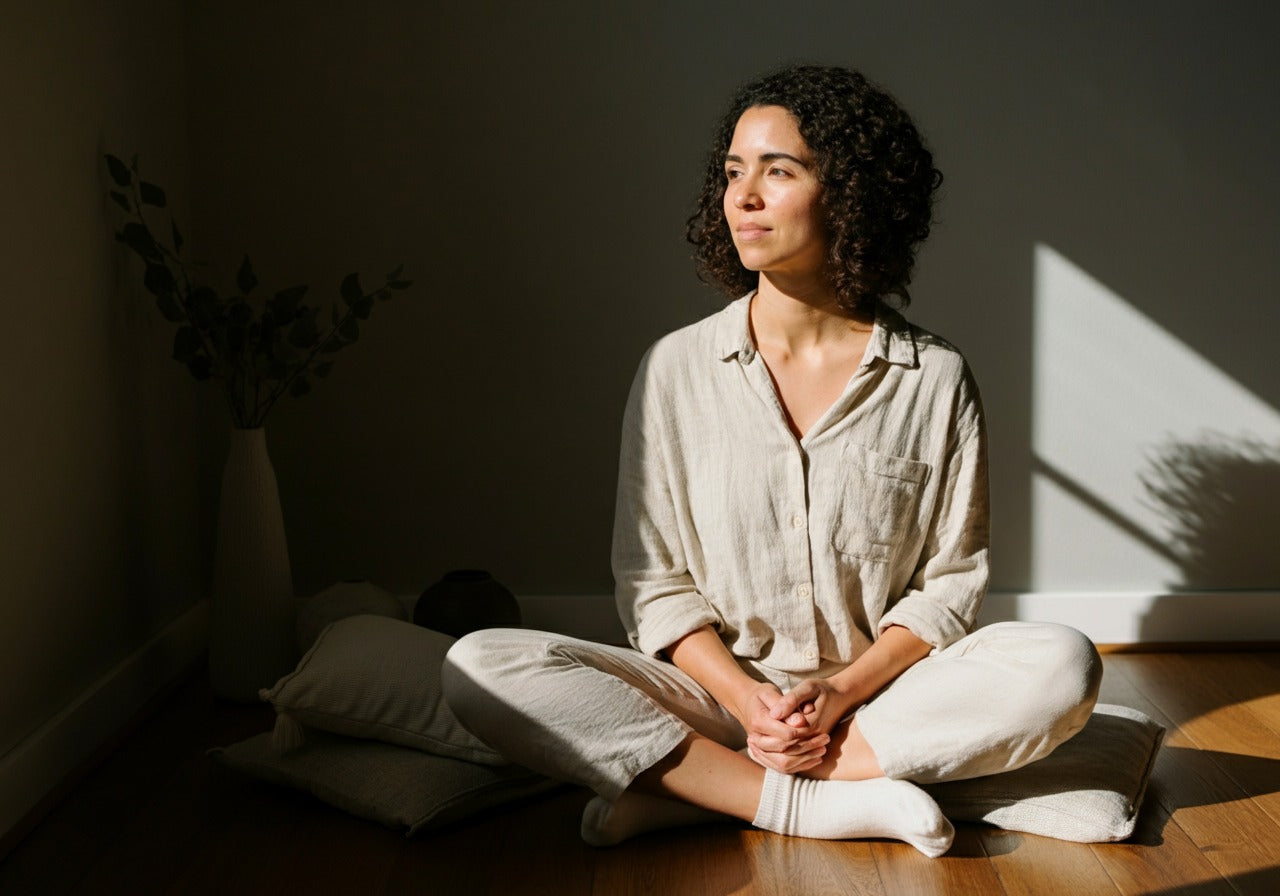
The most common barrier to starting is the belief that you need to set things up properly first. You don't.
What you actually need:
- A surface to sit on (a folded blanket works fine)
- Enough floor space to sit comfortably — roughly 4×4 feet minimum
- A wall or corner that is visually calm when you're sitting there
- A reason to return tomorrow
What you don't need:
- A separate room
- A zafu cushion (though they help — more on that in the zafu vs. zabuton guide)
- Incense, crystals, or singing bowls
- A neutral color palette
- Silence (ambient sound is fine; jarring interruptions are the real issue)
The "expensive setup first" pattern is one of the most reliable ways to delay starting indefinitely. Begin with what you have. Refine over time.
How to Choose the Right Spot in Your Home
Look for these qualities, roughly in order of importance:
1. Low foot traffic. You want a place where others are unlikely to walk through mid-session. This reduces the psychological sense of being observed and the chance of sudden interruption.
2. Visual calm when seated. Sit on the floor and look at what's in your sightline. If it's a pile of laundry, a screen, or a cluttered shelf, your brain will keep processing it. A blank wall, a window, or a simple plant works better.
3. Natural light if possible. Morning light, in particular, supports circadian rhythm regulation and signals the body toward alertness followed by ease — which is actually a good state for meditation (not sleepy, not wired).
4. Temperature consistency. Cold floors and drafts are underrated obstacles. A corner near a heating vent or with access to a blanket makes a real difference in November.
5. Proximity to your morning routine. Studies on habit stacking show that placing a new habit near an existing one dramatically increases follow-through (Clear, Atomic Habits, 2018). A meditation corner near where you make your coffee, or just outside the bathroom you use every morning, works with your existing patterns rather than against them.
Setting Up Your Corner Step by Step
Once you've chosen your spot, the setup takes less time than you might expect.
Step 1: Clear the area. Remove anything unrelated to sitting quietly. You don't have to decorate — just clear.
Step 2: Lay down a base layer. A folded blanket, a yoga mat, or a meditation cushion — whatever you have. This marks the space physically and signals the transition from "regular floor" to "this is where I sit."
Step 3: Address the light. If you're practicing in the morning, position yourself so you're not facing harsh direct sun. If you practice in the evening, a small lamp or candle gives warmer light than overhead fixtures — and a consistent scent anchors the state faster over time. The Clarity candle works well for morning sessions; the Warmth candle for evenings.
Step 4: Add one sensory anchor (optional). Many practitioners find a single sensory element — a scent, a small plant, a particular texture — helpful for deepening the environmental cue. Scent is particularly effective: the olfactory system connects directly to the limbic system, so a consistent candle used in your practice becomes a faster trigger for the calm state over time. If you want to go deeper on this, choosing a candle by how you want to feel explains the nervous system logic.
Step 5: Keep it clear between sessions. The space works because it stays associated with one thing. If it becomes a storage area between practices, the cue weakens.
Step 6: Sit there, even briefly. A three-minute sit in the same spot, daily, builds the neural association faster than a 45-minute session twice a week in different locations.
For those working with very limited square footage, the approach changes slightly — see the specific strategies in meditation corner ideas for small apartments.
A Simple Comparison: Seating Options by Practice Style
| Seating type | Best for | Space needed | Notes |
|---|---|---|---|
| Folded blanket | Beginners, any body | Minimal | Free, portable, good starting point |
| Meditation cushion (zafu) | Seated cross-legged practice | ~2 sq ft | Supports hip elevation, reduces strain |
| Zafu + zabuton set | Longer sits, knee sensitivity | ~4 sq ft | More stability; see full comparison |
| Low meditation bench | Those with tight hips | ~2 sq ft | Kneeling position, good for back |
| Supportive chair | Limited mobility, older practice | Chair + small rug | Equally valid; feet flat on floor |
What to Wear for Your Practice
The environment you sit in matters — and so does what's on your body. Restrictive waistbands, tight shoulders, and fabrics that don't breathe are quiet distractions during practice. They don't ruin a session, but they make it slightly harder to settle.
Soft, non-binding clothes that move with you make the transition into stillness easier. For a full look at what works across different meditation styles and times of day, see the companion article on what to wear while meditating. For a practice that moves between meditation and gentle movement, something like the long-sleeve crop top and wide-leg yoga set gives you enough ease to sit comfortably and enough coverage for cooler mornings.
The clothing question connects to something broader: the way our environment — including what we're wearing — signals to the nervous system that a shift in state is available. You can read more about that in how clothes affect mood and dressing for how you want to feel.
FAQ
Does a meditation corner actually make a difference, or is any quiet spot fine?
Any quiet spot can work for an occasional sit. But a dedicated corner makes a measurable difference for building a consistent practice. The mechanism is associative learning: your brain creates a conditioned link between the space and the mental state you cultivate there. Over weeks, the space itself begins to induce a mild parasympathetic shift — the "rest and digest" branch of your nervous system activates more readily when you enter it. This is the same principle behind why people sleep better in hotel rooms that feel distinctly separate from their workspaces. Novelty and dedicated context both affect how quickly you can access a particular mental state. A corner you return to daily becomes a shortcut.
How small can a meditation corner be?
Smaller than you think. A 3×3 foot area is enough to sit cross-legged or in a chair. You need room for your body in a seated position and a small buffer in front of you so you're not facing a wall six inches away. A closet with the door open, a bay window seat, a corner of a bedroom behind a door — all of these work. The key constraint isn't floor space; it's visual calm and freedom from interruption. A small corner with a blank wall and good morning light will serve you better than a large room with a cluttered sightline.
Do I need to meditate at the same time every day for the corner to help?
Consistency of time helps, but consistency of place matters more. The environmental cue — the visual, spatial, and sensory context of the corner — is the stronger trigger. If you can only maintain one variable, make it the location. That said, pairing your practice with a reliable time (just after you make coffee, or before you open your laptop) makes it easier to remember and harder to skip. The best habit is the one that doesn't require willpower to initiate because the context has already begun to cue the state.
What if I live with other people and can't guarantee quiet?
You have two practical options. One is timing — finding a window (early morning before others are active, or a consistent midday break) when interruption is unlikely. The other is sensory separation — using a specific scent, a pair of earbuds with ambient sound, or headphones during practice. The sensory signal replaces the need for environmental silence. Many experienced practitioners meditate in quite noisy environments by anchoring their practice to an internal cue (the breath, a word, a body sensation) rather than relying on external quiet. Over time, that anchoring becomes the cue, not the silence around it.
Should I meditate in my bedroom or somewhere else?
It depends on your relationship with sleep and with your bedroom. For most people, the bedroom is already strongly associated with sleep, and sitting upright in an alert posture there may feel slightly incongruent — which can actually be useful, since it distinguishes the practice from dozing off. What tends not to work is practicing lying down in bed, where the sleep association is too strong. A corner of the bedroom near a window, with you sitting upright facing a different direction than you sleep, generally works well. If your bedroom feels like the only truly private space in your home, use it without hesitation.
Can I pair meditation with a broader morning routine?
Yes, and this is one of the more effective ways to build consistency. A dedicated corner becomes part of a mindful morning routine — not because it needs to be elaborate, but because the sequence of actions (wake, move to the corner, sit) becomes automatic over time. If you also practice restorative yoga or gentle stretching, consider placing the corner near where you'd roll out your mat. The restorative yin yoga outfit guide covers the crossover between contemplative movement and stillness practice, which often share the same physical space and the same tone.