
Zafu vs Zabuton: Which Meditation Cushion Do You Need?
If you've started looking into meditation cushions, you've probably run into both terms without a clear explanation of which you actually need. Most guides jump straight to product lists. This one focuses on what each cushion does for your body — so you can make a choice that actually fits your practice.
The short version: A zafu is the round cushion you sit on — it raises your hips and helps your spine stack naturally. A zabuton is the flat rectangular mat underneath — it cushions your knees, ankles, and shins against the floor. They solve different problems. Many people need one, not both. A few need both. And some need neither — a folded blanket works just fine.
The zafu vs zabuton question is really asking: where does your discomfort come from?
What Is a Zafu?
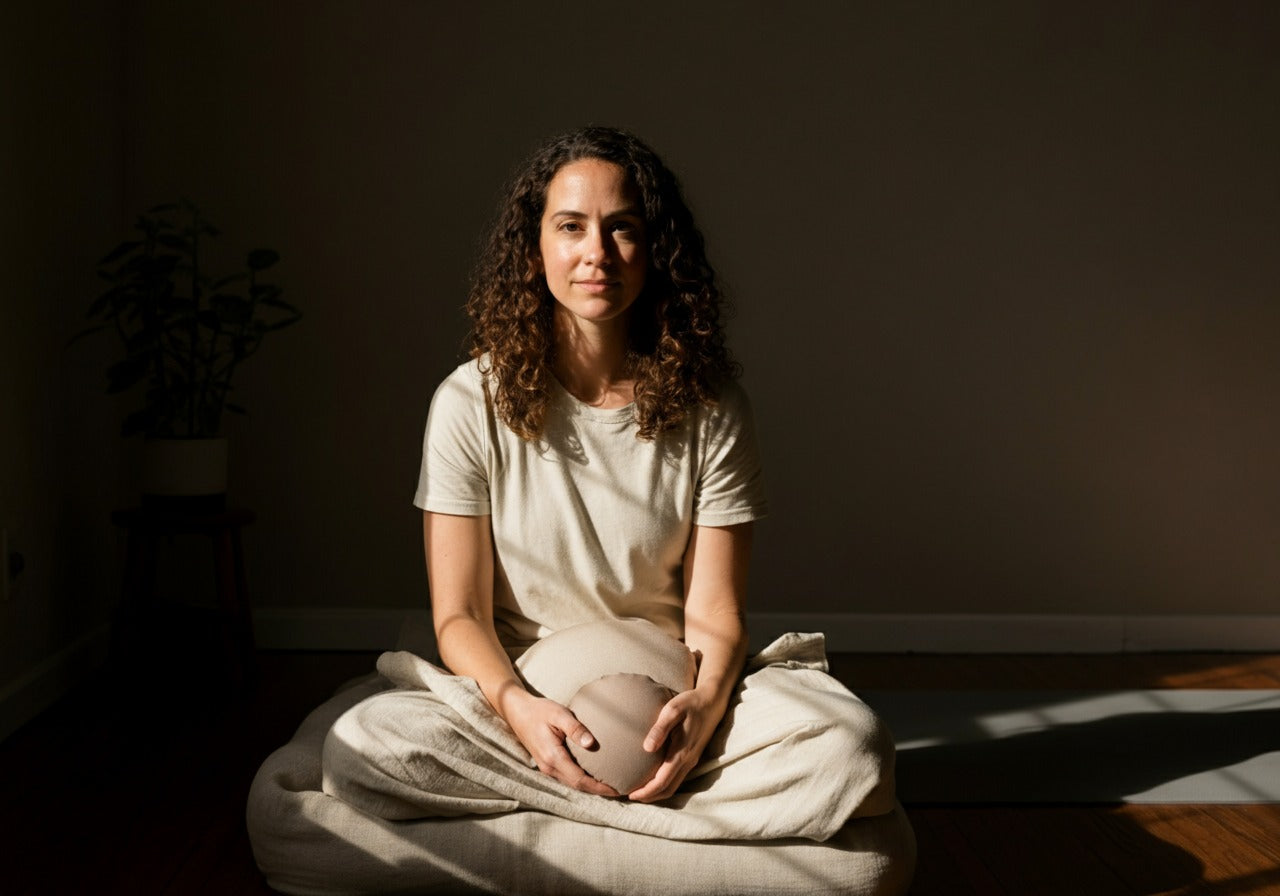
The zafu originated in Tang dynasty China (618–907 CE), where Chan Buddhist monks sat on cushions called putuan during long periods of seated meditation. When Chan Buddhism traveled to Japan and became Zen, the cushion came with it — and the word zafu (座蒲, literally "sitting rush") referred to the cattail fiber traditionally used as fill.
Today, zafus are round, firm cushions — typically 13 to 16 inches in diameter and 5 to 8 inches tall — filled with either buckwheat hulls or kapok. Buckwheat is heavier, molds slightly to your shape, and holds its form well. Kapok (a silky fiber from the Ceiba tree) is lighter and softer but compresses over time.
What a zafu does for your body: When you sit cross-legged on the floor, your hips tend to drop lower than your knees, which pulls the pelvis into a posterior tilt and rounds the lower back. A zafu lifts your hips above knee level, which allows the pelvis to tilt slightly forward. That forward tilt restores the lumbar spine's natural inward curve, reducing the muscular effort needed to stay upright. In practical terms: you can sit longer without your lower back aching.
If your main discomfort in seated meditation is in your lower back or you feel like you're fighting to stay upright — a zafu is likely what you're missing.
What Is a Zabuton?
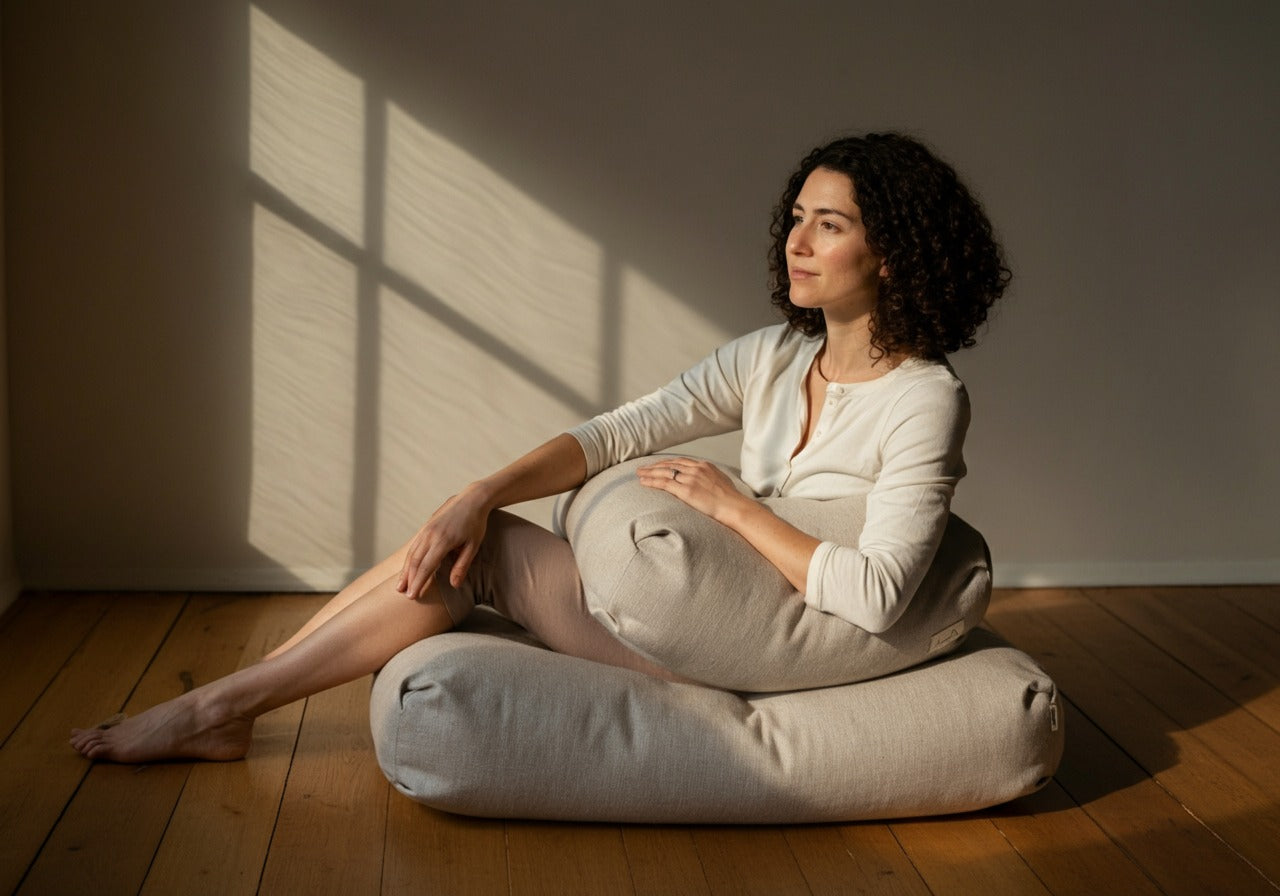
Zabuton (座布団) is a Japanese word meaning "sitting futon." It predates formal meditation practice and was historically used as general floor seating in Japanese homes. In meditation contexts, the zabuton became the standard foundation layer placed beneath the zafu.
A typical zabuton is rectangular — common sizes run from 25×31 inches (medium) to 30×34 inches (jumbo) — and about 2 to 3 inches thick. Most are filled with cotton batting, sometimes a cotton/polyester blend. Unlike the zafu, the zabuton is not meant to be firm. Its job is absorption, not lift.
What a zabuton does for your body: When you sit cross-legged, it's not just your seat that contacts the floor. Your knees, the outsides of your ankles, and your shins all press against hard ground. Over 15, 20, or 30 minutes, that pressure compounds — it creates a low-level distraction that pulls attention away from your breath or your body scan. The zabuton distributes and cushions those contact points, protecting the soft tissue around joints that aren't designed to take sustained ground pressure.
If your discomfort in meditation comes from your knees or ankles rather than your lower back — a zabuton addresses the actual problem. A taller zafu will not fix knee pain from hard flooring.
Do You Need Both?
Not automatically. Here's a realistic breakdown:
You probably need only a zafu if: - You meditate on carpet or a yoga mat, which already softens floor contact - Your knees sit comfortably close to the ground and don't feel pressure - Your main issue is staying upright without straining your back
You probably need only a zabuton if: - You sit in a kneeling (seiza) position or use a meditation bench — no hip elevation needed, but knee and shin contact is significant - Your floor is hard and your knees or ankles ache after more than a few minutes - You already have a stable seat height but want the floor layer
You may benefit from both if: - You sit cross-legged on a hard floor for 20+ minutes - You have less hip flexibility and need both the height and the floor cushioning - You're building a dedicated meditation corner and want a consistent setup
The counterintuitive part: many beginners buy a zafu and zabuton set before they've identified which problem they actually have. If you're just starting out with 10-minute sessions on a yoga mat, a zafu alone is usually enough. Get the zabuton when floor contact becomes a real issue — not as a default purchase.
How to Choose Based on Your Practice
| Zafu | Zabuton | |
|---|---|---|
| Primary purpose | Elevate hips, align spine | Cushion knees, ankles, shins |
| Shape | Round (or crescent) | Rectangular flat mat |
| Typical size | 13–16 in diameter, 5–8 in tall | 25–34 in wide, 2–3 in thick |
| Common fill | Buckwheat hulls or kapok | Cotton batting |
| Firmness | Firm | Soft/medium |
| Best for | Lower back tension, poor posture in sitting | Knee/ankle pain, hard floors, kneeling practice |
| Use alone? | Yes | Yes (especially for bench/seiza) |
On fill: Buckwheat zafus feel more supportive and adjust slightly to your body over time. Kapok zafus are softer and lighter — better if you travel with your cushion or prefer something less dense underfoot. Both are traditional. Neither is wrong.
On height: If you have tighter hips or thighs that sit higher off the floor, you'll want a taller zafu (7–8 inches). If you're more flexible and your knees naturally drop closer to the ground, a standard 5–6 inch zafu works well.
On size: A 25×31 inch zabuton fits most cross-legged positions. Go larger (30×34) if you shift position often or practice yin yoga on the same mat.
So Which Should You Buy First?
If you're staring at a "best zafu" list and just want a straight answer: for most people starting out, a single zafu is the one purchase that matters. It solves the most common problem — a lower back that fatigues from sitting — and it works on carpet, a rug, or a folded blanket underneath. Get a firm buckwheat-filled zafu at a height that matches your hips, and you're set for years.
Reach for a zafu and zabuton set only if you already know floor contact is your issue: hard floors, achy knees, longer sits, or a kneeling practice. A set isn't a better starting point — it's the answer to a specific problem. And it doesn't need to match; a zafu and zabuton from different makers sit together fine.
Where the cushion lives matters almost as much as which one you buy. Keep it out and visible — a corner of the bedroom, a spot by the window — instead of stored in a closet, and sitting down becomes a habit instead of a decision you have to remake each day. That's the same idea behind a mindful morning routine: consistency comes from removing friction, not from finding more willpower.
FAQ
Can I use a zabuton without a zafu?
Yes. This is common in seiza (kneeling) practice, where you kneel directly onto the zabuton with a meditation bench. You don't need a zafu if you're not sitting cross-legged. The zabuton is also useful on its own for yin yoga or restorative poses.
Is a zafu just a pillow?
Not quite. A zafu is specifically designed to be firm enough to hold your seated weight without collapsing, and shaped to elevate your hips while your legs extend outward. A regular pillow is too soft and too flat to provide the same support over time.
What's the difference between buckwheat and kapok fill?
Buckwheat hulls are small, dense, and hold their shape well — they don't compress much under weight, which makes them durable and supportive. Kapok is a natural plant fiber that's lighter and softer. Buckwheat zafus tend to last longer without losing height. Kapok zafus feel more plush but may need refluffing over time.
Do I need to buy a matching set?
Not necessarily. Zafus and zabutons from different brands work together fine — there's no standardized connector. A set just makes color-matching easier and often costs slightly less than buying separately.
Can I use a yoga block instead of a zafu?
A yoga block can work as a short-term solution, but it doesn't angle the hips the way a zafu does, and the flat hard surface creates pressure points under the sitting bones. If you meditate regularly, a proper zafu is worth the investment.
What should I wear while sitting?
Loose, non-restrictive clothing makes a real difference for long sitting sessions. If you're thinking through your full meditation setup, what to wear during meditation covers this in detail.
Building a meditation corner from scratch? The cushion question is just one piece — how to build a meditation corner walks through the full setup, from the floor layer to the light.
The right cushion sets up the physical conditions for a good practice — but what keeps people coming back to the cushion is rarely the cushion itself. It's the sensory cue around it. A steady flame and a familiar scent tell your nervous system, before you've taken a single breath, that this is where you settle. That's the quiet logic behind pairing a candle with meditation — and why a grounding scent like Warmth earns a place in a meditation corner. For the fuller picture of how candlelight and scent anchor a practice, Building Your Soft Glow Ritual covers the sensory side.
The same floor support carries over to lying-down practices. How to do a sound bath at home covers what to put under your hips and shoulders for a session you run yourself, along with the sound source and the timing.
Once the cushion question is sorted, the next one is usually what fills the quiet once you’re actually sitting on it. Not every session needs a teacher’s voice — sometimes what helps more is a short meditation written just for you, shaped around whatever’s actually on your mind that day instead of a generic script. Answer a few questions about how you’re feeling and which voice you’d like to hear, and an AI writes and narrates a roughly ten-minute practice that’s yours alone, delivered to your inbox.