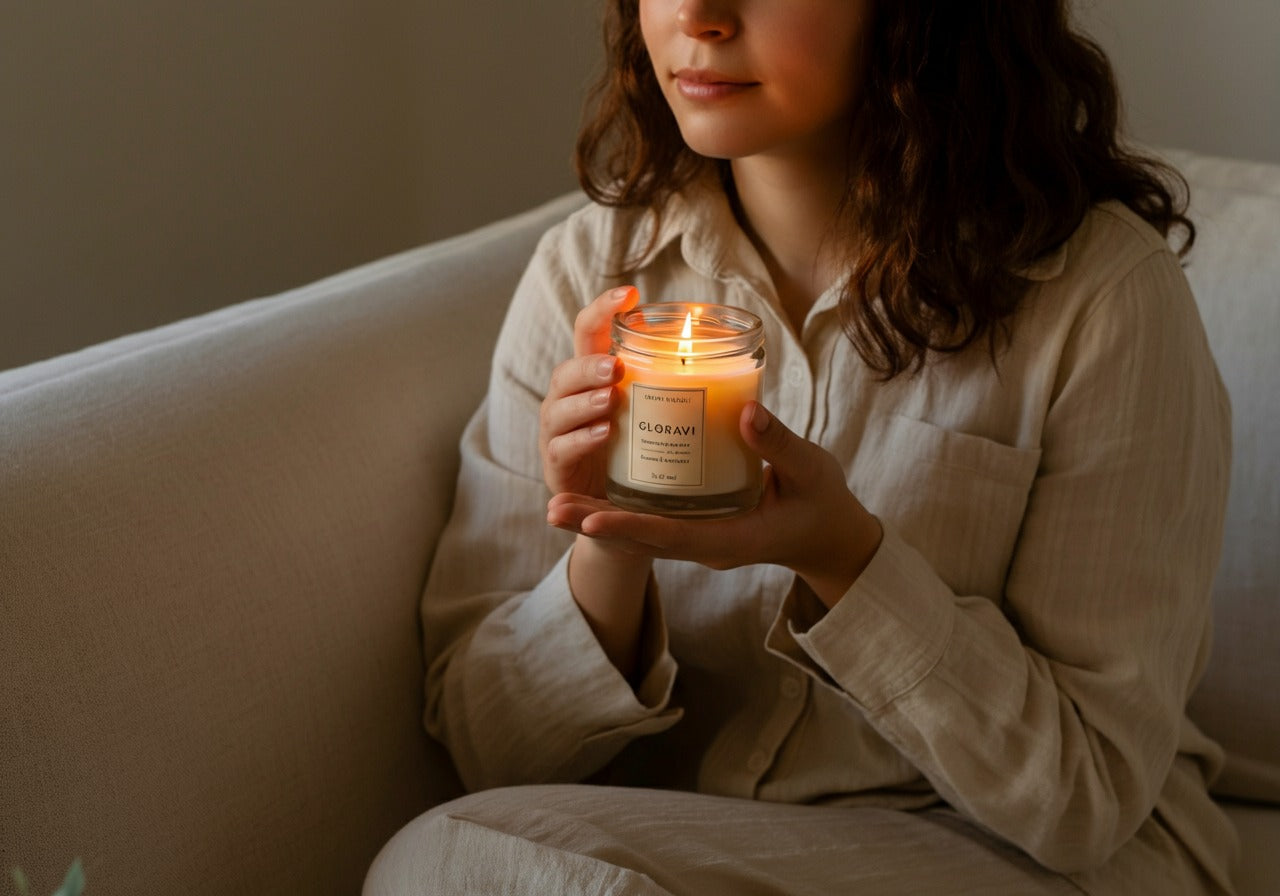
Building Your Soft Glow Ritual: How Candles Anchor Your Day — Gloravi
There are people who own candles and people who use them. The first group buys something that smells good, lights it occasionally, forgets it exists for weeks. The second group lights a candle as a signal — before a specific activity, at a specific time, in a way that has meaning outside the scent itself.
The difference isn't discipline. It's understanding what a candle actually does to your nervous system, and using that knowledge deliberately.
Your olfactory system has a direct line to the parts of your brain that manage emotion and memory. No other sense works this way. When you smell something consistently in a specific context — morning focus work, evening transition, meditation — your brain begins to encode that association. The scent becomes a cue. Eventually, the ritual of lighting it starts to produce the state you're aiming for before the scent has even spread through the room.
This is the mechanism behind the Soft Glow Ritual: three anchor points in the day where a specific candle marks a shift in state, not because of any mystical property, but because of how conditioning works.
Why Rituals Work (And Why Most People Build Them Too Large)
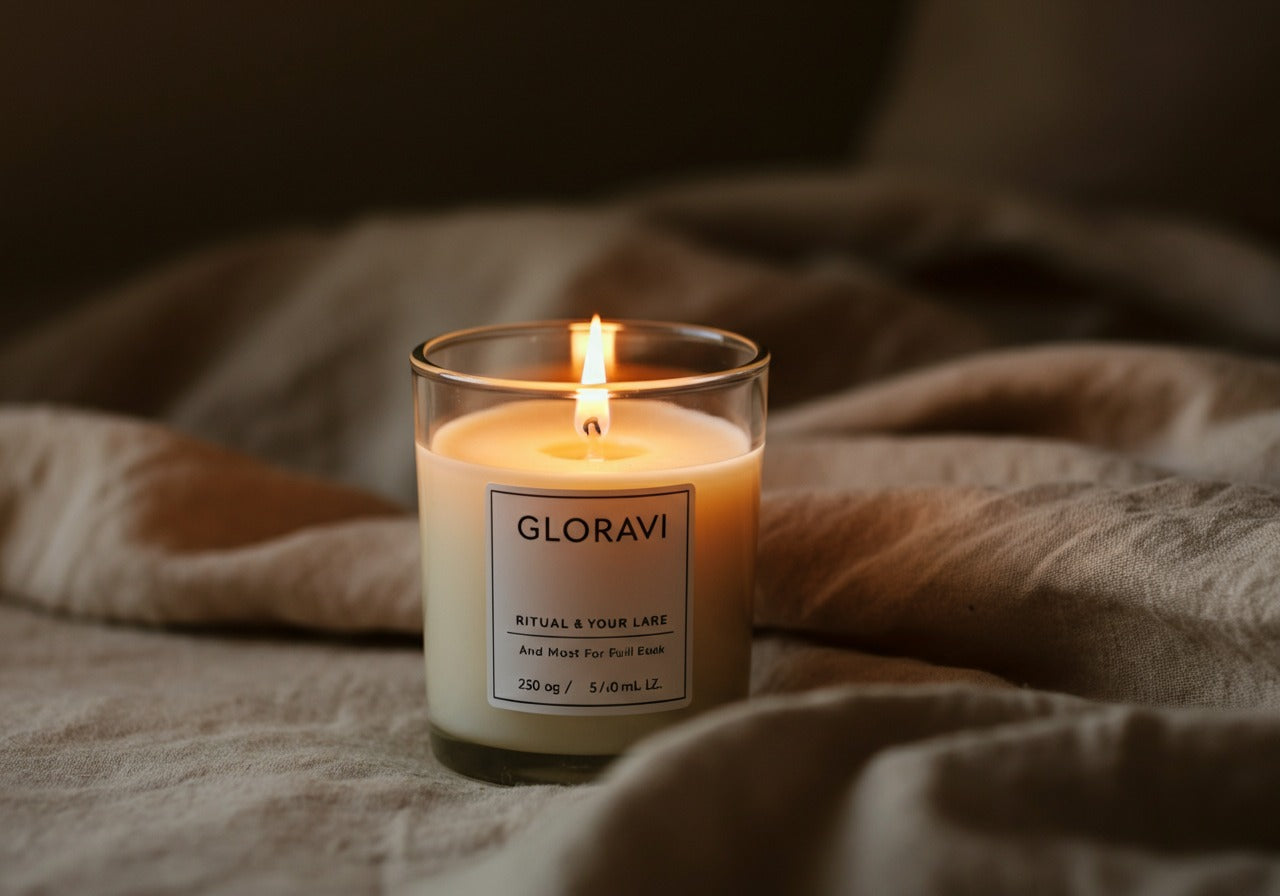
A ritual, in the neurological sense, is a repeated sequence of behavior that becomes a reliable trigger for a specific state. It works through context-dependent memory: your brain encodes the environment alongside the experience. When you recreate the environment, you partly recreate the experience. This is the same mechanism that makes meditation easier in a dedicated corner than in a new location, and why athletes have pre-game sequences.
The scent component adds something other environmental cues don't have. Smell bypasses the thalamus — the brain's central sorting station for sensory input — and connects directly to the amygdala and hippocampus. It's faster and more emotionally immediate than what you see or hear. Scent-based cues can shift your state before you've had time to think about it.
The practical implication: you don't need a long ritual. You need a consistent one. Even a thirty-second sequence — trim the wick, strike a match, take a breath — repeated in the same context, with the same scent, becomes a genuine state-transition tool over time. Ten to fourteen consistent pairings is the rough threshold for the association to establish. After that, the cue does work you didn't have to do consciously.
Most people skip rituals not because they don't have time, but because they try to build them too large. The Soft Glow framework is designed around the smallest possible version: three candle moments in a day, each lasting only as long as the activity they're attached to.
The Three Anchor Points
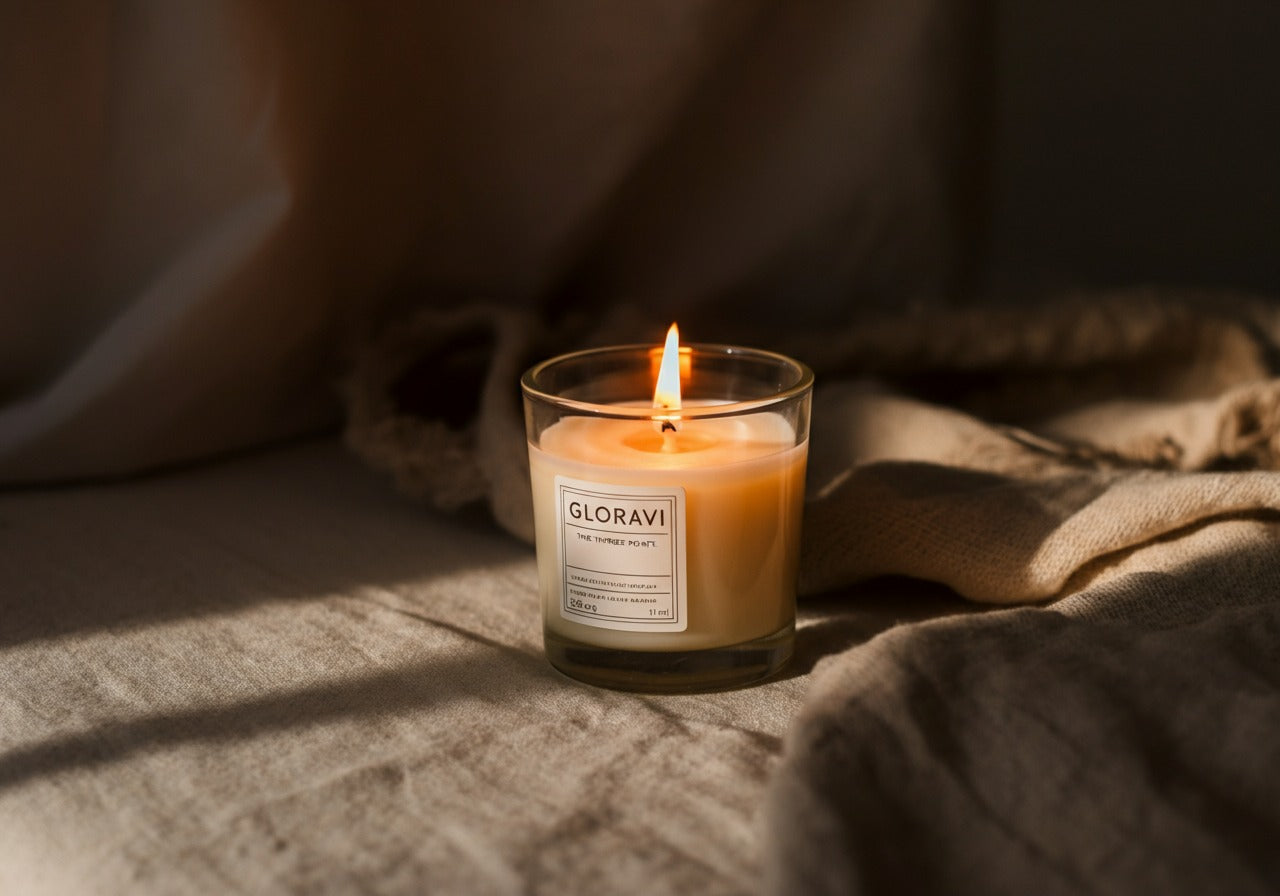
The nervous system goes through predictable state shifts during the day, whether you manage them deliberately or not. Cortisol peaks in the first hour of waking, dips in the mid-afternoon, and needs to descend before you can sleep. Most people experience three distinct registers: the alert, focused state of working hours; the transitional fog of mid-afternoon; and the decompression state that either happens or doesn't in the evening.
These three natural state shifts are where a candle ritual does the most work.
Morning: Setting the Register
The first anchor point is the beginning of whatever counts as your workday — not necessarily when you wake up, but when you begin the part of the day that requires focus. This is the moment when your nervous system needs a clear signal that the low-stimulation morning period is ending and the focused state is beginning.
A fresh, lighter scent profile works here — citrus or clean green notes that register as "beginning" rather than "performance." Light the Clarity candle before you sit down, not after you're already spinning your wheels. The ritual itself — trimming the wick, taking a moment before striking the match — creates a brief pause that helps your executive function engage.
If you have a morning routine that includes meditation or journaling, the sequence is: those practices first, then the candle when you're ready to begin work. The mindful morning routine covers the full morning framework; the candle is the sensory anchor that completes the transition.
Midday Transition: Marking the Break
The second anchor point is whatever marks the shift between work-mode and personal time — particularly relevant if you work from home, where the spatial separation between "work" and "not work" doesn't exist. This is also when most people default to scrolling — a technically passive behavior that keeps the nervous system in a mild scanning state.
A different candle than the morning one does something the room itself can't do: it signals that the context has changed. The Warmth candle works here — the softer, warmer scent profile registers as less task-oriented than Clarity. You're not trying to stimulate focus; you're trying to release it. Light it during lunch, during a walk break, or when you step away from work.
Changing what the room smells like is a genuinely fast way to change what the room feels like.
Evening: The Descent
The third anchor point is the most critical for sleep quality and the most commonly skipped. Cortisol needs to be significantly lower to initiate deep sleep; most people go from a mildly elevated state into bed and then wonder why they can't relax.
Ninety minutes before you want to be asleep is the right window. The Evening Ritual Candle Gift Set includes a candle, matches, and a wick trimmer — the full sequence of the ritual, not just the scent. That sequence matters: taking sixty seconds to prepare the candle deliberately is part of the signal. It's not the same as flicking on a lamp.
The evening candle wind-down ritual covers the full sensory protocol for this transition. The short version: same candle, same time, same brief sequence. Within two weeks, the scent begins initiating the state shift before you've settled onto the couch.
How to Build Your Own Version
The minimum viable Soft Glow Ritual has three components per anchor point.
The place — where you light it, always the same spot for each ritual — establishes the spatial context that reinforces the conditioning. The time — tied to a trigger in your existing routine — makes it a habit stack rather than a new thing to remember. The candle — consistent for each anchor point — builds the scent association.
That's the structure. You don't need to meditate while it burns, or journal, or do anything in particular. The candle is the signal, not the activity.
Where it helps to layer practices: if you already meditate, candles and meditation covers how to use a consistent scent to deepen the practice over time. For sound baths or breath work, sound bath and scent covers timing and scent logic for those sessions. And seasonal scents explains how to shift your candle choices as the year changes without breaking the associations you've built.
Using What You Already Have
The Soft Glow Ritual doesn't require three different candles before you start. It requires using whatever you have consistently.
With one candle: light it at the same time each day, in the same place. The anchor will form around whatever scent it is. The association is built by repetition, not by the specific scent family.
With two candles: assign one to morning and one to evening. The contrast — lighter in the morning, warmer at night — helps the transitions register as genuinely different.
If you're building toward three: choose your candle by how you want to feel walks through the six emotional states and which scent profiles support each. Start from what you need most right now.
The Soft Glow Ritual isn't about having the right things. It's about using what you have deliberately enough that your nervous system learns to trust the signal.
FAQ
Does the ritual only work if I do it every day?
Consistency matters, but it's not binary. Missing a day doesn't break the association. What matters most is that when you light the candle, you pair it with the same activity in the same context. Irregular use builds a weaker association, but it still builds.
Do I need separate candles for each anchor point?
Using the same candle for multiple anchor points means the scent becomes associated with multiple states — which can dilute its effectiveness as a signal for any specific one. If you're using one candle, it's better to use it consistently at one time of day. If you have two, the contrast itself is useful.
How long should I burn the candle?
Long enough to fully melt the top layer of wax — usually 30 to 45 minutes for most jar diameters. One to three hours is the standard range. The candle care guide covers burn length, wick maintenance, and how to avoid tunneling.
What if I can't smell much during cold or allergy season?
The visual component of a candle — flickering, warm-toned light — still does nervous system work even without the scent. Warm light suppresses alertness signals and activates the same parasympathetic pathways the scent would support. Don't skip the ritual; adjust your expectations about the olfactory component.
When does the conditioning actually kick in?
Most people notice, within two weeks of consistent use, that the candle begins initiating the associated state before they've settled into the activity. The nervous system starts the transition earlier because it's learned the cue. If that's not happening at two weeks, check that you're using the same scent, in the same location, paired with the same activity.
Can I use any candle for this?
Yes — the conditioning mechanism works with any candle. Consistency of scent matters more than brand. The reason to choose a clean-burning candle (plant-based wax, cotton wick, IFRA-compliant fragrance) is so that the only thing doing work is the scent — not combustion byproducts or phthalates layering in on top of the intended signal.
A ritual also makes one of the most thoughtful gifts you can give. Choosing a candle gift by the feeling someone needs shows how to hand someone a small evening practice, not just a scent.
For readers navigating perimenopause or menopause, a wind-down ritual can be an even steadier anchor. Our guide to a calming scent ritual during menopause shows how to build one honestly.
If your evenings call for something deeper than a quick reset, a warm bath and candle ritual uses heat, dim light, and scent together to tell your nervous system the day is done.
A ritual also travels well as a gift. A candle gift set that actually gets used hands someone this whole practice in a box, ready the night it arrives.
The ritual isn't separate from the rest of your day. It's the hinge that holds the parts together.