The Gentle Movement Wardrobe: What to Wear for Yin, Restorative, and Home Yoga
Gentle yoga — yin, restorative, and home practice — has entirely different clothing requirements from performance yoga, and most yoga outfit content doesn't make this distinction. Performance yoga (vinyasa, power, hot yoga) requires moisture-wicking fabrics, compression, and pieces that stay put during inversions. Gentle yoga requires almost the opposite: soft, non-constricting fabrics that don't create sensory distraction during long holds, enough coverage to stay warm as the body cools, and nothing that digs, pulls, or requires adjustment when you're in a passive position for three to ten minutes at a time.
Getting this wrong is more consequential than it sounds. Yin and restorative yoga involve holding floor poses for extended periods — the goal is to release connective tissue, down-regulate the nervous system, and cultivate stillness. Clothing that creates sensory friction (a seam pressing against the hip in reclined pigeon, a waistband that constricts during forward folds, fabric that rubs during long savasana) directly undermines what the practice is for.
The key difference: gentle yoga cools the body
The most important physical fact about yin and restorative yoga that determines what to wear: your core body temperature drops during passive practice. During active movement, the body generates heat as a by-product of muscle activity. During yin and restorative yoga — where poses are held passively for 3–10 minutes with minimal muscular engagement — no such heat is generated, and ambient cooling occurs consistently throughout the class.
This means the layering logic for gentle yoga is the opposite of performance yoga. Performance yoga starts warm and gets warmer — you shed layers as class progresses. Gentle yoga starts at room temperature and gets cooler — you need layers available to add, not remove. The end of a restorative class (savasana, extended relaxation) is reliably the coldest point, not the warmest.
Practically: arrive with more coverage than you think you'll need. Long sleeves over a base layer are standard. Socks are not unusual even in summer. A soft blanket or wrap for the final relaxation is standard practice in most yin and restorative classes, but having an outer layer to pull on is a useful backup.
The outfit formula for gentle yoga practice
Base layer
Soft, non-compressive coverage from neck to ankle. Compression leggings work for yin and restorative yoga in the sense that you can move in them, but they create passive sensory input throughout every long hold — the fabric is designed to push back against the body, and in a practice where the goal is releasing tension, that consistent pressure works against you.
What works better: soft, non-compressive bottoms with some stretch. Flared yoga pants in a smooth stretch fabric are well-suited for yin and restorative practice — the wide leg means no fabric bunching in seated and supine poses, the smooth nylon-spandex surface slides against the mat without friction, and the high waist prevents any gap or cold draft in forward folds.
For the top: any fitted or semi-fitted long-sleeve base layer that won't fall forward in downward dog or pull in side stretches. A crop top works if you layer over it; on its own, the exposed midriff in reclined poses gets cold quickly.
Mid layer
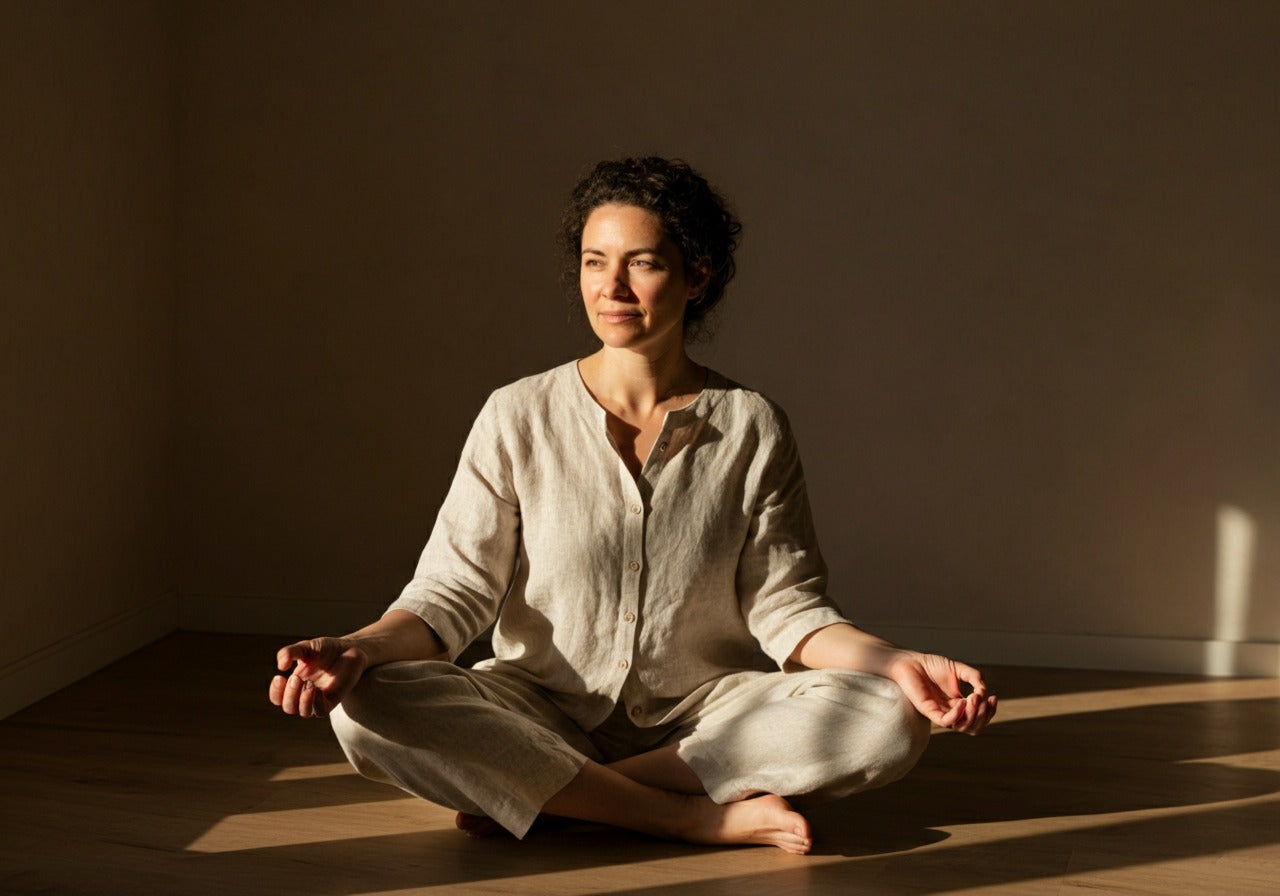
An additional soft layer for poses where you're not generating heat — which is most of them. A long-sleeve crop top and wide-leg pants set works for this as both the base and mid layer simultaneously: the long-sleeve provides coverage for cooling, and the wide-leg pants allow the extended holds in floor poses without any constriction. The matched construction means nothing gaps or pulls when the two pieces move independently.
Outer layer (for arrival and savasana)
Something you can pull on over everything else without disrupting the outfit underneath — a zip jacket rather than a pullover, or a large soft wrap, so you can add or remove it without taking the practice offline. The zip sports jacket works specifically because it goes on and off without pulling anything over your head, which matters when you're lying on a mat.
What to avoid in gentle yoga practice
Compression leggings as the only bottom layer. The compression is a feature in active yoga; it's friction in passive yoga.
Anything with a waistband that has hardware. Metal clasps, thick exposed elastic, or any structural waistband element will press against the body in supine and prone poses. Soft covered elastic or drawstring-only waistbands are what to look for.
Seams in high-contact zones. Standard garment construction places seams along the inner thigh, at the waistband, and through the seat — exactly the zones that press against the mat during yin and restorative poses. Seamless construction or flat-locked seams make a meaningful difference in passive practice in a way they don't in active practice.
Anything that requires readjustment when you move between poses. The transition from one yin pose to the next is a few seconds of conscious movement followed by several minutes of stillness. Clothing that needs pulling down, pulling up, or any other attention breaks the continuity of that practice.
Home yoga: the most flexible version
Home practice — whether that's a gentle morning stretch, ten minutes before bed, or a longer self-guided session — has no dress code whatsoever. The same principles apply (soft, non-compressive, enough coverage to stay warm), but the practical requirements are lower because you control the environment: you can adjust the room temperature, use blankets freely, and change if something isn't working.
For home practice, the most useful outfit is whatever already functions as your rest-and-recovery home outfit, assuming it has enough stretch to sit in pigeon pose. The long-sleeve set that serves as a comfortable home outfit becomes a home yoga outfit with zero additional thought — which is the real advantage of a soft movement wardrobe: it doesn't require a separate category.
For the specific question of how home yoga wear overlaps with general at-home comfort dressing, cozy outfits at home covers the principles that apply to both.
The studio-to-street consideration
Gentle yoga classes typically end slowly — no rushed exit, a gradual return to the outside world. This is an underrated advantage for outfit planning: you can arrive in and leave in the same clothes, and those clothes should work for wherever you're going next.
The formula: your practice outfit plus the zip jacket as an outer layer handles most studio-to-coffee or studio-to-errand transitions. The wide-leg silhouette of yin-appropriate pants reads as a deliberate casual choice outside the studio in a way that compression leggings don't. This is one practical reason to choose fluid-fabric wide-leg pants over compression as your default gentle yoga bottom: they're a better-looking street choice when the class is over.
For the broader question of how gentle yoga wear integrates with a daily wardrobe — including post-practice outfit considerations — outfit ideas for running errands covers the transition from movement to the rest of the day.
Frequently asked questions
Can I wear the same outfit for yin yoga and vinyasa?
Technically, but it's a compromise in both directions. Yin and restorative yoga needs non-compressive, layered softness; vinyasa needs compression and moisture management. A medium-compression legging in a moisture-wicking fabric is technically usable for both but optimal for neither. If you practice both regularly and want a single garment that works reasonably well for each, a medium-weight, medium-compression legging in a smooth nylon-spandex blend is the closest thing to a universal option.
Do I need to buy specific yoga clothes for a gentle practice?
No. Any soft, stretchy bottom with a waistband that doesn't constrict, and a long-sleeve top, covers the functional requirements of yin and restorative yoga. The specific yoga clothing industry exists largely for performance yoga, where the moisture management and compression specifications matter more. For gentle practice, good general-purpose comfortable clothing — a soft long-sleeve, non-compressive pants with some stretch — works just as well.
Why do I get cold during yin yoga even in a warm room?
Because yin and restorative yoga doesn't generate metabolic heat. During active exercise, your muscles produce heat as a by-product of work, which maintains and raises core temperature. In passive practice, this doesn't happen. Ambient room temperature (typically 19–22°C in most yoga studios) is comfortable at rest but feels cool when you're lying still on a mat for 60–90 minutes without any muscular activity. This is also why the end of a yin class — extended savasana after the poses — is reliably the coldest point: you've been cooling gradually throughout the practice, and the final stillness doesn't reverse that.
What socks, if any, for yin yoga?
Socks are entirely appropriate for yin and restorative yoga, and cold feet make stillness difficult. The main consideration: grip. Standard socks are slippery on a yoga mat. Grip socks (with rubber dots or treads on the sole) provide the warmth without the sliding. For home practice, any sock works because you can use your regular home surface rather than a mat. In a studio, grip socks are the practical choice.
Is it appropriate to wear what I'd wear at home to a gentle yoga class?
Generally yes, with two practical checks. First: does it stay put without adjustment during extended floor poses? If you'd need to pull something down or up after three minutes in supine pigeon, that's a problem in a class setting. Second: is it clean and not carrying strong scent? This matters in enclosed studio spaces where other people are practising. Beyond those two checks, the soft, comfortable home outfit and the gentle yoga outfit are functionally the same thing.
The gentle movement wardrobe is essentially a good home comfort wardrobe with two adjustments: enough coverage to stay warm as the body cools, and nothing that creates sensory friction in passive positions. The pieces that do this best also happen to be the pieces that feel best to wear throughout the rest of the day. For the specific science of how what you wear in these slower moments connects to nervous system regulation and mood, dressing for how you want to feel covers the research in full.
If you're also figuring out which style of yoga pants works best for your body shape and proportions, this fit guide to yoga pants for different body types covers rise, leg cut, and fabric in detail — useful whether you're shopping for the first time or finally replacing something that never quite worked.
If gentle movement is part of a broader stillness practice, two related guides are worth reading alongside this one. For those building a dedicated space for stillness, how to set up a meditation corner at home is a useful companion. For quieter practices, choosing the right clothes for meditation follows the same logic — comfort that disappears so your attention can go somewhere else.
If you practice mat pilates alongside yin and restorative work, the clothing logic carries over almost completely — and a few details shift. What to wear to pilates for mat work covers the floor-specific requirements: waistbands that don't dig when you're supine, fabric stretch that handles rolling movements, and why wide-leg pants work better on a mat than most guides suggest.
After a session of gentle movement, the body is already quieter than it was before. That's a good time to light a candle and let the stillness land. If you're curious about building that kind of wind-down into a consistent daily practice, building your soft glow ritual is a good place to start — it covers how to use scent as a reliable nervous-system signal at the end of an active day.