Yoga Pants for Your Body Type — The Complete Fit Guide
Choosing yoga pants that actually work for your body comes down to three things: rise height, fabric stretch direction, and leg cut. Everything else — color, pattern, brand logo — is secondary. The right pair stays in place through a forward fold, doesn't roll at the waist when you sit cross-legged, and feels like nothing once you're moving. This guide breaks down what actually matters for different body shapes, heights, and proportions, so you can stop guessing in the fitting room.
Why "Flattering" Isn't the Right Word to Optimize For
Most body type guides tell you what looks good. This one focuses on what feels good — and the two overlap more than you'd think.
The reason fit matters in yoga specifically is that your body is constantly changing shape: folding, twisting, sitting on the floor, lying flat, reaching overhead. A pair of pants that looks great standing in front of a mirror can gap at the waistband the moment you forward fold, or bunch at the inner thigh in a seated pose, or feel like it's cutting into your hip flexor during a low lunge. None of that has anything to do with your size — it has everything to do with how the garment is constructed relative to your proportions.
That said, visual balance is a real part of feeling comfortable in your own skin. Knowing which design details work with your body's natural lines — rather than against them — is genuinely useful, not vain.
Here's the framework:
- Rise — how high the waistband sits, which determines belly coverage and hip support
- Leg cut — straight, flared, or cropped, which affects how your proportions read visually
- Fabric behavior — four-way stretch vs. two-way, compression vs. soft drape
- Inseam length — especially critical for petite frames
Once you know what you need in each category, every pair of yoga pants becomes easy to evaluate.
Yoga Pants for Curvy and Plus Size Figures
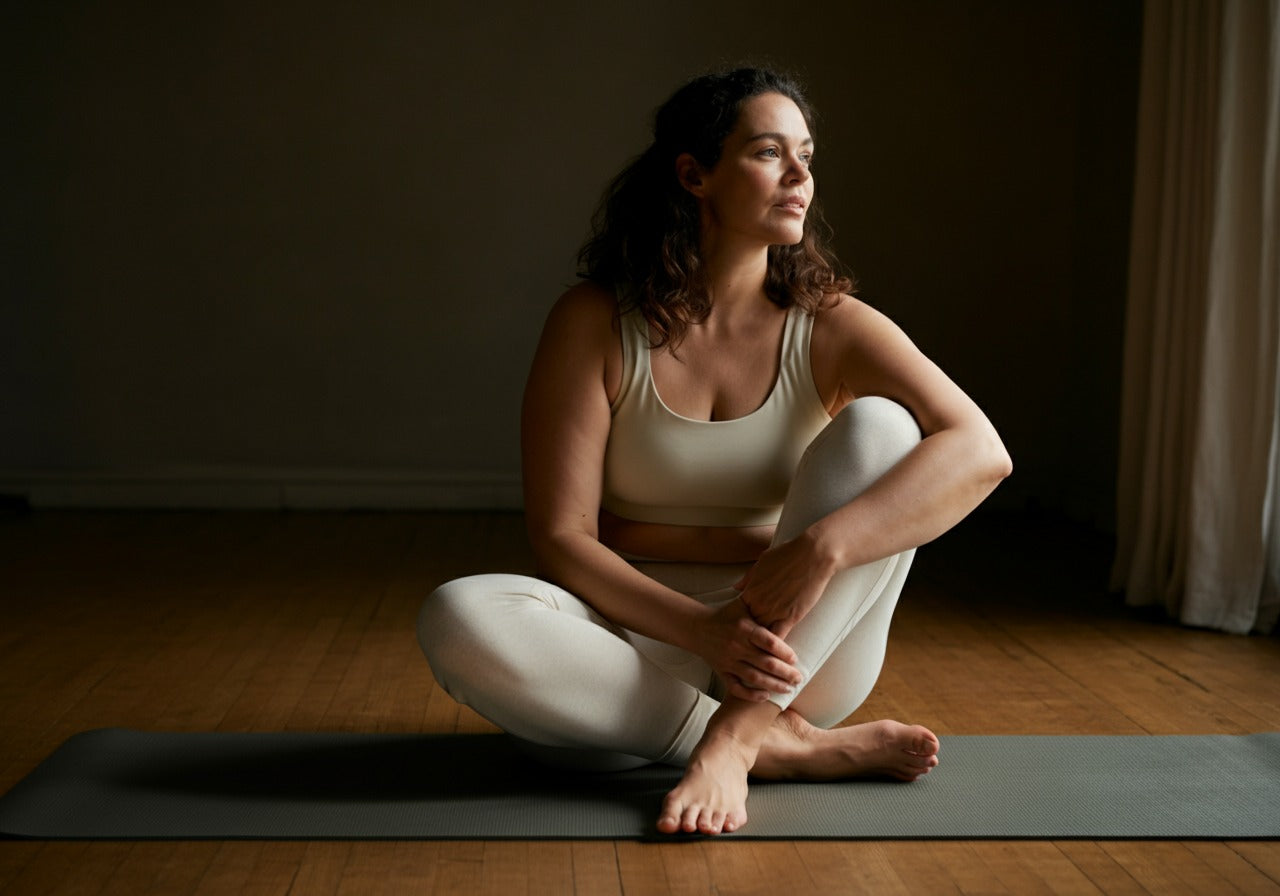
For curvy figures — whether that's full hips, a fuller midsection, or both — the single most important factor is waistband construction. A narrow elastic waistband will dig in and create an uncomfortable pressure point, especially when you're seated on the floor. What you want instead is a wide, flat-knit waistband (at least 3 inches) that distributes pressure evenly across the lower abdomen rather than concentrating it at a single point.
High-waist cut is almost always the better choice here, but not for the reason most guides give ("it holds everything in"). The real reason: a high waistband stabilizes the pants through movement. When you fold forward, bend, or twist, the waistband has enough surface area to grip and stay put. A mid-rise waistband on a curvy figure tends to roll down because the hips create outward pressure — the shorter band simply doesn't have enough contact area to anchor.
For fabric, nylon-spandex blends with four-way stretch are the practical standard — they hold their shape after washing, recover after stretching, and don't thin out in areas with more friction. What to avoid: single-direction stretch (the pants pull in one direction but resist in the other, creating that uncomfortable dragging feeling through the seat).
Leg cut for curvy figures depends on your specific proportions. If you carry more weight through the thigh and hip, a high-waist legging with full-length coverage gives you consistent compression and silhouette control from waist to ankle. If you prefer something that opens up below the knee — which draws the eye downward and creates visual length — a flared cut does this naturally without any extra effort.
Yoga Pants for Petite Women
The single biggest issue for petite women isn't rise — it's inseam length. Standard yoga pants are sized for women around 5'6"–5'8". If you're 5'2" or under, a "full-length" legging often ends mid-calf, which creates a visually choppy line that shortens the leg further.
What actually works for petite frames:
- 7/8-length in a standard size often hits at the perfect full-length point on a shorter leg (typically around a 23–25 inch inseam)
- Cropped leggings (hitting just above or below the knee) work well for studio yoga but tend to be cold for slower, floor-based practices
- High-rise cut is specifically worth prioritizing for petite bodies — it visually lengthens the leg by keeping the waistline higher, which increases the apparent leg-to-torso ratio
A flared hem also helps here. The slight flare at the ankle mirrors a slight visual elongation effect — it draws the eye toward the floor rather than stopping it abruptly at a hemline. For petite women who want both length and movement, high-stretch flared yoga pants are worth trying specifically because the flare adds visual length that standard straight-leg styles don't.
One thing that rarely gets mentioned: if you're petite and have a shorter torso, high-rise pants can feel like they're up around your ribs. In that case, look for high-rise styles with a waistband that folds down — you get the coverage without the constriction.
Yoga Pants for Hourglass and Athletic Figures
Hourglass figures — defined waist, fuller hips and chest — generally have the most flexibility in yoga pant choices, because most styles are designed with this proportional relationship in mind. The main thing to watch is the hip-to-waist ratio: if yours is significant (more than a 10–12 inch difference), you may need to size up to fit the hips and find the waistband slightly looser than intended. A wide waistband helps here because it has room to sit smoothly across the fullest point of the hip rather than gapping.
Athletic or rectangular figures — where hips, waist, and shoulders are close in width — tend to do well with any leg cut, because there's no strong visual angle to balance. Where athletic bodies often struggle with yoga pants is waistband gapping: if you have flat hips but a longer torso, pull-on waistbands can sit unevenly. Look for waistbands with some elasticity variation (often called "contoured" waistbands) that follow the body's natural curve rather than sitting straight across.
For both figures, compression leggings in a full-length cut give the most functional coverage across the range of yoga movements. The nylon-polyester-spandex construction found in most performance leggings is well-suited here — it provides enough compression to feel supportive without restricting blood flow or range of motion.
What Fabric Actually Does (and Doesn't) Do
A lot of yoga pant marketing leans heavily on fabric language — "buttery soft," "second skin," "sculpting." Here's what the fabric terms actually mean in practice:
| Fabric Behavior | What It Means |
|---|---|
| Four-way stretch | Moves with you in both directions — across and lengthwise |
| Two-way stretch | Stretches across only — can pull and resist when you fold or crouch |
| Compression | Fabric pushes inward; good for support, can feel tight for very slow or restorative yoga |
| Soft drape | Loose and flowing; comfortable for yin and floor work, less functional for active flows |
| Recovery | How well the fabric bounces back to its original shape after stretching |
Gloravi's yoga pants use a nylon/polyester/spandex construction — which is the standard for performance-oriented yoga wear. This blend has good recovery (doesn't stretch out over time), handles repeated movement without thinning, and keeps its shape wash after wash. It's not the softest fabric against bare skin compared to cotton or modal, but it holds up to the mechanical demands of yoga better than natural fiber alternatives.
For very gentle or restorative yoga, where you're mostly on the floor and fabric softness matters more than shape retention, a looser leg cut in this same fabric blend can give you both — the stretch and recovery of synthetic fabric, with the easy feel of wide-leg construction.
FAQ
Do high-waist yoga pants work for short torsos?
Yes, with a caveat. High-waist yoga pants sit above the navel — typically 3–4 inches above — which can feel restrictive if your torso is already short. Look for high-rise styles where the waistband is soft and foldable rather than structured. That way you can wear it folded down one roll for a mid-rise effect, or fully up for maximum coverage and support during active practice. The key is flexibility in how you wear it, not just the labeled rise height.
What's the best yoga pant cut for reducing hip visibility?
Dark colors and minimal seaming at the outer hip are the most effective design choices if you want to minimize the visual width of your hips. Avoid side pockets or decorative seaming at the hip — these add visual bulk to the exact area you're trying to de-emphasize. A high waistband also helps because it focuses attention on the waist rather than the hip. For leg cut, both straight and flared work; avoid tapered cuts that narrow toward the ankle, as these exaggerate the hip-to-ankle ratio.
Can plus size women wear flared yoga pants?
Yes — and for some body types, a flared cut is actually more comfortable than a fitted straight-leg style. The flare opens below the knee, which removes any compression or constriction through the lower leg. For fuller figures, a high-waist flared pant can feel more freeing than full-length compression leggings because it holds firmly at the waist (where support matters most) and gives you room to move from the knee down. The main thing to check is that the flare starts at or below the knee — a flare that starts too high reads more like a boot-cut and doesn't give the same visual effect.
How do I know if yoga pants have enough stretch for my body?
The practical test: hold the waistband at opposite sides and stretch horizontally. High-quality four-way stretch fabric should be able to stretch to roughly twice its resting width without feeling like it's fighting back. Then check the leg panel — stretch it lengthwise. If it resists significantly in either direction, the pants will likely feel restrictive during yoga movements like a deep lunge or a seated forward fold. A nylon-spandex blend with at least 20% spandex content will generally pass this test.
Are high-waist yoga pants better for core support?
Somewhat, but the effect is often overstated. A wide, high waistband creates mild intra-abdominal pressure, which gives a slight sensation of support. But it doesn't replicate the function of actual core engagement — you still need to activate your own muscles. What a high waistband does reliably is stay in place, prevent rolling during movement, and provide coverage. For most yoga practitioners, that's reason enough. The "core support" language is mostly marketing.
What should petite women look for when buying yoga pants online?
Inseam measurement is the most important spec to check — look for it in the size chart, not just the size name. For reference: a standard full-length yoga pant is typically a 28–30 inch inseam. If you're under 5'4", a 7/8-length style in a standard size (usually a 26-inch inseam) will often give you a true full-length fit. If you're under 5'2", look specifically for styles labeled "petite" or check the inseam measurement against your own — measure from the crotch seam to the floor with your preferred footwear, and subtract one inch for a clean break at the ankle.
Every body is different, and so is every yoga practice. The guidelines here give you a framework, but the best yoga pants are the ones you forget you're wearing. If you're building out a wardrobe for slower practice and gentle movement, our guide to the gentle movement wardrobe covers exactly that — what actually works for yin, restorative, and home practice. If you've been curious about how fabric choices interact with movement and comfort over time, our fabric guide covering the most common activewear materials breaks down what each one actually does.
Glow softly. Live freely.