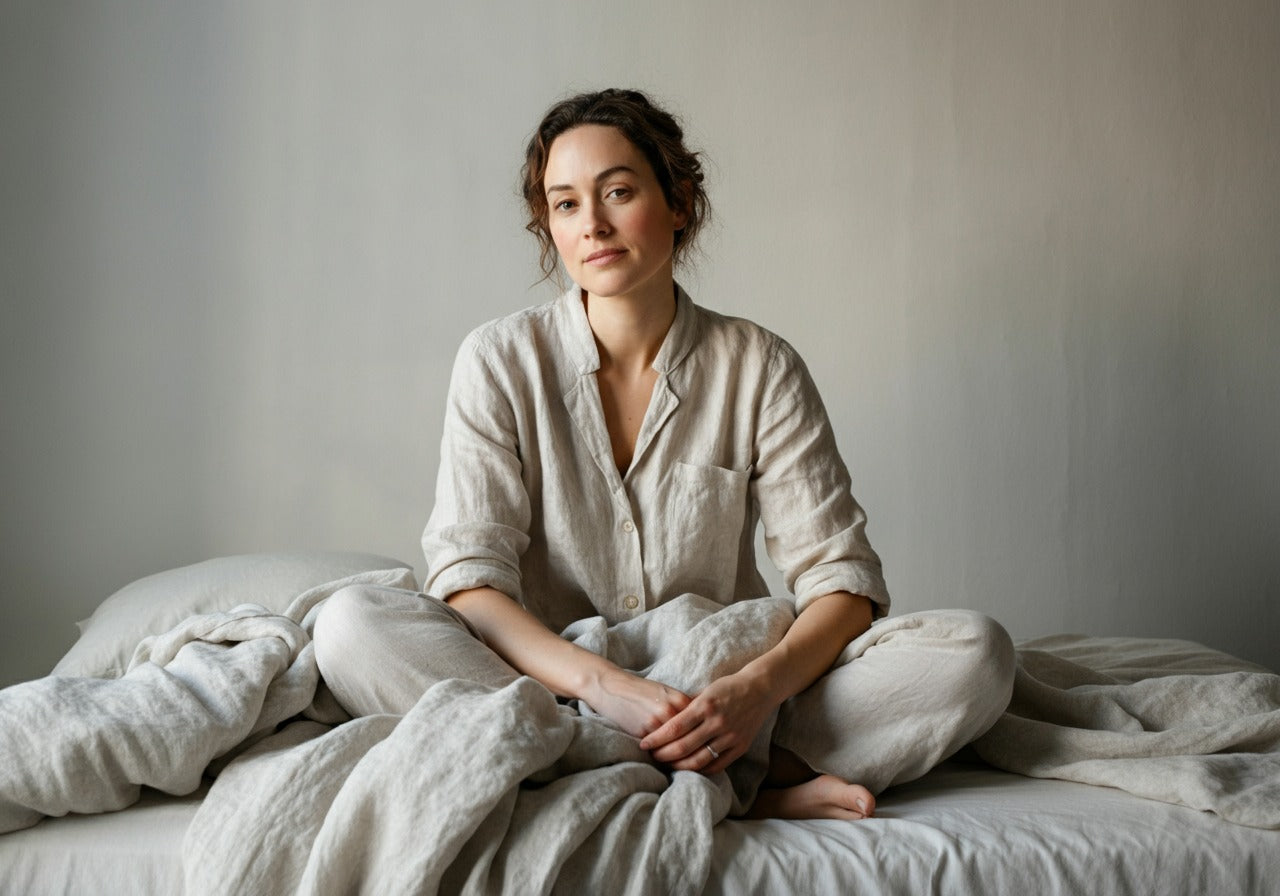
Comfortable Outfits for Women in Their 30s (That Don't Feel Like Giving Up on Style)
The most useful thing to know about dressing comfortably in your 30s is that the discomfort you're trying to solve isn't the same discomfort you were solving in your 20s. It's not just about finding cuter basics or loosening up your style. Something has actually shifted — in your body, in your daily energy, and in what you're willing to tolerate — and the wardrobe that worked before doesn't always account for that.
Comfortable outfits for women in their 30s work when they're built around what specifically changes in this decade: body composition shifts that affect fit, a narrower window of decision-making energy, and a much lower tolerance for spending hours in clothes that are subtly wrong. The outfits and principles below are designed around those realities, not a generic "dress your age" framework.
What actually changes in your 30s (and why it matters for what you wear)
Most style content for women in their 30s skips this part entirely. Here's what's actually happening.
Body composition shifts — even without weight change. From the late 20s onward, hormonal changes begin affecting where the body stores fat and how muscle distributes. Research published in the American Journal of Clinical Nutrition found that lean muscle mass begins declining at approximately 3–8% per decade from the late 20s, with fat redistribution — particularly around the midsection — occurring independently of overall weight change. This means garments that fit well in your early 20s can fit differently in your 30s even if the number on the tag is identical. It's not the body that's wrong. It's that the fit logic needs updating.
The cost of discomfort goes up. In your 20s, you could ignore a waistband that digs after four hours because you had the cognitive bandwidth to override it. By your 30s — with more competing demands on attention, less sleep, more logistical complexity — the same low-grade irritation compounds much faster. This isn't a personality change. It's a resource calculation: uncomfortable clothes are expensive in exactly the currency you have least of.
Decision fatigue is real and cumulative. Research on ego depletion (Baumeister et al.) establishes that decision-making ability degrades across the day. Women in their 30s are typically making significantly more decisions before 9am than they were at 23. A wardrobe that requires effort to style drains the same resource. This is why capsule thinking and default outfits resonate so strongly in this decade — they're cognitive load management as much as aesthetic preference.
Temperature regulation shifts. Hormonal fluctuations — which can begin as early as the early 30s in perimenopause's prodromal phase — affect core body temperature regulation. More women in their 30s report unpredictable warmth and cooling cycles throughout the day. Layering isn't just a style strategy. For many women, it's a physiological necessity.
5 principles for building comfortable 30s outfits

These aren't style rules. They're practical responses to the changes above.
1. Prioritise fit over size
Body composition changes in your 30s are often about redistribution rather than overall size increase. The issue is usually fit in specific areas — the waist, the bust, the hips — rather than needing a completely different size. Garments with built-in ease (elasticated waistbands, stretch fabrics, fluid silhouettes) handle these distribution shifts without requiring precise sizing. Rigid garments — structured denim, fitted non-stretch trousers — are the ones most likely to feel wrong even when the size technically fits.
The practical application: prioritise waistbands that don't require you to hold your breath to fasten, and fabrics with at least some stretch or drape in the areas that touch your body most closely.
2. Build default outfits, not a large wardrobe
The decision fatigue reality means that a wardrobe of 40 mediocre pieces is actively more exhausting than a wardrobe of 15 excellent ones. The goal isn't variety — it's having two or three combinations that reliably work, so that getting dressed is a single action on most days.
A practical default outfit: a base layer you love (a ribbed tank or soft long-sleeve in a neutral you wear constantly), a lower-body piece that requires no management across a full day (high-waist leggings or wide-leg soft pants in a matching tone), and a layering option for temperature variation. Pre-pair them. That's your default.
3. Solve for the full day, not the morning mirror
The outfit that looks fine at 8am and feels wrong by 2pm is a bad outfit regardless of how it photographs. The most useful question to ask about a garment is: how will this feel after six hours? Waistbands that compress, fabrics that trap heat, straps that require constant adjusting — these are problems that don't show up in the first ten minutes. Soft waistbands, natural or semi-natural fabrics, and garments that move with rather than against the body are the ones that still feel good at the end of the day.
4. Use layering as a physiological tool
If you've noticed your relationship with temperature has gotten more complicated — randomly warm, then cold, within the same hour — you're not imagining it. The layering strategy that works: a base layer in a breathable natural fabric, plus an outer layer that can be removed without making you look like you're carrying extra stuff. A zip-front jacket rather than a pullover for exactly this reason — it can go from on to off in ten seconds and be held over one arm without bulk.
5. Invest in fabric before investing in style
The shift from buying more to buying better is a 30s cliché for a reason. But the usual advice focuses on durability and cost-per-wear. The more immediately relevant reason in your 30s is sensory: when your tolerance for friction and irritation is lower, fabric quality is the factor with the most direct effect on whether you'll actually want to keep wearing something. Modal, bamboo viscose, high-grade cotton-jersey — these feel genuinely different against the skin after eight hours compared to cheap synthetics. That difference is where the money goes.
What a practical 30s comfortable wardrobe looks like
| Category | What works | What often doesn't |
|---|---|---|
| Bottoms | High-waist leggings, soft wide-leg pants, elasticated-waist trousers | Rigid denim, structured trousers with no stretch, waistbands with interior hardware |
| Tops | Ribbed tanks, seamless long-sleeves, soft knit tees in solid neutrals | Itchy knits, anything requiring constant tucking, stiff structured blouses |
| Layers | Zip-front soft jacket, drape cardigan in matching tone | Heavy pullover sweatshirts, structured blazers for daily wear |
| Sets | Matching two-piece in modal or soft knit — top and bottom paired | Mismatched separates that require coordination effort |
| Shoes | Slip-on, supportive sole, no break-in period | Anything that needs "breaking in," heels for daily wear |
Frequently asked questions
Why do clothes that fit last year feel wrong now?
Likely because of body composition redistribution rather than overall size change. Hormonal fluctuations in the late 20s and through the 30s affect where the body stores fat and how muscle distributes — independently of weight. A waistband that sat neutrally two years ago can feel constrictive now even in the same size. The fix is usually fit in specific areas (waist ease, hip ease) rather than sizing up across the board. Stretch fabrics and elasticated waistbands are not a compromise — they're the appropriate technical solution.
Is it possible to look stylish and be genuinely comfortable in your 30s?
Yes, and the tension between the two is mostly a product of 20s-era style logic — where discomfort was a semi-acceptable trade-off for looking a particular way. In your 30s, the more useful frame is: style is about the choices you make within comfort constraints, not despite them. A well-fitting ribbed set in a muted, considered colour is stylish. Wide-leg soft pants with a tucked ribbed tank is stylish. Neither requires discomfort.
How do I stop dressing like I'm still in my 20s without dressing "old"?
The shift isn't about age-appropriate rules. In your 20s, the wardrobe could be experimental, trend-driven, and high-effort because the cost of getting it wrong was low. In your 30s, the cost — in terms of how you feel across the full day — is higher. The practical update: buy slower, prioritise fabric, solve for the full day rather than the morning, and build defaults rather than maximising variety. That's a more sophisticated wardrobe, not an older one.
What colours work best for comfortable 30s outfits?
The most useful practical answer: warm neutrals and muted tones require the least coordination effort. Stone, oatmeal, soft sage, dusty blush, warm grey — these all mix and layer without visual conflict, which means less decision-making every morning. The 30s wardrobe tends naturally toward muted tones not because of any age-related rule, but because a palette of similar tones means any piece works with any other piece — the most efficient possible reduction of daily decision-making.
How many pieces do I actually need?
Less than you probably own, more than you might think in any single category. Research on decision fatigue suggests that beyond roughly twelve to fifteen well-chosen pieces for a specific life stage, additional items increase anxiety without increasing actual outfit options. The useful number is one where you can get dressed without deliberating — which for most people means two or three complete outfits per daily scenario, with enough overlap that pieces work across scenarios.
The practical reality of comfortable dressing in your 30s is that the standards have shifted — but so have the options. Better fabrics, smarter silhouettes, and a clearer sense of what a full day actually requires make this decade easier to dress for than the ones before it, once you stop using 20s-era logic to do it.
For the complete wardrobe framework covering all daily scenarios — WFH, errands, social occasions, and rest days — the comfort-first wardrobe guide covers the full system. On the days when comfortable home dressing is part of your self-care in this decade, cozy outfits at home goes into the research and the specific outfits that work. And for the broader understanding of why what you wear connects directly to how you feel — which becomes more relevant, not less, in your 30s — dressing for how you want to feel is the place to start.
If working from home is part of your routine, comfortable work-from-home outfits for women is worth a look — the same principles around ease and intention carry over.
Not sure what's already working in your closet? a step-by-step wardrobe audit for slow living helps you sort it with intention.