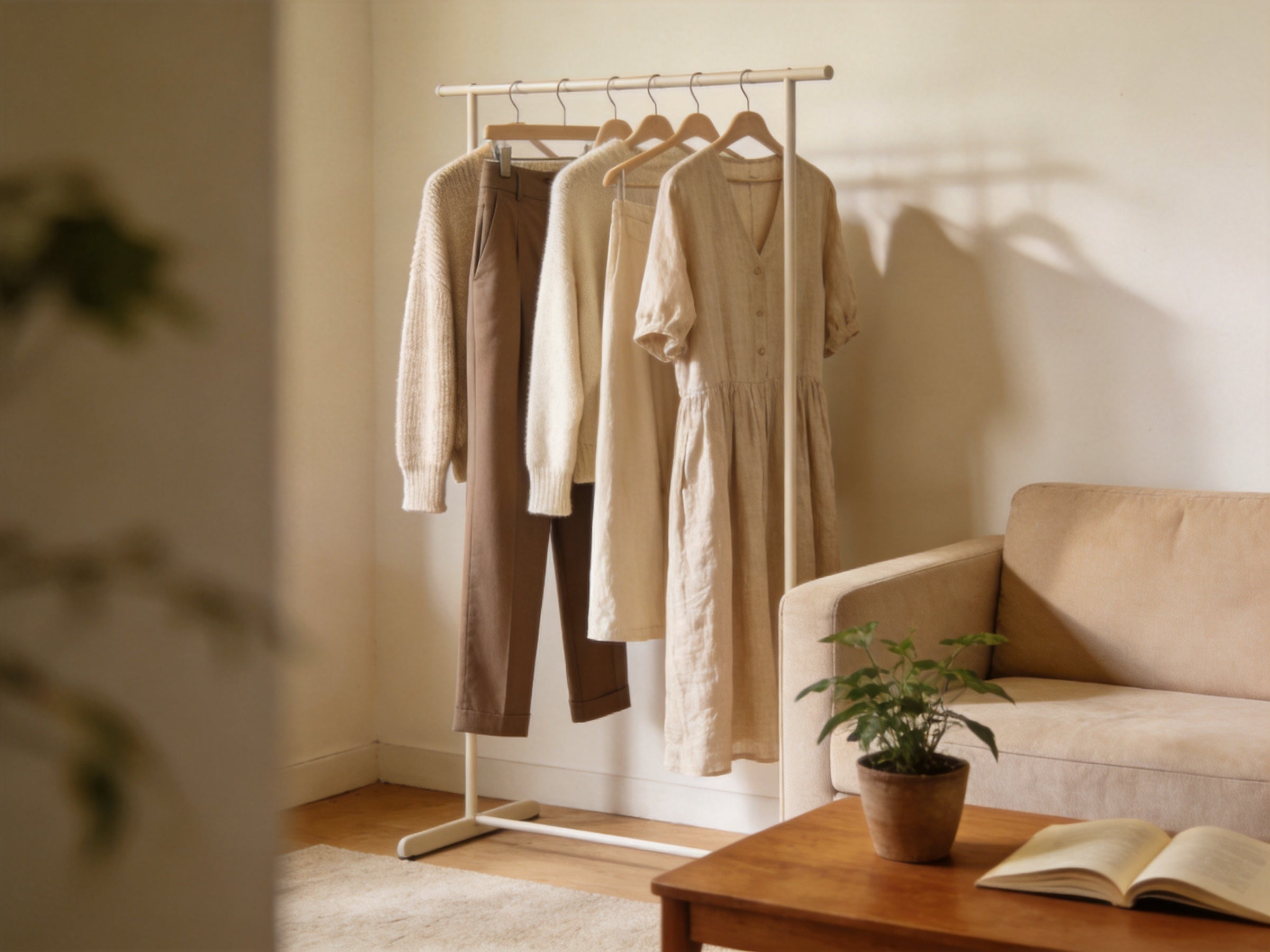
5 Steps to a Capsule Wardrobe That Complements Your Home Decor
Share
There's a particular feeling when your home and your closet are speaking the same language. You walk from the bedroom to the kitchen, and everything — the soft taupe walls, the linen-colored throw, the muted sage of the cushions — feels like one continuous exhale. A capsule wardrobe that mirrors your home's palette isn't a design project. It's just a way of making getting dressed feel as easy as settling into your favorite chair. Here are five simple moves to get there.
Step 1: Find the Palette You Already Live In
Look around the room you spend the most time in. What colors are doing the quiet work — the walls, the rugs, the mugs you keep reaching for? Those are your palette. Neutrals like cream, warm gray, and soft taupe tend to show up in spaces that feel calm, and they translate beautifully into a wardrobe that doesn't demand attention.
- Pick three or four base colors from your home and let those anchor your closet. They don't need to match exactly — just belong to the same mood.
- Notice your accent tones. A sage green throw or a dusty terracotta pot can translate directly into clothing. Our drapey wide-leg pants in sage green are one of those pieces that looks like it was pulled from your home's color story rather than a store rack.
- When every piece in your closet could sit comfortably in your living room, getting dressed stops being a decision.
Step 2: Prioritize How Fabric Feels, Not What It's Called
This is the part that gets overcomplicated. A lot of wardrobe advice tells you to reach for linen, bamboo, or cashmere — materials that sound right. But what actually matters is how something moves against your skin and holds its shape through a day at home.
- Soft stretch knits and ribbed fabrics have a quiet give to them — they move when you do, without pulling or bunching. That's the sensation worth looking for, whatever the fiber content.
- A ribbed matching set in a neutral tone has that worn-in texture that feels at home the moment you put it on — not stiff, not slippery, just settled.
- If you want to dig into what fabric terms actually mean (and which ones are marketing), the honest fabric guide is a good place to start without the usual noise.
Step 3: Build Around Pieces That Pull Double Duty
A capsule works when everything earns its spot. The pieces I keep reaching for are the ones that move between contexts without me having to think about it — from a slow morning at home to a coffee run to an afternoon working at the kitchen table.
- A good matching set is the easiest version of this. Worn together, it reads as intentional. Separated, the top goes with leggings and the pants work with a simple tank. Our matching lounge set is what I mean — it's one of those buy-once pieces that just keeps working.
- Soft ribbed tanks are the invisible foundation. In eight neutral shades, the soft ribbed tank layers under everything or works on its own when the weather shifts.
- Think about what you actually wear, not what you think you should wear. The pieces that get chosen every time are the ones worth keeping.
For more on how to build around pieces like this, the cozy capsule wardrobe guide has a framework worth reading.
Step 4: Let the Seasons Rotate Your Closet
Slow living follows natural rhythms, and your wardrobe can too. Rather than buying constantly to feel refreshed, rotating what's visible each season does most of the work.
- At the start of each season, move what you won't need to the back or into storage. What's left should be everything you want to reach for right now.
- Add one or two new pieces if something genuinely calls to you — but let it fill a gap in the palette or the layering system rather than just being a novelty.
- This rotation becomes a quiet ritual. The same way you swap out a summer throw for something heavier in October, rotating your closet keeps the space feeling tended-to.
Step 5: Let Go of What Doesn't Belong
The last step is the simplest and the hardest. A capsule that actually functions isn't about adding — it's about what you're willing to release.
- If a piece doesn't sit naturally in your palette, or you've been meaning to wear it for two seasons, it's probably not yours anymore. Let it go the same way you'd let go of a decor piece that stopped fitting the room.
- What's left should feel like a relief every time you open the closet. Fewer pieces, all of them actually you.
- A well-made soft layering sweatshirt that you wear constantly is worth more than four things you skip over.
The comfort-first wardrobe framework is where this whole approach is grounded — it's worth reading if you want the bigger picture behind why a smaller, more intentional closet actually changes how you move through your day. And if you're in your 30s and thinking about this more seriously, everyday outfits for women in their 30s has some grounded ideas that fit right in.
Frequently Asked Questions
What does it mean to match your wardrobe to your home decor?
It means curating your clothing with the same color palette, texture feeling, and general mood as your living space — so that getting dressed feels continuous with the calm you've built at home. Not a design project, just a way of making everything feel cohesive and easy. When your closet and your space are speaking the same visual language, the small friction of choosing what to wear mostly disappears.
How do I pick clothing colors that work with my home?
Start with what's already dominant in the rooms you love — your walls, your larger furniture pieces, the textiles you keep. Those are usually your neutral base. Then notice one or two accent tones that show up in smaller pieces (a pillow, a plant pot, a piece of art) and let those translate into a piece or two of clothing. The goal isn't exact matching — it's belonging to the same feeling.
Can a capsule wardrobe actually make home feel calmer?
It can, yes. When what you see in your closet shares the same soft tones and relaxed textures as your home, it removes a low-level visual tension you might not have noticed was there. A curated closet also reduces the mental weight of choosing — and that quiet ease carries into the rest of your morning.
How many pieces should a capsule wardrobe include?
There's no single right number. Somewhere between twenty and thirty-five is where most people land when they're being honest about what they actually wear. The useful question isn't how many but whether every piece earns its place — whether you'd genuinely choose it, not just tolerate it.
What should I look for in fabrics for a capsule built around comfort?
Focus on how a fabric moves and feels after a few hours of wear, not just at first touch. Soft stretch knits and ribbed fabrics tend to hold their shape without stiffness, move naturally with the body, and stay comfortable through a full day at home. For a deeper look at what fabric terms actually mean, the honest fabric guide is worth a read.
How often should I update a capsule wardrobe?
Seasonally is a natural rhythm — every three or four months, rotate what's visible and add a piece or two only if something is genuinely missing. This keeps the wardrobe feeling fresh without turning into a shopping habit. Think of it like tending your home: a small, regular adjustment rather than a complete overhaul.
Related reading
- Cozy Capsule Wardrobe
- Comfort-First Wardrobe: Everyday Outfits
- Dressing for How You Want to Feel