
The Elevated Lounge Set Guide: Styling Matching Sets from Couch to Coffee Shop
Not all matching sets read the same way. Two women wearing nearly identical two-piece lounge sets can produce completely different impressions — one looks like she put thought into getting dressed, the other looks like she forgot to change out of her pyjamas. The difference isn't the set itself. It's three specific factors: the weight and drape of the fabric, the proportion of the silhouette, and the visual coherence of everything worn together. Get those three right and a matching lounge set becomes one of the most versatile pieces in a wardrobe — something that genuinely works from a slow morning at home to a coffee with a friend to a low-key errand run, without requiring a costume change between them.
This guide covers the mechanics of elevated loungewear, the outfit formulas for each daily scenario, and the specific choices that determine whether a set reads as intentional or incidental.
What "elevated loungewear" actually means
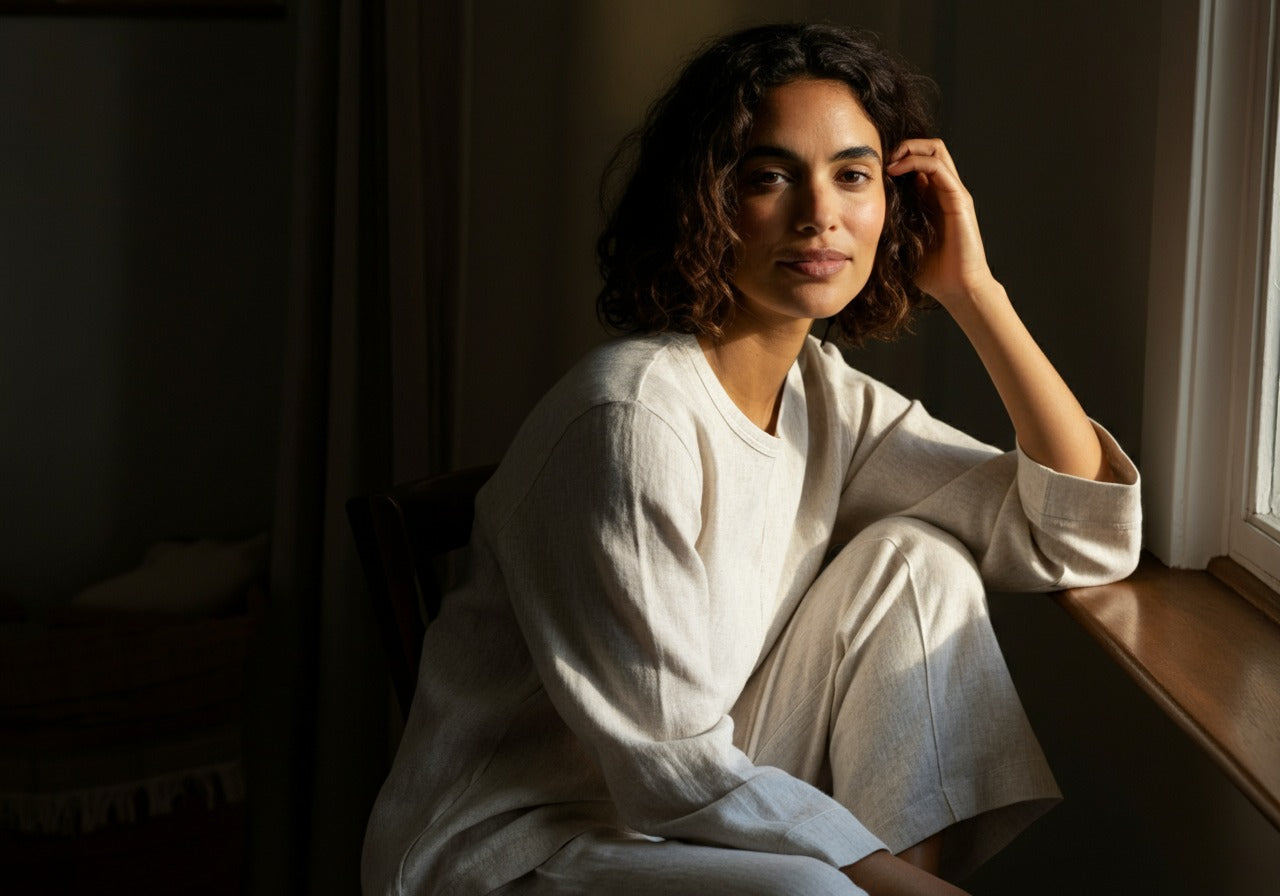
Elevated loungewear is not the same as expensive loungewear. A high-priced set in a stiff synthetic fabric can look less elevated than a well-chosen mid-range set in a good draping knit. Elevation in this context means three things:
1. The fabric does visible work. Elevated lounge fabric has either a noticeable texture (ribbed knit, waffle weave) or a noticeable drape (modal, soft viscose) that reads as intentional. Flat, featureless jersey reads as underdressed unless it's extremely well-fitted, because there's nothing for the eye to register as "this was chosen." Ribbed fabric catches light slightly; draped fabric moves. Both signal that what you're wearing has some quality to it.
2. The proportions are balanced. A lounge set elevates when the silhouette is internally coherent — when the volume of the top relates logically to the volume of the bottom. A fitted crop top with wide-leg pants works because the contrast is intentional and clear. A boxy top with wide-leg pants works because the oversized-oversized combination creates a deliberately relaxed silhouette. Where it stops working is when proportions are in conflict by accident rather than intention — an awkward hem length on a mid-rise pant, a top that's slightly too long for a high-rise bottom, a loose top with a loose bottom that together create shapelessness rather than ease.
3. The surrounding choices are consistent. A lounge set worn with shoes that match the energy of the outfit — clean slip-ons, simple sandals, low-profile sneakers — reads as elevated. The same set worn with aggressively casual footwear (beat-up slides, thick rubber slippers) reads as loungewear regardless of the quality of the set. The elevation of a matching set is co-determined by what surrounds it, not only by the set itself.
The 4-scenario styling framework
The reason lounge sets are worth investing in is their genuine cross-scenario versatility — when styled correctly, a single set covers most of a real day without requiring a change. Here's the specific formula for each context.
Scenario 1: At home (rest mode)
At home, the goal is physical ease first. The set should feel genuinely comfortable across several hours of sitting, moving around, stretching, and resting — which means no waistband that pressures, no fabric that pulls, and enough room to move in whatever position feels natural.
For this scenario, the priority in fabric is softness and breathability. A long-sleeve crop top and wide-leg pants set handles this particularly well — the wide leg allows unrestricted movement, and the long-sleeve top provides the gentle covered feeling that many people find easier to properly rest in compared to a sleeveless or crop-heavy option. The matching construction means the outfit requires no decisions once you've put it on.
For the specific research on why your home outfit affects more than just physical comfort — including the psychological context-switch mechanism — cozy outfits at home that don't look like you've given up covers it in detail.
Scenario 2: Coffee / casual social
This is where the elevated lounge set does its most interesting work. The goal is to look like you made a deliberate choice without it looking like you made an effort. The formula:
- A set with visible texture — ribbed knit is the most reliable option because it reads as intentional in a way that flat jersey doesn't, even in the same colour and silhouette
- A muted, considered colour — not because bold colours don't work, but because muted tones in the warm neutral range (taupe, cloud, dusty stone) don't require any other element to look complete
- One clear accessory — a bag that can stand on its own, simple earrings, or clean minimal shoes. One thing, not several
The ribbed 2-piece set with crop top and high-rise flared pants is built for this scenario specifically: the ribbed texture does the visual work, the flared pant creates a silhouette that reads as outfit rather than loungewear, and the colour options (Cloud, Cocoon, Taupe, Black) all sit in the range that works without accessories to finish the look.
Scenario 3: Errands and outside the house
Errands require the most from a lounge set because you're moving between environments and potentially interacting with people you didn't expect to see. The elevation formula here adds a layer:
- The set as a base — any of the above
- A zip jacket or longer outer layer in a complementary tone, worn open rather than zipped. Open layering reads as intentional styling; fully zipped reads as you were cold
- Shoes with a slightly cleaner profile than pure slip-ons: a leather-look flat, a simple clean sneaker, or a low mule
The layer is doing most of the transitional work. The same soft set that reads as home wear becomes a considered outfit the moment there's a deliberate outer layer over it — because the combination signals "I chose this" rather than "I grabbed something."
For the specific formulas that handle movement, temperature variation, and the unexpected social encounter on errands, outfit ideas for running errands has the full breakdown.
Scenario 4: Slow Sunday / intentional ease
This is the scenario where a lounge set can be the main event rather than the base layer — where the goal is a specific aesthetic of intentional relaxation rather than functional comfort. The crop tee and wide-leg lounge set is designed for this register specifically: the relaxed crop tee adds a deliberate styling element that reads as considered, the wide-leg silhouette creates graceful movement, and the drape of the fabric means the outfit looks better in motion than static — which is the quality that makes a slow morning feel like an aesthetic choice rather than a default.
For this scenario: minimal shoes or bare feet, one small accessory, natural lighting if possible. The whole point is that it looks effortless, which requires that the pieces themselves do the work.
The 3 choices that determine whether a set reads as elevated
These apply across all scenarios and all sets.
Colour coherence over colour matching. A matching set in the same colour is automatically coherent, but it can still fall flat if the surrounding elements are in conflicting colour temperatures. Warm-toned sets (cream, taupe, oatmeal, sage) work best with warm-toned shoes and accessories (tan, camel, warm white, natural materials). Cool-toned sets (slate, dusty blue, cool grey, off-white) work best with cool or neutral-toned surroundings. Mixing colour temperatures — a warm-toned set with cool-grey shoes — creates low-level visual friction that reads as slightly off without most people being able to identify why.
Fabric weight appropriate to the silhouette. Wide-leg and flared silhouettes need fabric with enough drape to fall cleanly — lightweight knits and fluid fabrics work; stiff or structured fabrics create a shape that holds rather than flows, which looks wrong in these silhouettes. Fitted or ribbed silhouettes can handle more structure — ribbed knit holds its shape and creates the definition the silhouette needs. Matching fabric weight to silhouette is what separates a set that looks like it was designed well from one that looks like two pieces that happen to be the same colour.
One elevated detail per outfit, not several. The common mistake with lounge set styling is over-elevating — adding a structured bag, statement earrings, a belt, and specific shoes simultaneously. This creates visual noise that works against the effortless quality that makes elevated loungewear interesting in the first place. One elevated detail — a good bag, or specific earrings, or considered shoes — is the ceiling. Everything else should be quiet.
What to look for when buying a lounge set
| Factor | What works | What doesn't |
|---|---|---|
| Fabric | Ribbed knit, modal, bamboo viscose, soft stretch jersey | Stiff polyester, pilling-prone synthetics, fabrics that trap heat |
| Waistband | Soft elasticated, covered elastic, no internal boning | Exposed elastic, anything with hardware, waistbands that compress |
| Silhouette | Clear proportion contrast (fitted top / wide bottom, or both relaxed) | Accidental mid-ground proportions where nothing is intentional |
| Colour | Muted solids in warm or cool neutral families | High-saturation colours or bold prints for cross-scenario wear |
| Construction | Clean seams, consistent fabric weight throughout the set | Different fabric weights in top and bottom of the same set |
Frequently asked questions
Can I wear a matching lounge set outside the house?
Yes, with the right set and the right styling. The sets that work outside are those with visible texture (ribbed, waffle, or structured knit) or a clear drape quality (modal, fluid viscose) — these read as outfits in outdoor contexts where flat jersey wouldn't. The styling element that makes the biggest difference is footwear: clean slip-ons, simple leather flats, or low-profile sneakers shift the reading from "loungewear outside" to "elevated casual."
How do I stop a matching set from looking like pyjamas?
Three things: fabric, proportion, and context. Pyjama-adjacent sets tend to be in flat, featureless jersey with straight-cut proportions and nothing to differentiate them visually. An elevated set has either texture or drape, proportions that create an intentional silhouette, and is worn with at least one non-home element (shoes designed for outdoor wear, a bag, or an outer layer). Any one of these alone is insufficient — all three together read clearly as a considered outfit.
Are matching lounge sets worth buying over mixing separates?
For simplicity and cross-scenario versatility, yes. The main advantage of a set over separates is that the colour coordination and proportion problem is solved at the design stage — you never have to work out if the top goes with the bottom. This means you're making one decision (which set) rather than several (which top, which bottom, do they work together), which is a genuine daily quality-of-life improvement. The case for separates is flexibility: pieces that work in multiple combinations give you more variation from fewer garments. Both approaches work; they optimise for different things.
What colours are most versatile for a lounge set?
For cross-scenario versatility, warm neutrals outperform everything else: taupe, cloud, oatmeal, soft stone, cream, warm grey. These tones work at home, in social settings, and on errands without requiring specific accessories or shoes to complete the look. Black is the most versatile in absolute terms but reads differently depending on context — more considered in some settings, more athletic in others. Muted dusty tones (dusty sage, dusty blush, slate blue) are the most visually interesting option while remaining easy to wear.
If you want a closer look at how to pick a set that works across your whole day — not just at home — this guide to comfortable matching sets for lounging and living covers fabric performance, fit frameworks, and three styling scenarios in detail.
Elevated loungewear works because it removes the question of what to wear while still giving the day a sense of intention. For the specific question of what makes loungewear read as put-together rather than casual — the five styling rules that apply regardless of which set you're wearing — loungewear that looks put together covers the practical framework in detail. And on the days when comfortable home dressing connects to something more intentional — when what you wear is part of how you take care of yourself — dressing for how you want to feel covers the broader relationship between clothing and mood.
For a specific Sunday use case — days that are deliberately slow and unhurried — 5 slow Sunday outfits covers complete outfit concepts built for that pace.
If you're still deciding which set to buy before thinking about how to style it, a buying-decision framework covering fabric, fit, and proportion walks through the signals that separate a set you'll actually wear from one that ends up unworn.
Once you have built a set you love, the next question is wearing it beyond the couch. How to style a lounge set to wear out of the house covers the one-swap system that takes a matching set from sofa to street.
Before you add another set to the rotation, it helps to know whether it will actually earn its place. Whether a matching set is worth it comes down to a simple cost-per-wear test.