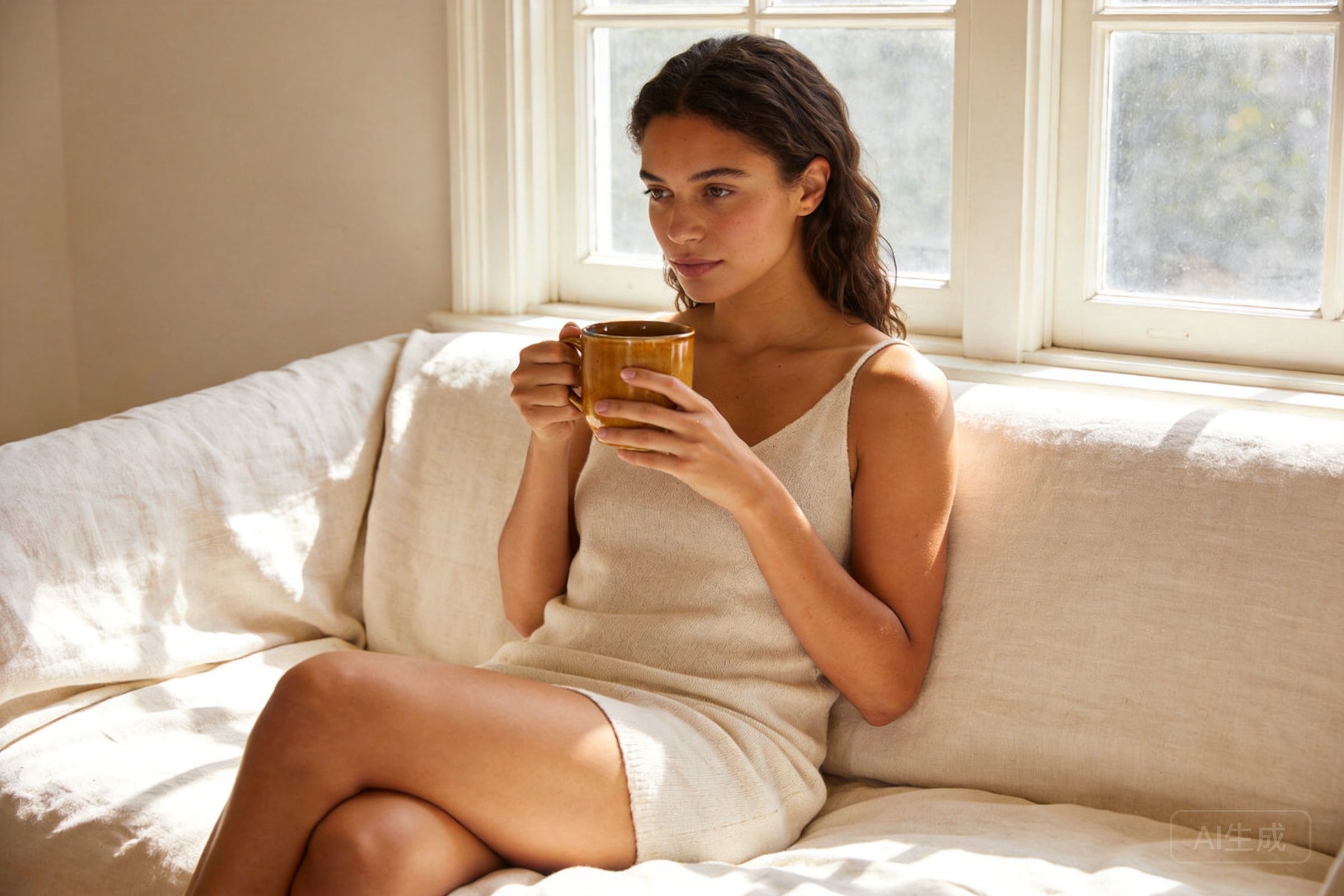
Why Some Loungewear Looks Effortless (and Some Doesn't)
Two people put on a lounge set. One looks like she got dressed with intention. The other looks like she's still deciding whether to get up. The sets might be similar in price, similar in fabric, even similar in color. So what's different?
It's not magic, and it's not really about taste. It comes down to three visual signals that your brain reads almost instantly — before you've consciously registered anything. Fit, proportion, and color story. When those three are right, loungewear reads as put together. When one is off, the whole thing shifts.
Here's how each one works — and how to choose loungewear where all three are working for you, not against you.
The 3 Signals Your Brain Reads in the First Second
Visual perception research has consistently shown that the human brain processes overall silhouette and color before it registers individual details. In dress contexts, this means first impressions happen at the level of shape and tone, not at the level of fabric quality or specific pieces.
The three signals that drive that first read:
- Fit — does the fabric follow your body, or is it fighting it?
- Proportion — is there a clear relationship between the top and bottom silhouette?
- Color story — do the pieces look like they belong together, or like they're coincidentally similar?
Getting all three right doesn't require buying expensive pieces or spending time on styling. It mostly requires knowing what to look for before you buy.
Signal 1: Fit — Why "Comfortable" and "Shapeless" Feel Different
This is where most loungewear goes wrong. The instinct is to go as loose as possible — maximum comfort, maximum ease. But there's a difference between a relaxed fit (still has shape) and a shapeless one (fabric has given up on your body entirely).
The distinction comes down to whether the fabric does any work. A well-fitted lounge top should skim — it touches the body at the shoulder, the bust, and the waist, but doesn't compress. A shapeless top hovers around all of those points without landing anywhere. The first reads as chosen; the second reads as something grabbed.
For bottoms, fit means the waistband sits where it's meant to sit, and the leg has a consistent silhouette — either fitted through the leg, or wide-leg with enough structure in the fabric that it holds its shape rather than collapsing. The problem with many budget lounge pants is that they use fabric with low spandex content, which loses shape quickly and starts to look formless by mid-morning.
The practical rule: a lounge set should fit as if it was cut for your specific body, not as if it was cut to fit everyone generally. That requires trying things on — or buying from brands that show actual body-realistic fit photography, not just flat shots or hanger photos.
Signal 2: Proportion — The Ratio That Makes Lounge Sets Read as Intentional
Even with good fit on each piece, proportion is what makes an outfit cohere. Proportion is the relationship between your top and your bottom: how much visual weight each carries, and whether they balance.
The combination that consistently reads as most put-together in loungewear is a fitted or slightly cropped top with a wider-leg bottom. This is the crop-and-flare proportion. It works because it creates a clear visual contrast — the eye sees a defined top half and a relaxed bottom half — and that contrast reads as intentional, even in soft fabric.
The combination that tends to fail is loose top and loose bottom. When both pieces have the same amount of visual weight and similar silhouette, the brain doesn't register a relationship between them. They look like two separate things happening at once rather than one outfit.
A few working pairs: - Fitted ribbed crop + high-waist flared pants: the classic. Clear contrast, visually complete. - Boxy crop tee + wide-leg pants: works when the tee has enough structure not to drape. A wide-leg set where the tee has real shape gets this right. - Cropped long-sleeve + straight or flared wide-leg: very versatile, handles both movement and static wearing. For how this plays out in actual outfit combinations, five slow Sunday outfits shows the proportion logic across different day types.
What usually doesn't work: oversized sweatshirt with wide-leg joggers in the same relaxed fabric. Both pieces are pulling in the same direction — and that direction is "unresolved."
Signal 3: Color Story — Why One Color Always Beats Two Close Colors
This is the subtlest signal, and also the easiest to get right once you understand it.
A matching set — same color, same dye lot — will always read as more intentional than two pieces in similar but not identical shades. The reason is that the brain reads the matching tonal pair as a decision. Even if neither piece is particularly special, the visual unity says "this was chosen together." Two pieces in close-but-not-matching shades say "these were both bought at different times and are approximately the same color."
The same principle extends to color mixing: when you're wearing two different colors in a lounge outfit, the cleaner the contrast, the more intentional it reads. A light top and dark bottom has clear logic. A medium-toned top and a slightly different medium-toned bottom reads as unresolved.
Practical notes: - Matching sets remove this entirely — buy both pieces at once, same dye lot, done. - Mixed separates work best when there's a clear tonal logic: very light + very neutral, or one neutral + one soft color. - Pattern mixing only works if there's a scale difference and a shared color (which is why it's rarely worth attempting in loungewear, where the whole point is low effort).
How to Apply All Three Without Thinking About It
The good news: you don't have to assess fit, proportion, and color story consciously every time you get dressed. You do it once at the point of purchase, and then the outfit handles itself.
When choosing a lounge set, run through three questions:
On fit: When you put on the top, does it sit at the shoulder and skim at the waist? When you put on the bottom, does the waistband stay where it started after twenty minutes? If yes to both, fit is working.
On proportion: Is there visible contrast between how the top and bottom fit on your body? If both pieces have similar silhouettes, look for a different pair where one is clearly closer-cut and one is clearly relaxed.
On color: If it's a matching set, you're done — one decision made. If you're buying separates, check whether the colors have a clear relationship: same color family, or clean contrast. Avoid pieces that are close but not quite matching. For a deeper look at how matching sets perform across a full week, comfortable matching sets for lounging and living covers fabric, fit, and styling across different use cases.
A ribbed two-piece with a crop top and high-waist flared pants handles all three automatically: the fit is built in, the proportion is clear, and the matching construction means the color is sorted. That's why this silhouette — in its various forms — is consistently the format that makes loungewear read as effortless.
FAQ
How do I make loungewear look more put together?
Start with proportion. A fitted or cropped top with wide-leg pants creates a clear visual relationship between your top and bottom half — and that's what makes an outfit read as intentional rather than incidental. After that, make sure the fit is doing something: the top should skim, not float, and the pants should have enough spandex to hold their shape. A matching set handles all of this in one purchase.
Why does my lounge set look sloppy?
Usually one of three things. First, fit: fabric that's too loose relative to your body doesn't register as a silhouette. Second, proportion: if both pieces are similarly loose, there's no contrast for the eye to read. Third, fabric condition: lounge sets that have stretched out or pilled at the seams stop looking intentional regardless of their original quality. Most nylon/spandex blends hold shape well; modal and bamboo blends stretch out faster, especially at the waistband and knees.
Does loungewear have to match to look put together?
No, but it needs a clear color logic. A matching set is the easiest version because the decision is already made. Mixed separates can work — a warm neutral bottom with a slightly lighter top in the same color family, or a clean dark-and-light contrast — but two pieces in similar but not identical tones tend to look unintentional.
What's the best fabric for loungewear that holds its shape?
Nylon or polyester/spandex blends. The spandex content (usually 15-30%) is what maintains shape through a full day of wearing, washing, and wearing again. Modal and bamboo feel softer initially but tend to lose structure faster — especially at waistbands and around the knees. If you want loungewear that looks the same at 6 p.m. as it did at 7 a.m., spandex-blend construction is the practical choice.
Can lounge sets work outside the house?
Yes, when proportion and fit are doing their job. A ribbed matching set with a cropped top and flared pants reads as a deliberate outfit, not as sleepwear. The signals that make it work outside: no visible stretch-out at the waistband or knees, a clear silhouette contrast between top and bottom, and a clean shoe instead of a slipper. The outfit handles the rest.
If you want to go further — how many sets to own, which styles carry the most of your week, and how to build a lounge wardrobe that works for every version of your day at home — the full guide to elevated lounge sets is where to start.
If the goal is wearing that put-together loungewear out in the world, how to style a lounge set to wear out of the house gives you the simple sofa-to-street system.
Glow softly. Live freely.