How to Choose a Lounge Set That Feels as Good as It Looks
You've scrolled past dozens of lounge sets and they all look soft and comfortable in the photos. Then you order one, try it on, and something's off — the waistband rolls, the top gaps, or the fabric feels thin in a way that doesn't photograph. Most lounge set buying advice skips the decision part entirely and jumps straight to "how to style it." This guide starts earlier, with how to choose loungewear that looks put together before it ever reaches your closet.
The short answer: look for four-way stretch fabric with at least 10% spandex content, a waistband that lies flat without internal boning, and proportions where one piece is fitted and the other has volume. Get those three right, and the set will do the rest.
Why Most Lounge Set Advice Misses the Point
Search "loungewear tips" and you'll find styling articles — how to add a blazer, which sneaker to pair with wide-leg pants, how to layer a set for fall. That's useful once you already own something that works. But the harder question, and the one most guides skip, is how to know which set to buy in the first place.
The difference matters because fabric and fit decisions are permanent. You can't style your way out of a waistband that cuts into you by 2pm, or a top that goes sheer under bathroom lighting, or pants that lose their shape after three washes. Those are structural problems, and they happen before you ever think about what shoes to wear.
A 2022 study published in the journal Clothing and Textiles Research found that fit was the single most influential factor in consumer satisfaction with activewear and athleisure purchases — ahead of color, price, or brand. The sets that end up at the back of a drawer almost always got there because of fit, not styling.
The Decision Framework: 4 Things to Evaluate Before You Buy
1. Fabric — What the Label Is Actually Telling You
Fabric names are marketing. "Buttery soft" is a feeling in the moment; what matters is whether the set still feels and looks the same six months later.
The most useful thing to look for is spandex content. Sets with less than 8% spandex lose their shape quickly — the waistband stretches, the leg opening widens, the ribbing goes slack. Sets with 10–20% spandex retain structure through extended wear and wash cycles. Four-way stretch (the fabric moves both horizontally and vertically) is what you want for any set you plan to wear for more than a couple hours.
Here's how the main fabric types compare for all-day wear:
| Fabric Blend | Stretch | Shape After 50 Washes | Best If You... |
|---|---|---|---|
| Nylon/Spandex | Four-way, high | Excellent — holds original shape | Want the set to last and perform through movement |
| Polyester/Spandex | Four-way, high | Very good — slight pilling possible | Want all-day structure at a lower price |
| Modal/Spandex | Two-way, moderate | Moderate — stretches out over time | Prioritize initial softness over longevity |
| Bamboo Viscose | Low to moderate | Lower — pills with repeated wear | Wear sets lightly and wash infrequently |
| Cotton/Spandex | Two-way, moderate | Good — breathable but can shrink | Live somewhere warm and want breathability |
The honest note: most lounge sets that hold up over time — including expensive ones — use a nylon or polyester/spandex blend, because it genuinely outperforms natural-fiber blends at shape retention. Modal and bamboo feel incredible the first time you put them on. Nylon/spandex feels the same on the fiftieth wear.
If a product listing doesn't show the fiber percentage, that's worth pausing on.
2. Fit — The Difference Between Relaxed and Shapeless
There's a version of "comfortable" that looks intentional and a version that looks like you gave up. The difference is whether the fabric does any work.
A well-fitting lounge top skims the body — it touches the shoulder, the bust, and the waist without compressing any of them. A shapeless top hovers near all of those points without actually landing. The first reads as chosen. The second reads as something grabbed because it was there.
For bottoms, the key question is whether the waistband sits where it's supposed to sit, and stays there. Internal elastic casings without a drawstring tend to roll after two or three hours of wear. Look for either:
- A wide flat waistband with internal grip (nylon-backed elastic) — stays put without constant readjusting
- A drawstring with a flat-fold waistband — adjustable, and the fold gives visual structure at the waistline
The waistband is also what determines whether a lounge set reads as loungewear or as athletic wear outside the house. A flat, wide waistband looks more refined than a thin exposed elastic band, regardless of the silhouette above or below it.
3. Proportion — Why This Matters More Than Style
Proportion is the relationship between the visual weight of the top and the visual weight of the bottom. When it's right, an outfit coheres without any styling effort. When it's off, you can throw accessories at it and it still won't quite work.
For lounge sets, two proportions reliably work:
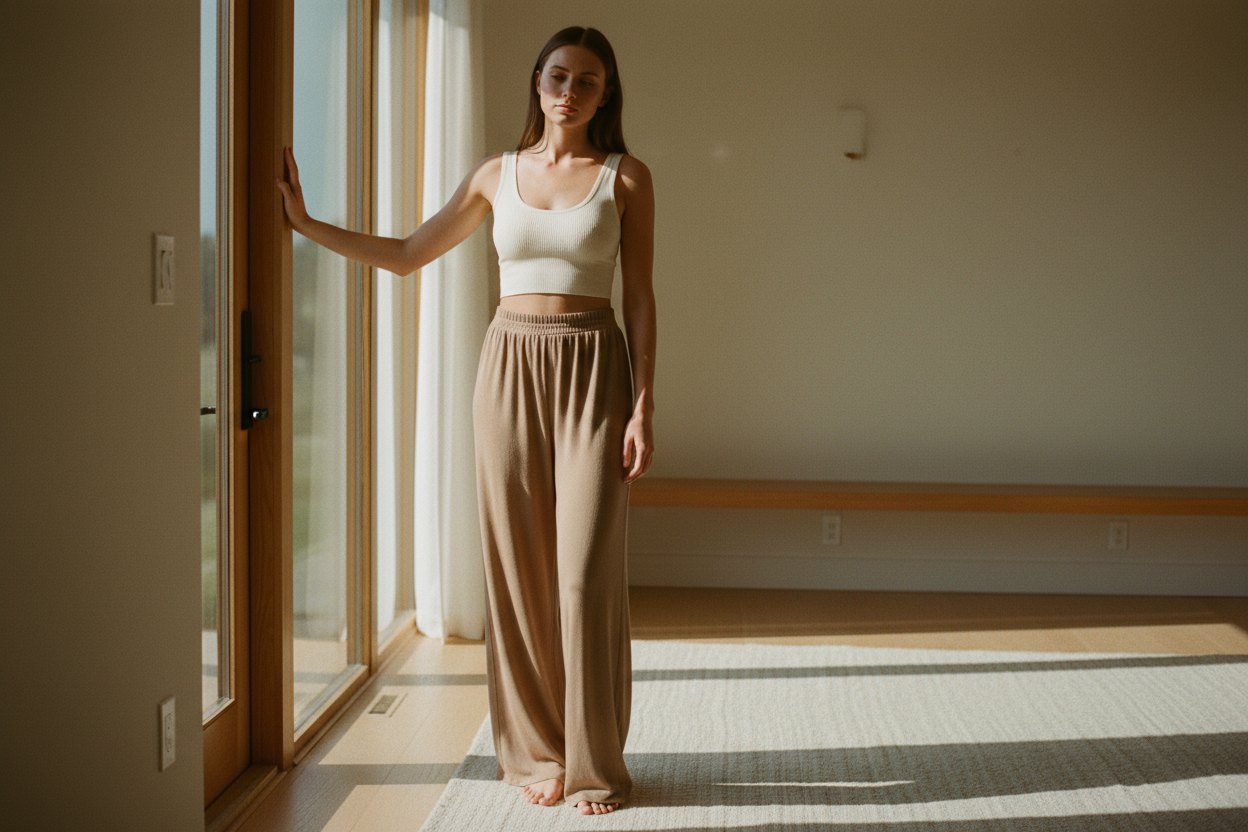
Fitted top + volume bottom — a ribbed crop top or fitted tank with wide-leg or flared pants. This is the most versatile because the wide leg reads both casual and polished, depending on what you add to it. A ribbed crop top paired with flared lounge pants is the format that photographs well on video calls, transitions to errands without needing anything extra, and sits flat at a waistline rather than bunching.
Volume top + straight bottom — a relaxed or boxy top with a straight or tapered pant. Works well for very slow days. Less versatile because the bottom doesn't carry as much visual interest.
The proportion that tends not to work: oversized top + wide-leg bottom. Both pieces fight for dominance and the silhouette reads as unintentional. This is the combination that makes loungewear look like you're still in pajamas.
One combination most people overlook: a wide-leg pant with a simple crop tee creates an easy, relaxed proportion that doesn't require any thought. A wide-leg set with a clean crop tee has the same visual ease as more structured sets because the tee reads as a top, not as an undershirt.
4. How You'll Actually Use It
The question "what lounge set should I buy" is really three different questions depending on how you live.
If you work from home most days: The top will be on camera. Ribbed or textured fabrics photograph better than jersey — they have dimension and don't go flat or washed out on video. A waistband that stays put matters more here than anywhere else, because you're wearing the set for eight or nine hours at a stretch. Prioritize structure over maximum softness.
If you want a set you can wear on quick errands: Fit and fabric surface matter most. Ribbed or structured knits read as intentional outside the house; jersey or terry reads as comfortable inside it. The silhouette should have one fitted piece — either a fitted top or a structured bottom — to anchor the look. Add a clean shoe and you're done; nothing else is required.
If you want a slow-day set, home only: This is the one case where you can prioritize softness over shape retention. A draped silhouette, a looser waistband, a fabric with more initial softness — all fine, because you're not asking the set to work for eight hours or look a specific way on camera. Even here, though, one considered proportion — a long-sleeve crop against a full wide-leg pant, say — adds visual interest without adding structure, which is why a long-sleeve wide-leg lounge set reads as a deliberate choice rather than something you grabbed on the way out of bed.
The Signals That Separate a Good Set From a Great One
These are the details that don't photograph but determine whether you reach for a set every week or stop wearing it after two months.
- Seam placement on the waistband — a seam at the center back of a waistband creates a pressure point you'll feel after two hours. No seam, or a seam at the side, is more comfortable for long wear.
- Hem weight on wide-leg pants — a small amount of weight at the hem (dense hem tape or a slightly thicker edge) makes wide-leg pants hang straight and move cleanly. Lightweight hems flutter and can look unfinished in motion.
- Armhole depth on crop tops — too deep and the top gaps when you reach overhead; too shallow and it feels restrictive. The right depth lets you raise your arms without the top lifting.
- Color consistency between pieces — sets dyed at the same time in the same dye lot will be an exact match. Some brands sell "matching sets" where the pieces come from different production runs; the tonal difference is subtle but visible in natural light and is what makes a set look off without obvious reason.
What Makes Loungewear Look Put Together: The Short Version
The visual signals that make loungewear read as intentional rather than accidental are fit, proportion, and color consistency — in that order. Fit means the fabric does something for your silhouette rather than hanging from your shoulders. Proportion means one piece has structure and one has volume, not both the same. Color consistency means the two pieces look like they were made to go together, because they were.
For a deeper look at how those three signals work — and how to read them quickly when you're shopping — the full guide to elevated lounge sets walks through each one in detail.
Styling comes after choosing. Once you have a set that fits well, has the right proportions, and holds its shape, you don't need much guidance on how to wear it. It does that on its own.
FAQ
What makes loungewear look put together?
Three things: fit, proportion, and color consistency. Fit means the fabric follows your body rather than hovering around it — a top that skims the shoulder, bust, and waist without compressing reads as chosen. Proportion means one piece is fitted and the other carries more volume, so there's a clear visual relationship between the two. Color consistency means the pieces were dyed in the same lot and read as exactly matching, not approximately matching. When all three are right, loungewear reads as intentional. When one is off, even well-styled sets look accidental. The place most lounge set purchases go wrong is fit — specifically, waistbands that roll or tops that gap — because those are structural problems that no amount of styling can fix.
How do you make loungewear look polished without trying?
Choose fabric with enough structure to photograph well — ribbed or textured knits have dimension that jersey doesn't — and buy a set where both pieces were designed to work together rather than sold as approximate pairs. The polished read comes mostly from proportion: a fitted top with a wide-leg bottom, or a relaxed top with a straight-leg pant, creates a silhouette that coheres without effort. Swap house slippers for a clean low-profile sneaker or slip-on if you're going outside. One shoe change shifts the whole register of an outfit. Everything else — accessories, layers, bags — is optional.
Can loungewear be worn outside?
Yes, with two conditions: the fabric needs to have enough surface structure to read as intentional, and the silhouette needs at least one fitted piece. Ribbed sets, structured knit sets, and sets with a visible waistband detail all read as outdoor-appropriate. Jersey, fleece, and oversized silhouettes read as indoor clothing outdoors. The cleanest test: if you'd feel comfortable opening your front door in it, you can wear it to the coffee shop. If you'd hesitate at the door, that's the fit or fabric giving you an honest signal. Most people find that a ribbed two-piece or a wide-leg set with a structured top handles both home and light errands without any effort.
How do I choose the right lounge set for my body type?
The most useful frame isn't body type — it's proportion preference. If you want to create more visual length, a high-waist bottom with a cropped top and a vertical-stripe or narrow rib pattern does that. If you want to balance a narrower top with more volume below, a wide-leg pant in a slightly heavier fabric creates that proportion. If you want a set that looks equally good seated and standing, a mid-rise straight-leg pant with a fitted tank is the most forgiving silhouette across positions. The one consistent finding across fit research: a waistband that sits at the natural waist (rather than riding below the hip bone or sitting too high at the rib) reads as flattering on the widest range of body types.
What is the difference between loungewear and pajamas?
The practical difference is fabric weight and cut. Pajamas are built for sleep — lighter fabrics, less structure, waistbands meant to be comfortable lying down rather than upright for hours. Loungewear is built for being awake — higher spandex content, waistbands designed for movement and extended upright wear, silhouettes that photograph and read well in social situations. The visual difference: loungewear has intentional proportions (crop top + wide-leg, fitted tank + straight pant). Pajama sets tend to use the same silhouette for both pieces — full-length top and full-length bottom, similar weight, similar cut. A good lounge set functions as pajamas; pajamas rarely function as loungewear.
How much spandex should a good lounge set have?
Between 10% and 20% is the range where most well-made lounge sets land. Below 8%, the fabric loses shape quickly — the waistband stretches out, the leg silhouette goes slack, the ribbing loses its texture. Above 25%, the set starts to feel more like performance sportswear — higher compression, less breathable for static wear. The 10–20% range gives you four-way stretch, shape retention through 50+ washes, and enough give for floor-level movement without the set feeling like a workout piece. If a label lists spandex or elastane content and it's below 8%, that's a set to wear lightly, not daily.
For a broader look at how to build a set of lounge pieces that cover most of what your week actually requires, the matching sets guide for lounging and living covers how to style each silhouette beyond the couch — and which fabrics hold up when you're wearing the same set three days in a row.