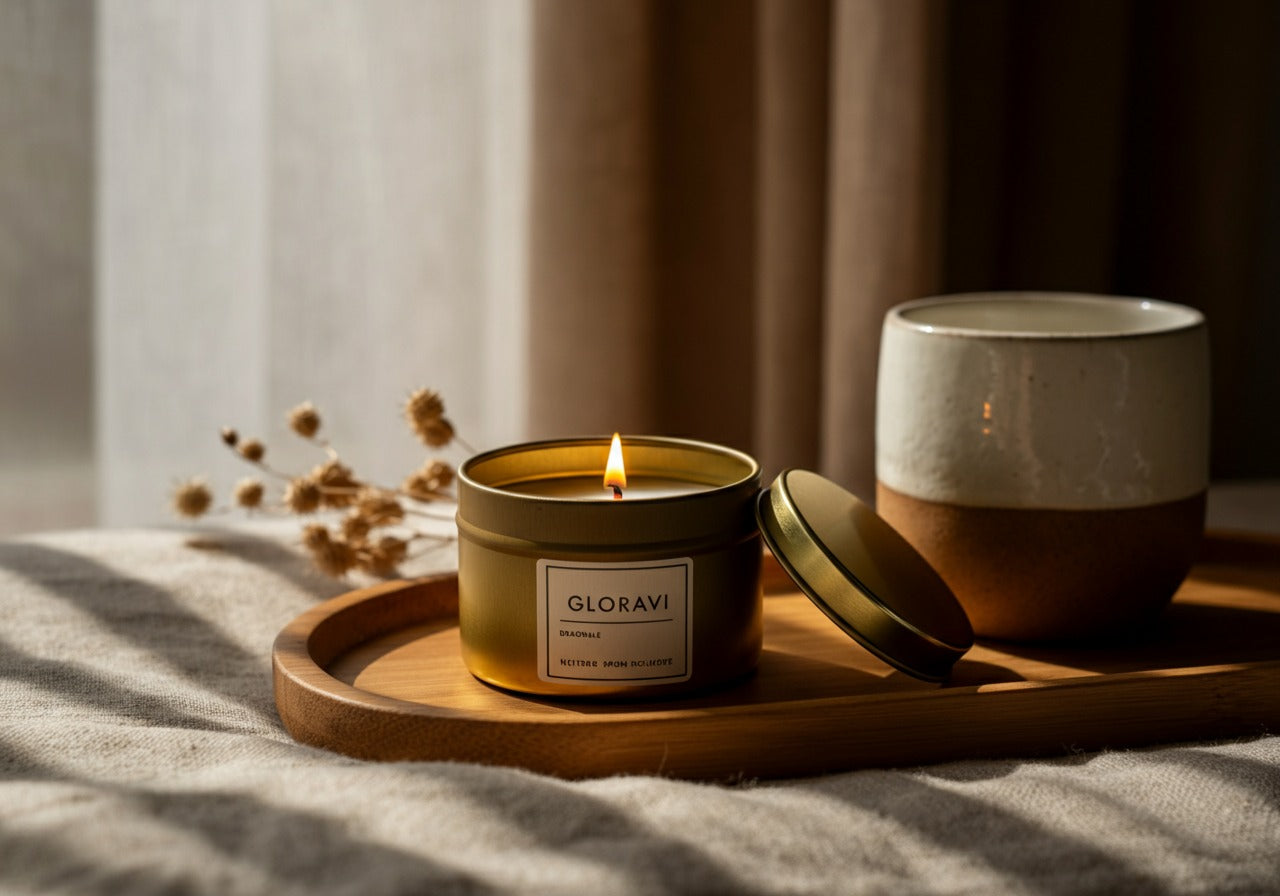
Candles for Warmth: The Science of Feeling Safe — Gloravi
There are different ways to feel unsettled, and they don't all need the same fix.
Anxiety has a direction — it's aimed at something specific. But there's another state that's harder to name. The apartment is too quiet. You're not exactly anxious about anything, but nothing feels quite okay. Not sad. Not stressed. Just not held.
This is the Warmth state in the Gloravi NSD framework, and it has its own scent logic.
Why Warmth Is Different from Calm
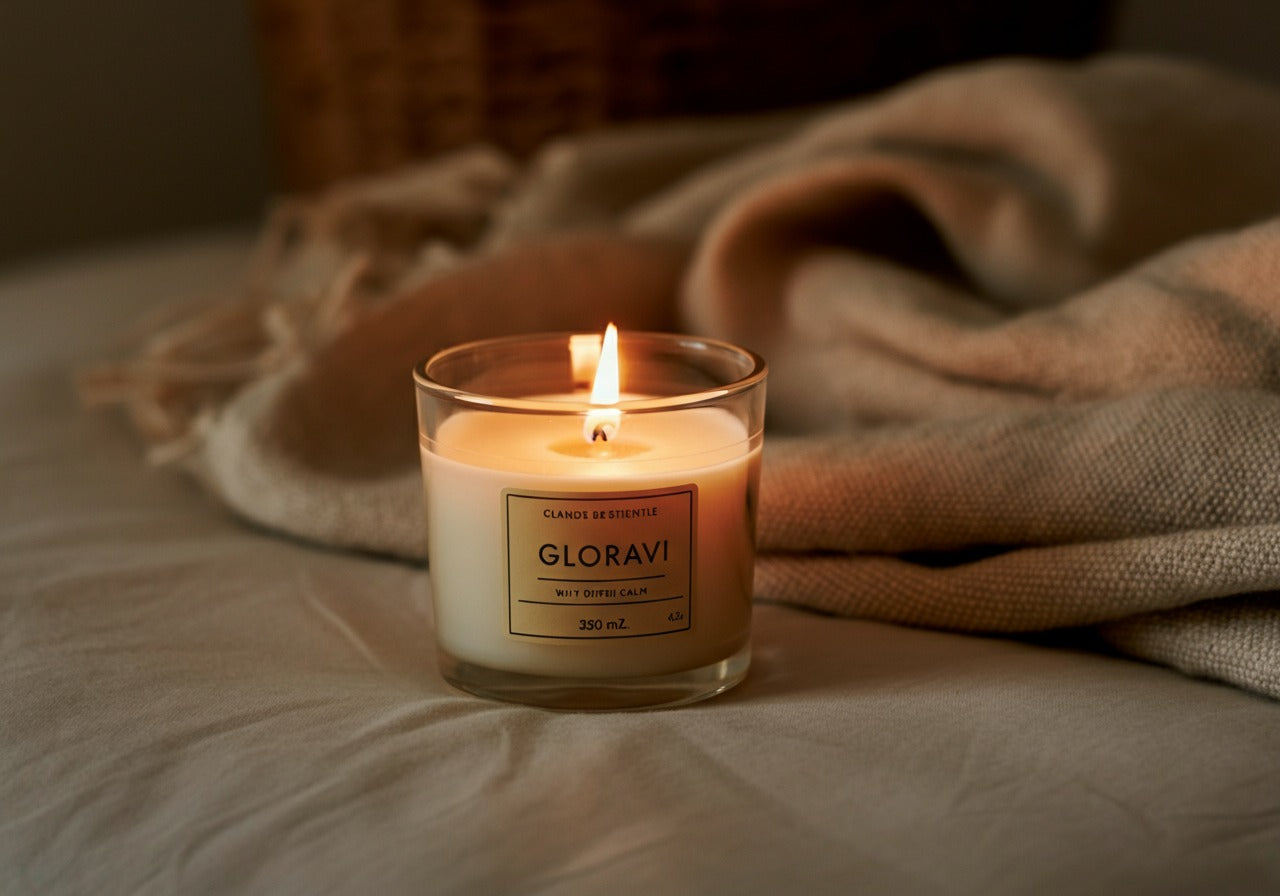
Most "calming" candle science is about down-regulation: slowing the nervous system from activated or anxious back to baseline. Lavender, light eucalyptus, clean musks — these are downregulatory scents. They reduce stimulation.
Warmth works differently. The nervous system doesn't just need to calm down; sometimes it needs to be reassured. Those are different processes.
Oxytocin — often called the "bonding hormone" — is active when we feel safe with others, when we experience physical warmth, when we're somewhere familiar. It reduces cortisol, lowers vigilance, and shifts the threat-detection part of the brain out of high-alert mode.
Scent can activate an oxytocin-adjacent response. Warm, sweet, familiar scents — vanilla, cinnamon, soft musks — are associated with food, proximity, and comfort at an evolutionary level. These are the scents of someone's kitchen, of familiar warmth, of being somewhere safe. They don't demand analysis. They register, quickly, as non-threatening.
This is different from relaxation. Relaxation is the absence of tension. Warmth is a positive state — active ease, not just deactivated anxiety.
The Scent Profile of Warmth
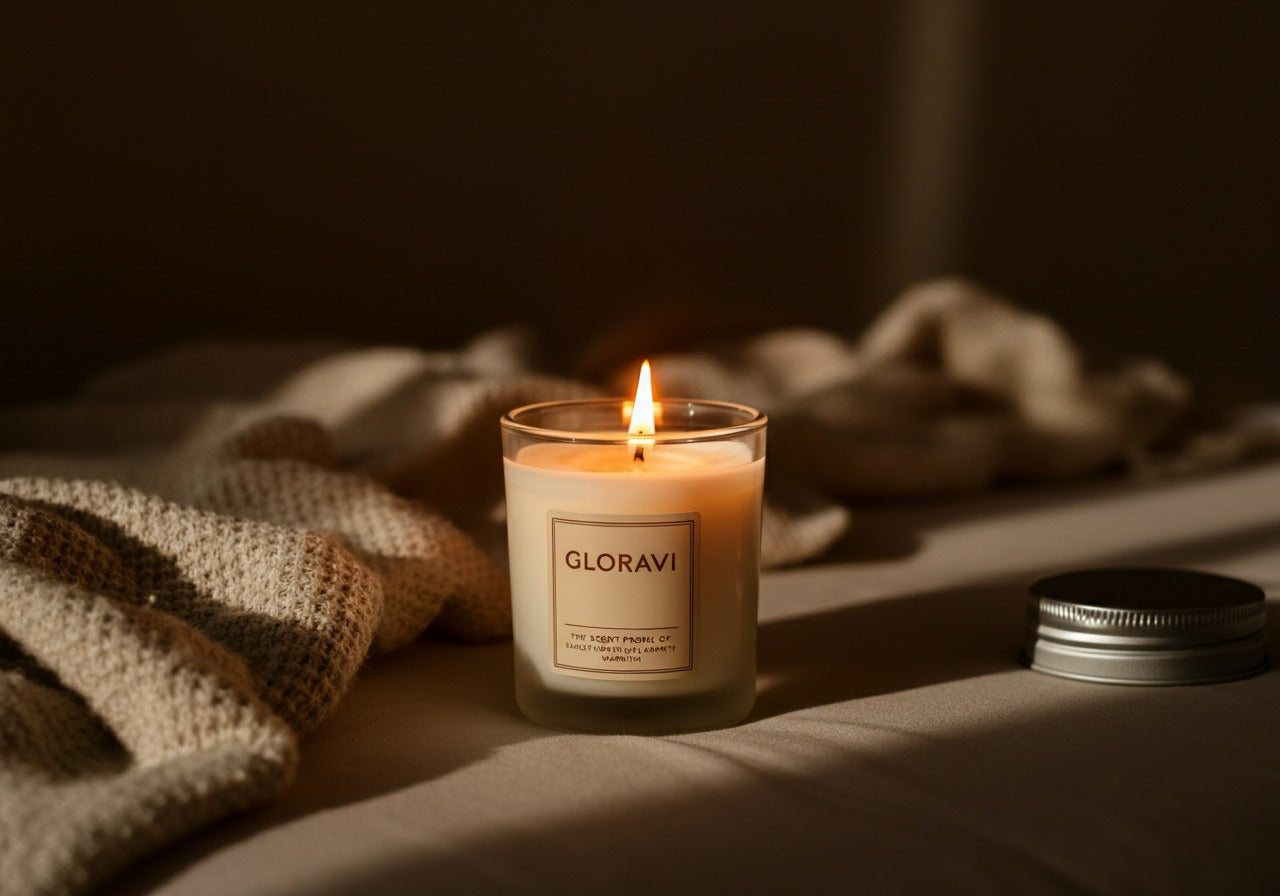
Warm, round notes work for this state. What they share: sweetness without sharpness, depth without intensity, familiarity without novelty.
Vanilla is one of the most well-documented scents for reducing psychological arousal. Multiple studies have found that vanilla fragrance lowers skin conductance — a physiological marker of stress — and reduces reported anxiety. The mechanism is likely associative: vanilla is almost universally encountered in positive, safe contexts from early childhood. Combined with some direct neurochemical pathway that researchers are still mapping, it lands quickly as comfort.
Cinnamon at candle concentrations — diffused, not concentrated — falls in the "familiar and grounding" register rather than the alerting register. Combined with vanilla, the two create something round and enveloping.
Cashmere musk at low projection registers as proximity, the olfactory equivalent of being near someone. Not sweet, not sharp. Simply present.
The Warmth candle combines these three in a coconut-apricot soy wax base — vanilla, warm cinnamon, cashmere musk. The coconut-apricot carries a soft sweetness that reinforces the overall warmth profile without adding sharpness or weight.
When Warmth Is What You Need
The Warmth state shows up in specific, recognizable moments.
After a draining conversation, not every exchange ends with resolution. Sometimes you leave a meeting, a phone call, or a hard exchange needing to return to yourself. The room feels empty. A warmth scent signals to the nervous system that the exchange is over and you can release it.
Solo evenings that feel heavy have a specific emotional texture — not quite lonely, but aware of the quiet. The Warmth candle changes the quality of the room. It makes the space feel inhabited, occupied, held.
The late-afternoon transition — somewhere between 4pm and 6pm — is physiologically awkward. Cortisol drops. Energy flags. Work isn't fully over but you're no longer in it. A warmth scent signals that the active part of the day is winding down and shifting is acceptable.
After travel or time in unfamiliar environments, the nervous system runs on a low hum of alertness. Coming home — or arriving somewhere new and needing to settle in — calls for re-establishing a baseline of safety. Warmth does this faster than neutral scents.
How to Use the Warmth Candle
Timing matters more than most people realize. The Warmth candle is most effective as a transition signal — light it before you've fully decompressed, not after. Light it when you walk in the door, not when you're already on the couch.
This matters because the nervous system responds to signals, not states. If you light it after you're already relaxed, it's just ambient. If you light it when you're still in post-conversation or post-commute alertness, the scent is doing real work — meeting you in the activated state and signaling the shift.
For evenings: light it during dinner or at the start of your evening. Keep it burning through the first hour of your wind-down. If you're also building a pre-sleep ritual, transition to the Evening Ritual Gift Set 60-90 minutes before bed — the Warmth candle carries you to that handoff.
For difficult afternoons: use it wherever you're working through the hard hour. The goal isn't to stop working; it's to change the emotional temperature of the environment while you do.
FAQ
Is Warmth just another way of saying "relaxing"?
They overlap but they're distinct. Relaxing means reducing activation — moving from tense to less tense. Warmth means adding a positive quality — moving from cold or unmoored to held and safe. You can be relaxed and still feel emotionally flat. Warmth addresses the flatness directly.
Does this work if I live with other people?
Yes. In shared spaces, warm scents tend to soften the social environment without demanding attention. After a tense household moment, lighting the Warmth candle changes the room for everyone in it.
What's the difference between the Warmth candle and the Evening Ritual Set?
The Warmth candle is for the Warmth emotional state — post-depletion recovery, emotional safety, solo-evening grounding. The Evening Ritual Set is designed specifically for the pre-sleep window, with a wick trimmer and matches to make the ritual feel intentional. They work well in sequence: Warmth for the afternoon and early evening, Evening Ritual for the pre-sleep window.
Can I use it in the morning?
The Warmth profile is too round and comforting for morning focus work. Morning calls for something fresher and lighter. The Clarity candle handles the morning. Save the Warmth candle for the second half of the day.
How long should I burn it?
Until the warmth has done its work — typically 45-90 minutes. Burn it for the length of your decompression, transition, or early evening. Always extinguish after 4 hours and never leave it burning unattended. The candle care guide covers the basics.
Once the Warmth candle is part of your evening, it naturally becomes one anchor in something larger. If you're interested in building a consistent daily ritual around scent — morning, midday, and evening — the Soft Glow Ritual guide walks through how to structure those touchpoints so they compound over time.
Most of what's here assumes you're alone with the candle, and that's where Warmth does its quietest work. But the same scent shifts something when another person is in the room too. If your evenings are more often shared than solo, candles for connection and presence looks at how light and scent change the way two people settle into the same space.
The room doesn't warm itself. That's what the candle is for.